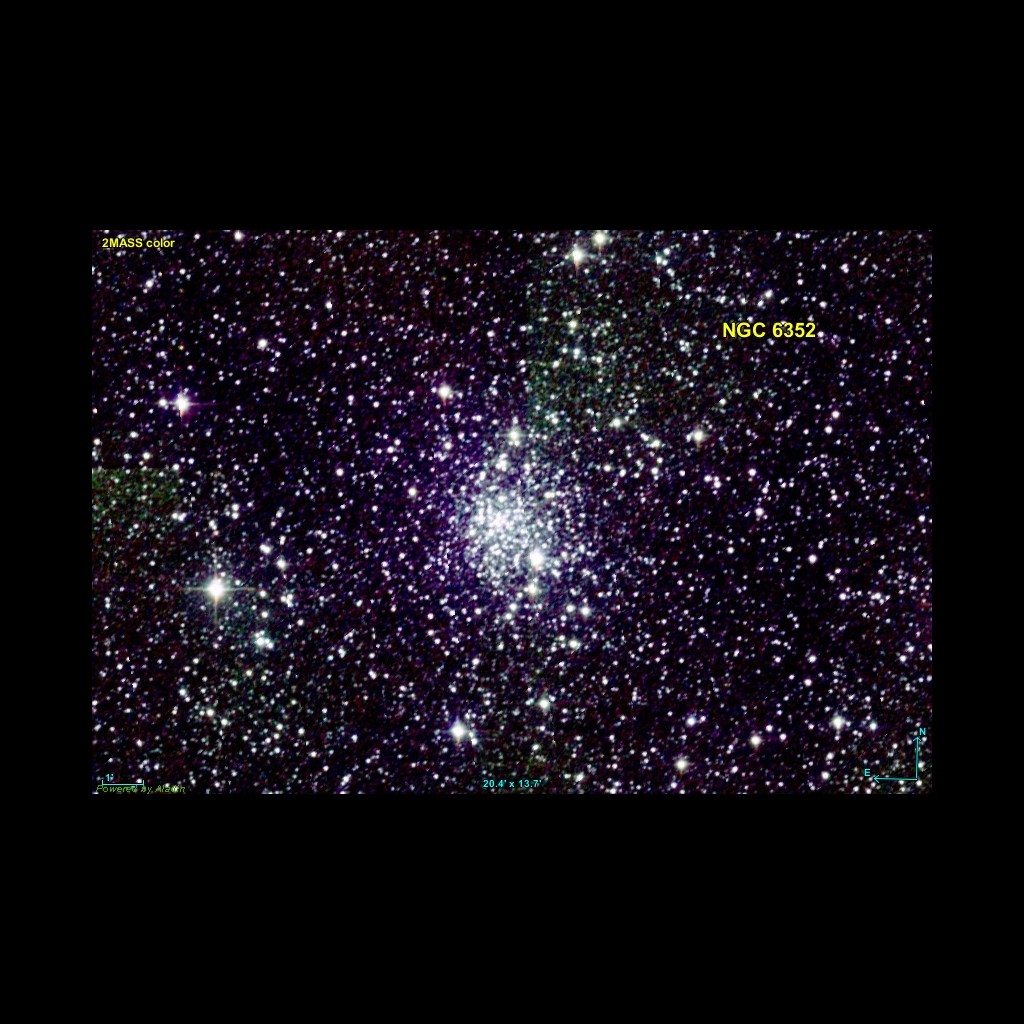
Donald Pelletier / 2MASS - CC SA
| Type | Globular Cluster | Constellation | Ara |
|---|---|---|---|
| Magnitude | 8.1 | Size | 7.1′ |
| Distance | 19,000 light-years | Best Month | July |
| Visibility | Southern | Difficulty | Moderate (level 3/4) |
| Min. Aperture | binoculars | RA / Dec | 17h 25m 30.0s · -48° 25' 12" |
| Discovered by | James Dunlop, 1826 | ||
Donald Pelletier / 2MASS - CC SA
Caldwell 81, also designated as NGC 6352, is a globular cluster located approximately 19,500 light-years away in the southern constellation of Ara, the Altar. While it shares a classification with the massive Omega Centauri, Caldwell 81 offers a striking visual contrast due to its "loose" appearance. It is classified as a Shapley-Sawyer Class XI cluster, indicating a very low central concentration of stars. To the backyard observer, this lack of a dense, blazing core makes the cluster appear more like a rich, tightly-packed open cluster, providing a unique perspective on the structural diversity of the Milky Way’s ancient stellar satellites.
Despite its modest appearance, Caldwell 81 is a subject of significant astrophysical interest due to its "metal-rich" nature. In astronomical terms, this means its stars contain a higher-than-average proportion of elements heavier than hydrogen and helium compared to other globular clusters. This chemical footprint suggests that the cluster formed from gas that had already been enriched by previous generations of supernovae, likely within the inner regions of our galaxy’s disk. Studying these stars helps researchers piece together the timeline of the Milky Way's chemical evolution and the formation history of the galactic bulge.
The accompanying image was meticulously constructed using the Aladin Sky Atlas software, leveraging public data from the 2MASS (Two Micron All-Sky Survey) and the Pan-STARRS (Panoramic Survey Telescope and Rapid Response System) archives. By utilizing the 2MASS infrared data, the image is able to peer through the interstellar dust that often obscures objects in the plane of the Milky Way, revealing the cluster's stars with remarkable clarity. The Pan-STARRS contribution adds deep optical detail, resulting in a composite that highlights both the faint, ancient members of the cluster and the vibrant foreground stars of the Ara region.