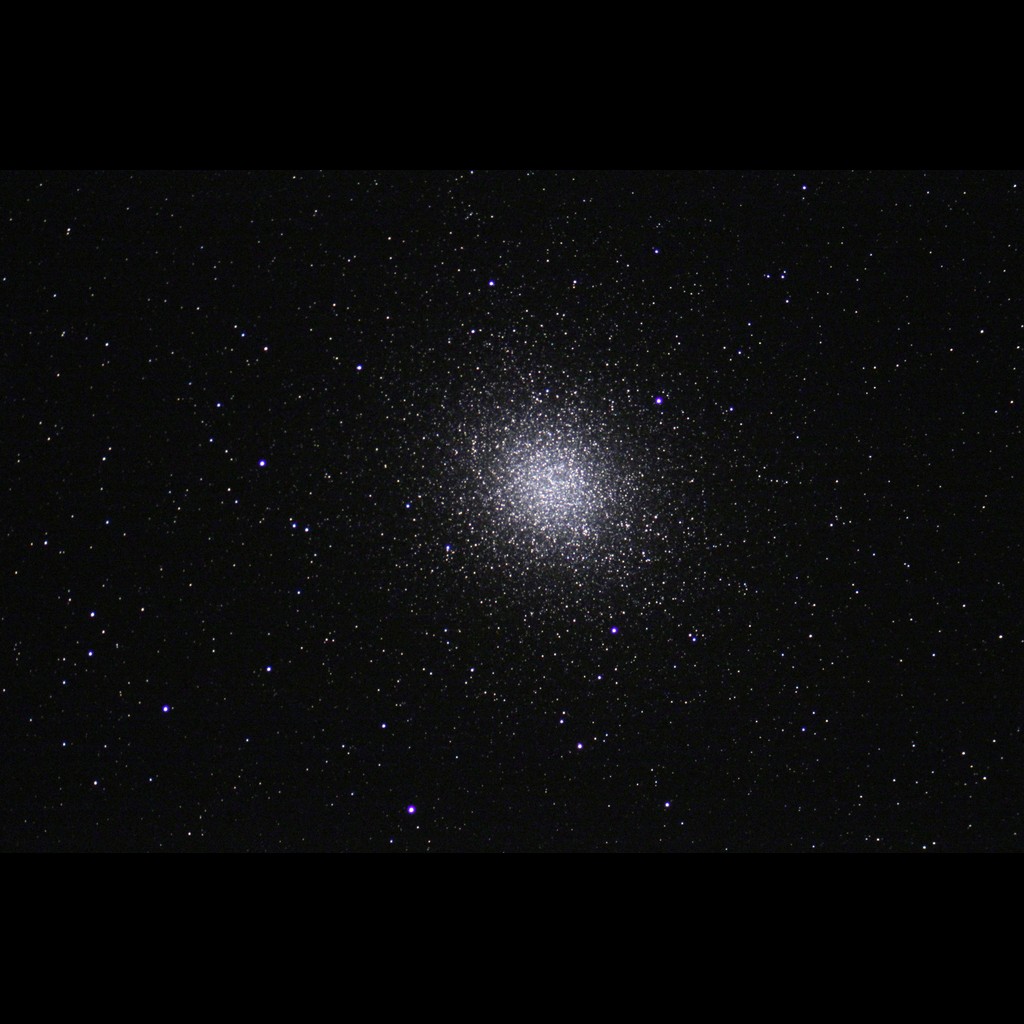
KPNO/NOIRLab/NSF/AURA/Blythe Guvenen
| Type | Globular Cluster | Constellation | Cen |
|---|---|---|---|
| Magnitude | 3.9 | Size | 36.3′ |
| Distance | 17,000 light-years | Best Month | May |
| Visibility | Southern | Difficulty | Easiest (level 1/4) |
| Min. Aperture | naked eye | RA / Dec | 13h 26m 49.2s · -47° 28' 48" |
| Discovered by | Edmond Halley, 1677 | ||
KPNO/NOIRLab/NSF/AURA/Blythe Guvenen
Caldwell 80, or NGC 5139, famously known as Omega Centauri, is the largest and most luminous globular cluster in the Milky Way. Located approximately 18,000 to 20,000 light-years away in the constellation Centaurus, it is so bright that early astronomers, including Ptolemy and Bayer, misidentified it as a single "star"—hence its Bayer designation "Omega." Under dark skies, it appears to the unaided eye as a distinct, fuzzy patch of light, similar in size to the full moon. Its visibility at such a great distance is due to its sheer scale; it contains an estimated 10 million stars, far exceeding the population of standard globular clusters.
Beyond its size, Omega Centauri is scientifically unique and currently passing directly through the plane of our galaxy. Unlike most globular clusters, which consist of a single generation of stars, Omega Cen contains multiple stellar populations with a wide range of ages and chemical compositions. This complexity has led many astronomers to conclude that it is not a true globular cluster, but rather the remnant core of a dwarf galaxy that was long ago disrupted and swallowed by the Milky Way. Evidence for this theory includes the discovery of an intermediate-mass black hole at its center, a feature typically reserved for galactic nuclei.
This image was captured as part of the Advanced Observing Program (AOP) at the Kitt Peak Visitor Center during 2014. Because the cluster is situated deep in the southern sky, it barely climbs more than 10 degrees above the horizon from Kitt Peak’s latitude in Arizona. While the low altitude presents significant atmospheric challenges for high-resolution imaging, the resulting photograph successfully conveys the "sparkling glitter" of its dense stellar field. For observers, the sight of this massive "island of stars" remains one of the most impressive spectacles in the celestial catalog.