ESO - CCA
| Type | Globular Cluster | Constellation | Vel |
|---|---|---|---|
| Magnitude | 6.7 | Size | 18.2′ |
| Distance | 16,300 light-years | Best Month | March |
| Visibility | Southern | Difficulty | Easy (level 2/4) |
| Min. Aperture | binoculars | RA / Dec | 10h 17m 49.2s · -46° 24' 36" |
| Discovered by | James Dunlop, 1826 | ||
ESO - CCA
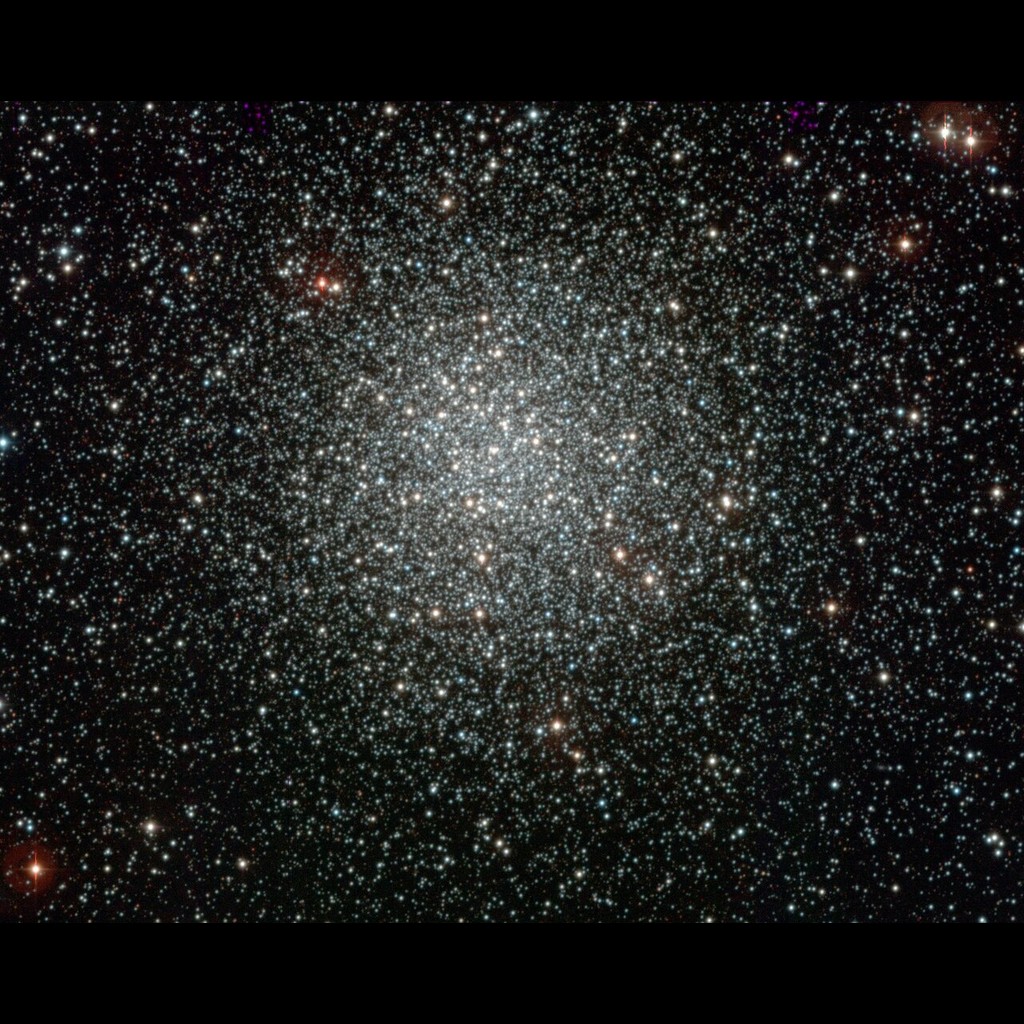
Caldwell 78, or NGC 6541, is a large and brilliant globular cluster located approximately Caldwell 79, or NGC 3201, is a distinct globular cluster located approximately 16,000 light-years away in the southern constellation of Vela. Comprising hundreds of thousands of stars, this cluster is part of an ancient population of aggregates that formed during the early stages of the universe, roughly the same time as the Milky Way itself. Despite its age, NGC 3201 is an astronomical outlier; it possesses a unique retrograde orbit, meaning it travels around the galactic center in the opposite direction of most other stars and clusters, suggesting it may have been captured from another galaxy.
This color-composite image was captured using the Wide Field Imager (WFI) on the ESO/MPG 2.2-meter telescope at the La Silla Observatory in Chile. The data was produced as part of the ESO Imaging Survey (EIS), a public project designed to map the southern sky in high detail. The resolution provided by the WFI instrument highlights the cluster's relatively open structure—unlike more centrally condensed globulars, NGC 3201 allows for a clearer view of individual stars deep within its core, which is essential for studying the cluster's internal dynamics and the black holes recently discovered lurking within it.