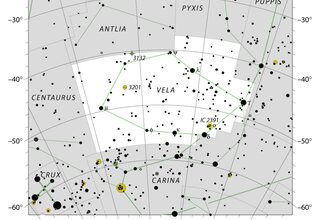
 IAU Chart
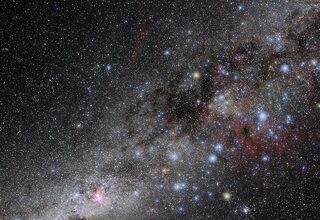 NOIRLab Images
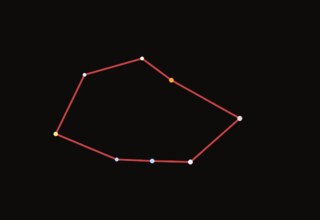 Stars and Sticks
| Abbreviation | Vel |
|---|---|
| Meaning | Sails of the Ship |
| Pronunciation Guide is based on “Pronouncing Astronomical Names,” published in 1943 by the American Astronomical Society. | VEE-luh |
| Genitive The genitive is the Latin possessive form used in star names. For example, Alpha Orionis means “the Alpha of Orion.” | vee-LOR-um |
| Best Month | March |
| Visibility | Southern |
| Origin | AncientThese figures are rooted in the classical Greek and Mesopotamian traditions cataloged by Ptolemy in the 2nd century AD. |
| Author | Lacaille (Split) |
| Type | constellation |
| Difficulty | Moderate |
| Description | The Sails of the Argo were another section of the ancient Argo Navis constellation split by Lacaille in the 1750s. Vela contains the famous 'False Cross' — an asterism formed by four of its stars that is frequently mistaken for the Southern Cross by inexperienced navigators, lacking a fifth star and oriented differently. The constellation is home to the Vela Supernova Remnant — the expanding shell of gas from a star that exploded about 11,000 years ago, one of the closest supernova remnants at roughly 800 light-years. At its center lies the Vela Pulsar — a rapidly rotating neutron star spinning 11 times per second and one of the brightest pulsars in the sky. |
| Asterism | The Sails: Stars forming a shape resembling the sails of a ship. |
Click a thumbnail to view full-size. Plain and Annotated versions available on the image page.
Images: NOIRLab/NSF/AURA/E. Slawik · IAU and Sky & Telescope · Stellarium — Full credits →