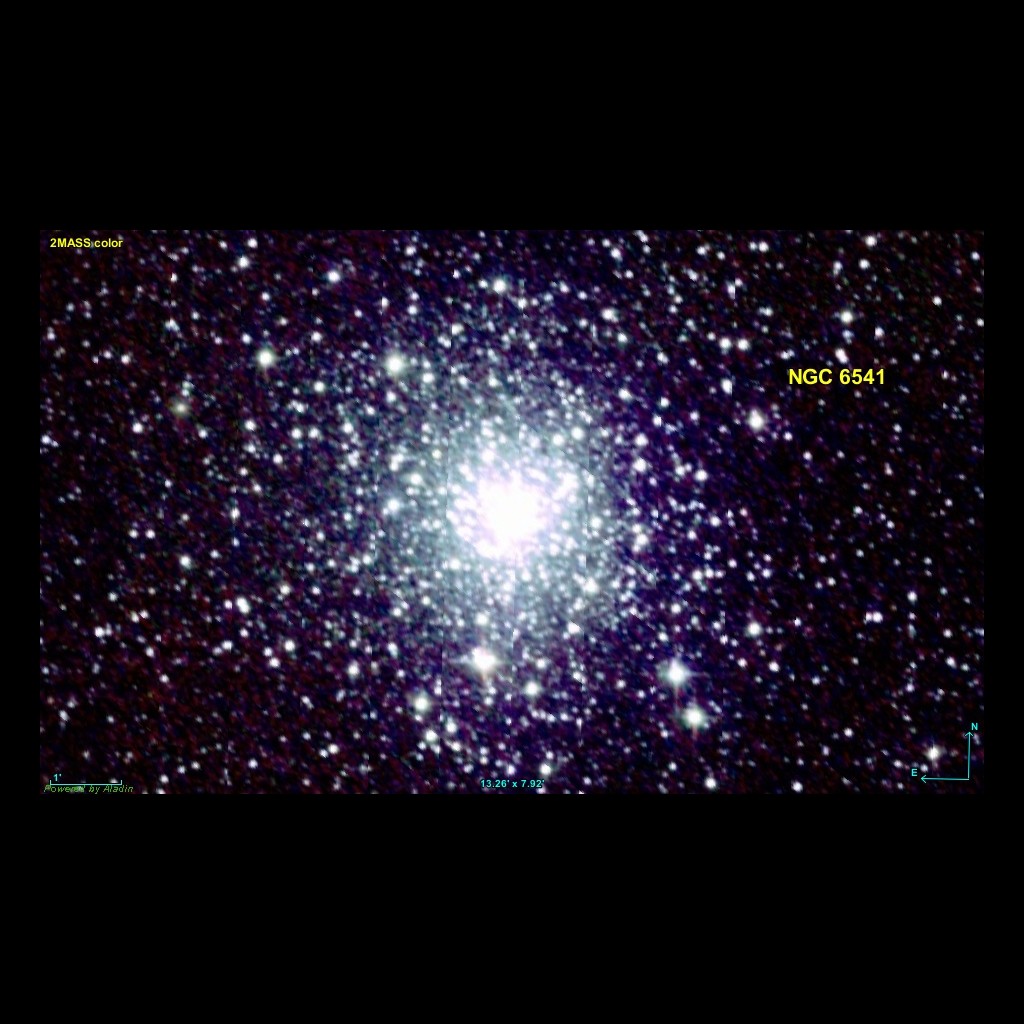
Donald Pelletier - 2MASS - CC SA
| Type | Globular Cluster | Constellation | CrA |
|---|---|---|---|
| Magnitude | 6.6 | Size | 13.1′ |
| Distance | 22,800 light-years | Best Month | July |
| Visibility | Southern | Difficulty | Easy (level 2/4) |
| Min. Aperture | binoculars | RA / Dec | 18h 08m 16.8s · -43° 42' 36" |
| Discovered by | Nicolas Louis de Lacaille, 1751 | ||
Donald Pelletier - 2MASS - CC SA
Caldwell 78, or NGC 6541, is a large and brilliant globular cluster located approximately 22,000 light-years away in the southern constellation of Corona Australis. It is a highly concentrated assembly of hundreds of thousands of stars, tightly bound by gravity into a nearly perfect spherical shape. Discovered by Niccolò Cacciatore in 1826, this cluster is one of the oldest structures in the Milky Way, containing stars that formed billions of years ago. Its proximity to the dense star fields of the galactic center makes it a particularly rich and luminous target for study.
The cluster is distinguished by its intense central brightness, which gradually tapers off into a sprawling halo of individual stars. Because it is an evolved system, its most massive stars have long since transitioned into red giants, while its more modest members continue to burn steadily. Astronomers utilize NGC 6541 to understand the chemical history of our galaxy, as the "metallicity" of its stars—the abundance of elements heavier than hydrogen and helium—provides a snapshot of the conditions present in the early universe when the cluster first collapsed from a primordial gas cloud.
This image was created using data from the Strasbourg Astronomical Data Center and the 2MASS (Two Micron All Sky Survey), integrated with the Panoramic Survey Telescope and Rapid Response System (Pan-STARRS) public archives. By utilizing the near-infrared capabilities of 2MASS alongside the high-resolution optical mapping of Pan-STARRS, the view penetrates the interstellar dust often found in this region of the sky near the galactic plane. This multi-survey approach provides a clear, resolved look at the cluster's dense population, highlighting the precise distribution of its ancient stellar members.