ESO - CCA 4.0
| Type | Galaxy | Constellation | Cen |
|---|---|---|---|
| Magnitude | 6.8 | Size | 25.7′ |
| Distance | 13.7 million light-years | Best Month | May |
| Visibility | Southern | Difficulty | Easiest (level 1/4) |
| Min. Aperture | naked eye | RA / Dec | 13h 25m 40.8s · -43° 01' 12" |
| Discovered by | James Dunlop, 1826 | ||
ESO - CCA 4.0
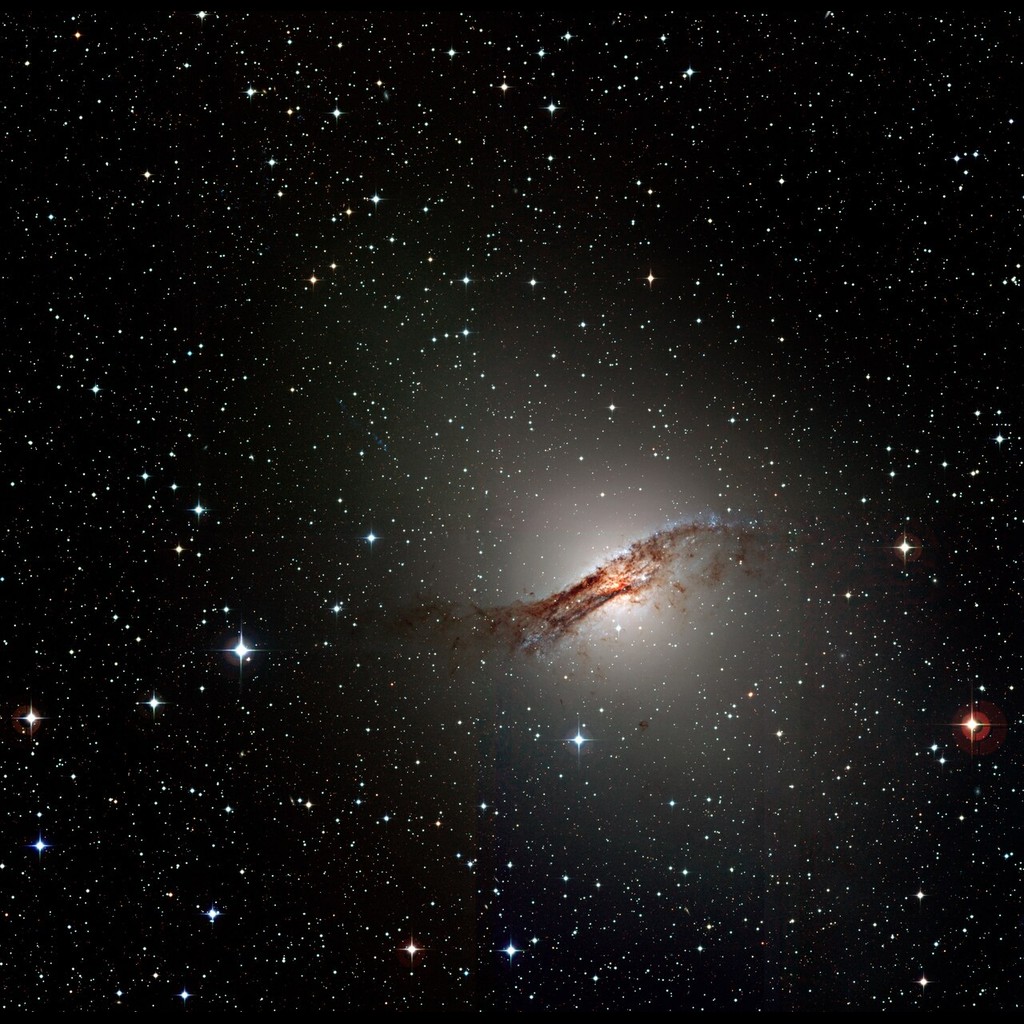
Caldwell 77, popularly known as Centaurus A, is one of the most famous and peculiar galaxies in the night sky. Located approximately 12 million light-years away in the constellation Centaurus, it is a massive elliptical galaxy that appears to be undergoing a violent transformation. Its most striking feature is a thick, dark lane of dust that bisects its bright, glowing center. This dust lane is the remnant of a smaller spiral galaxy that Centaurus A collided with and began consuming millions of years ago, a process that has sparked intense star formation and made it one of the most studied objects in extragalactic astronomy.
At the very heart of this cosmic collision lies a supermassive black hole with a mass equivalent to 55 million Suns. This black hole is highly active, swallowing surrounding material and ejecting powerful jets of plasma that extend thousands of light-years into space. These jets make Centaurus A a "radio galaxy"—one of the strongest sources of radio waves in the sky. The energy released by the central engine is so immense that it influences the evolution of the entire galaxy, heating the surrounding gas and regulating the birth of new stars within the turbulent dust lanes.
This image is a color composite obtained with the Wide-Field Imager (WFI) camera at the ESO/MPG 2.2-meter telescope on La Silla, Chile. The WFI data beautifully resolves the contrast between the smooth, aged stellar population of the elliptical galaxy and the jagged, opaque dust clouds that dominate its midsection. By capturing the galaxy across multiple wavelengths, this perspective highlights the chaotic beauty of a galactic merger in progress, offering a detailed look at how the largest structures in the universe grow and change through gravitational interaction.