KPNO/NOIRLab/NSF/AURA/Adam Block
| Type | Open Cluster | Constellation | Sco |
|---|---|---|---|
| Magnitude | 2.6 | Size | 15.0′ |
| Distance | 5,900 light-years | Best Month | June |
| Visibility | Southern | Difficulty | Easiest (level 1/4) |
| Min. Aperture | naked eye | RA / Dec | 16h 53m 49.2s · -41° 49' 48" |
| Discovered by | Giovanni Batista Hodierna, 1654 | ||
KPNO/NOIRLab/NSF/AURA/Adam Block
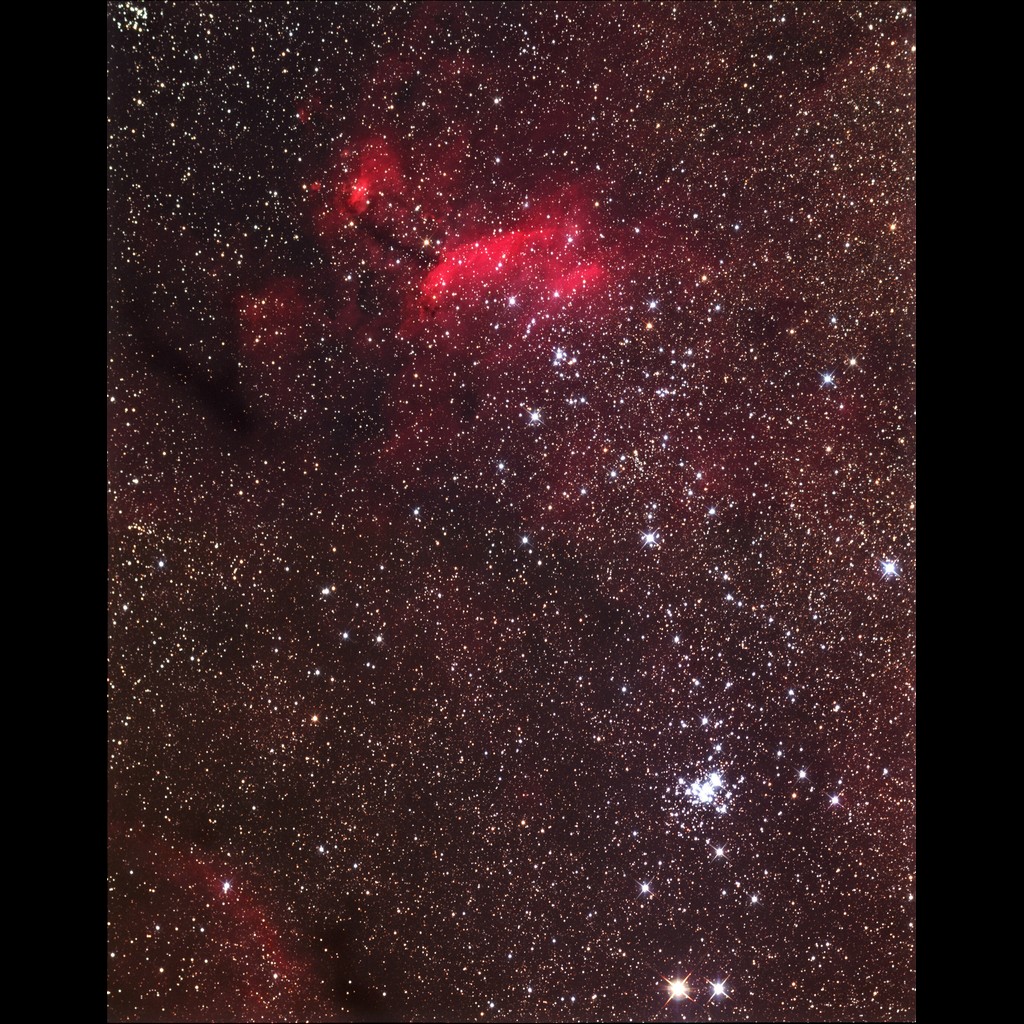
Caldwell 76, or NGC 6231, is a dazzling open cluster located approximately 5,200 light-years away in the constellation Scorpius. Often referred to as the "Northern Jewel Box," it is one of the most luminous and spectacular clusters in the galaxy. To the unaided eye, this part of the sky appears as a brilliant spray of stars emerging from the bend in the scorpion's tail, just beneath the bright star Antares. The cluster is extremely young—estimated at only 3.2 million years old—and serves as the "heart" of the Scorpius OB1 association, a massive group of hot, giant stars traveling through space together.
The region surrounding the cluster is a complex landscape of stellar activity and glowing gas. Toward the top of the frame lies IC 4628, a vast area of reddish nebulosity also known as the Prawn Nebula, where new stars are actively forming. The bright, concentrated cluster seen in the lower right is NGC 6321. This entire region is situated north of Zeta Scorpii and contains an incredible density of rare Wolf-Rayet stars and blue supergiants, which are tens of thousands of times more luminous than our Sun.
This image was captured as part of the Advanced Observing Program (AOP) during 2014 at the Kitt Peak Visitor Center. The data highlights the stark contrast between the icy blue of the cluster's young stars and the deep crimson of the neighboring hydrogen clouds. For observers, Caldwell 76 provides a rare opportunity to see a high-mass stellar nursery in its prime, offering a glimpse into the chaotic and energetic environments that define the spiral arms of the Milky Way.