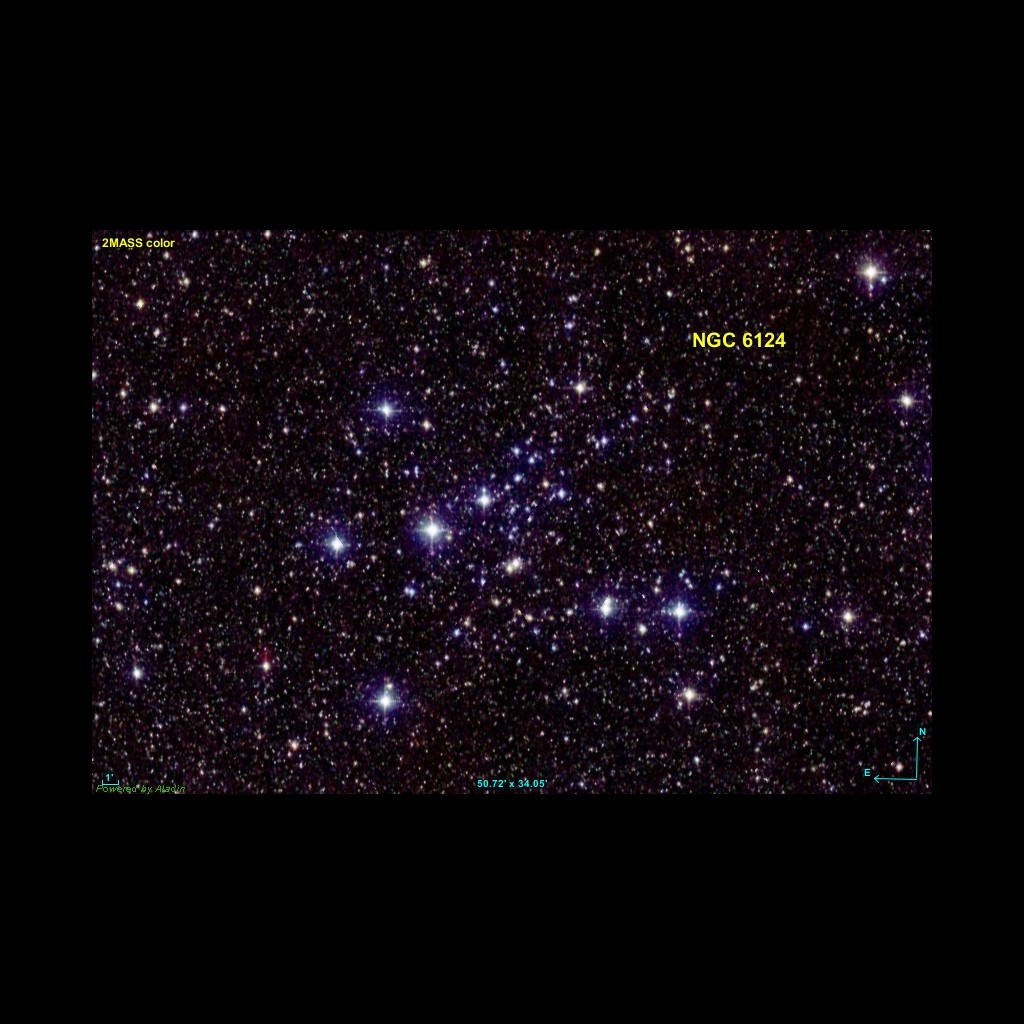
Donald Pelletier / 2MASS - CC SA 4.0
| Type | Open Cluster | Constellation | Sco |
|---|---|---|---|
| Magnitude | 5.8 | Size | 29.0′ |
| Distance | 1,800 light-years | Best Month | June |
| Visibility | Southern | Difficulty | Easiest (level 1/4) |
| Min. Aperture | naked eye | RA / Dec | 16h 26m 49.2s · -40° 40' 12" |
| Discovered by | Nicolas Louis de Lacaille, 1751 | ||
Donald Pelletier / 2MASS - CC SA 4.0
Caldwell 75, or NGC 6124, is a large and brilliant open cluster located approximately 1,700 light-years away in the constellation Scorpius. Discovered by Nicolas-Louis de Lacaille in 1751 during his trek through South Africa, it is one of the most conspicuous clusters in the southern sky. It spans an area of the sky nearly the size of the full moon and contains approximately 125 stars that are physically bound together. These stars are relatively young in galactic terms, though at an estimated age of 100 million years, they have begun to settle into a stable population within the Milky Way's spiral arms.
The cluster is particularly noted for its high concentration of "red giant" stars, which stand out against the backdrop of younger, blue-white members. This variety in stellar color provides a vibrant field for astrophotography and offers astronomers a clear view of how stars of similar age but different masses evolve at varying speeds. Because it is situated in a rich part of the Milky Way, the cluster appears to "float" on a dense carpet of distant stars, making it a spectacular target for wide-field viewing with binoculars or small telescopes.
This image was created using data from the Strasbourg Astronomical Data Center, the 2MASS (Two Micron All Sky Survey), and the Panoramic Survey Telescope and Rapid Response System (Pan-STARRS) public archives. By combining near-infrared data from 2MASS with the high-resolution optical mapping of Pan-STARRS, the image reveals stars that might otherwise be partially obscured by interstellar dust. This multi-wavelength approach highlights the intricate distribution of stars within the cluster, emphasizing the structural symmetry and the diverse luminosity of its constituent members.