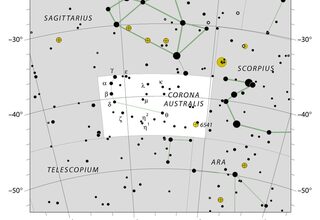
 IAU Chart
 NOIRLab Images
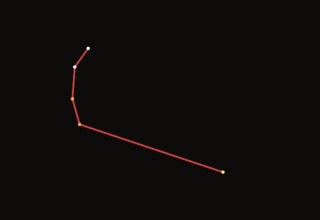 Stars and Sticks
| Abbreviation | CrA |
|---|---|
| Meaning | Southern Crown |
| Pronunciation Guide is based on “Pronouncing Astronomical Names,” published in 1943 by the American Astronomical Society. | co-RO-nuh aw-STRAL-iss |
| Genitive The genitive is the Latin possessive form used in star names. For example, Alpha Orionis means “the Alpha of Orion.” | kuh-ROH-nee os-TRAY-lis |
| Best Month | August |
| Visibility | Southern |
| Origin | AncientThese figures are rooted in the classical Greek and Mesopotamian traditions cataloged by Ptolemy in the 2nd century AD. |
| Author | PtolemyPtolemy, a 2nd-century Greco-Egyptian astronomer, cataloged the 48 classical constellations in his landmark work, the Almagest. These form the core of the 88 modern constellations recognized today. |
| Type | constellation |
| Difficulty | Challenging |
| Description | The Southern Crown is one of the smallest but oldest constellations, known to the ancient Greeks as a wreath or crown lying at the feet of the Archer (Sagittarius). Some myths associate it with the crown Sagittarius wears, others with a laurel wreath. It sits in an exceptionally rich region of the Milky Way near the galactic center. The constellation contains the Corona Australis Molecular Cloud — one of the nearest and most active star-forming regions to our Solar System at about 430 light-years away. Despite its small size it has been recognized since antiquity and is one of Ptolemy's original 48 constellations. |
Click a thumbnail to view full-size. Plain and Annotated versions available on the image page.
Images: NOIRLab/NSF/AURA/E. Slawik · IAU and Sky & Telescope · Stellarium — Full credits →