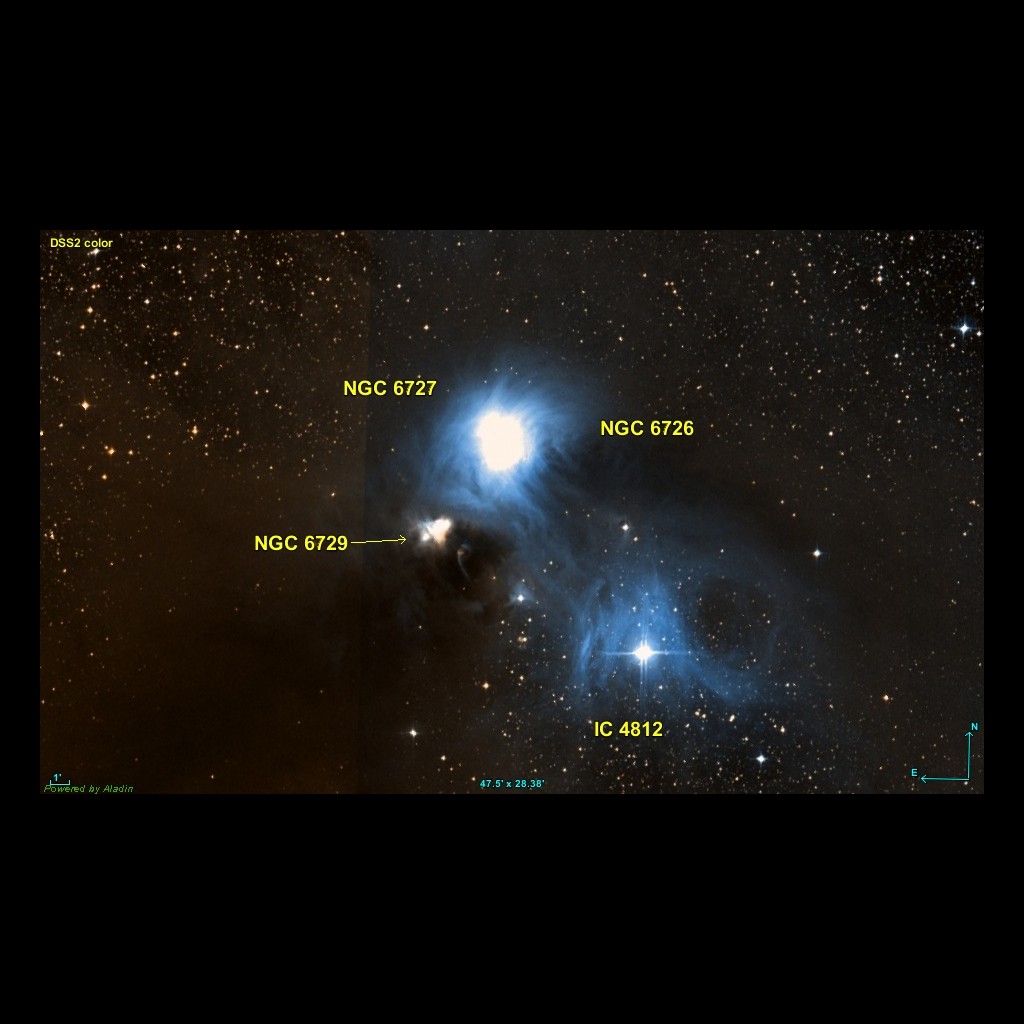
Strasbourg Astronomical Data Center and the Digitized Sky Survey (DSS)
| Type | Reflection Nebula | Constellation | CrA |
|---|---|---|---|
| Magnitude | 9.7 | Size | 1.0′ |
| Distance | 430 light-years | Best Month | August |
| Visibility | Southern | Difficulty | Moderate (level 3/4) |
| Min. Aperture | 3in | RA / Dec | 19h 01m 01.2s · -36° 57' 00" |
| Discovered by | Johann Friedrich Julius Schmidt, 1861 | ||
Strasbourg Astronomical Data Center and the Digitized Sky Survey (DSS)
Caldwell 68, also known as NGC 6729, is one of the most dynamic and intriguing reflection nebulae in the southern sky, located approximately 400 light-years away in the constellation Corona Australis. Unlike many static nebulae, C68 is a variable nebula, meaning its brightness and shape change over time as the young, eruptive star R Coronae Australis flickers and moves behind clouds of interstellar dust. This creates a "theatrical" lighting effect, casting moving shadows across the surrounding gas that can be observed changing over weeks or months.
This object is part of a remarkably dense and beautiful celestial neighborhood. In a wide-field view, NGC 6729 sits immediately adjacent to the bright reflection nebulae NGC 6726 and NGC 6727. Their extreme closeness in the sky creates a stunning tapestry of blue and gray dust clouds, often referred to as the Corona Australis Molecular Cloud. While C68 is the small, fan-shaped patch hugging its parent star, its neighbors are much larger and more diffuse, together forming one of the nearest and most active star-forming regions to our solar system.
This image was created using the Aladin Sky Atlas software from the Strasbourg Astronomical Data Center and the Digitized Sky Survey (DSS) data. The DSS is a cornerstone program of the Space Telescope Science Institute (STScI), and its files are held in the public domain for research and education.