NOIRLab
| Type | Galaxy | Constellation | For |
|---|---|---|---|
| Magnitude | 9.2 | Size | 9.3′ |
| Distance | 45.0 million light-years | Best Month | December |
| Visibility | Southern | Difficulty | Moderate (level 3/4) |
| Min. Aperture | 3in | RA / Dec | 02h 46m 22.8s · -30° 16' 48" |
| Discovered by | James Dunlop, 1826 | ||
NOIRLab
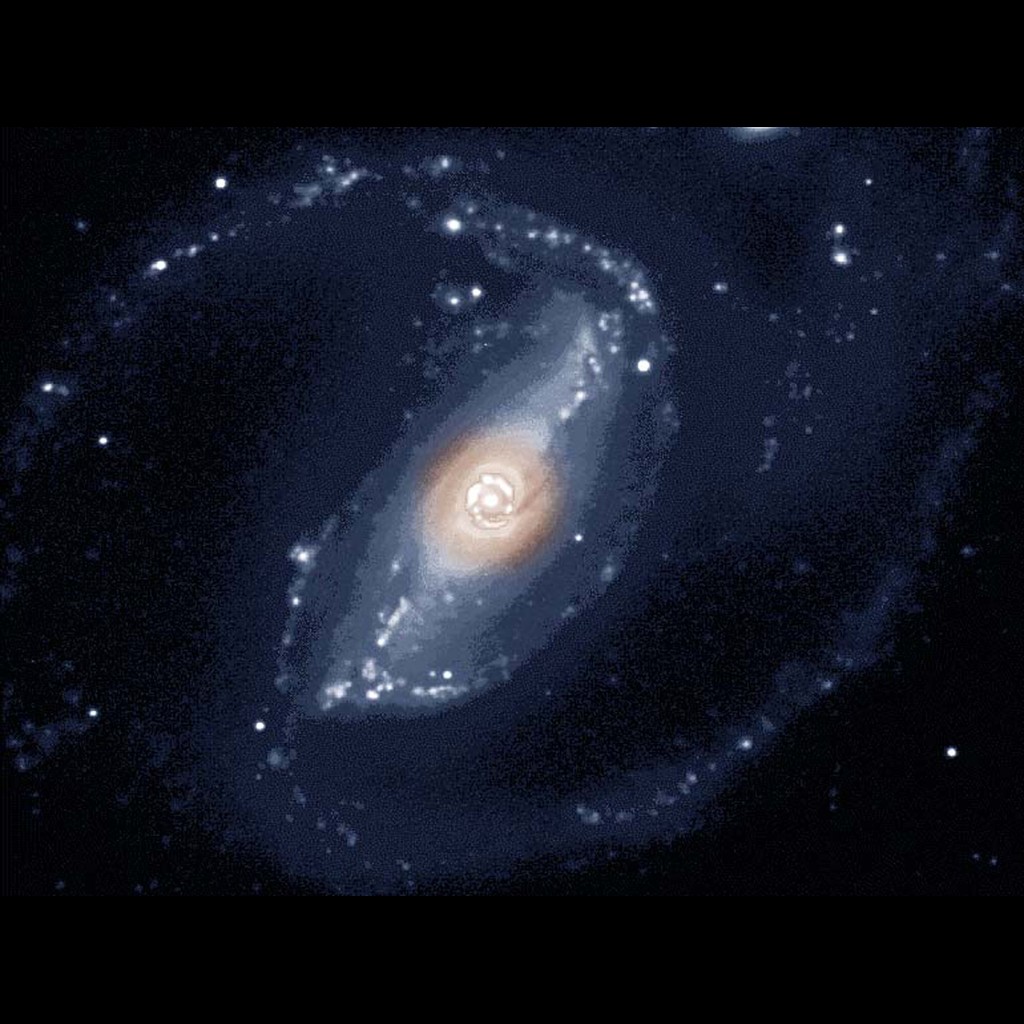
Caldwell 67, NGC 1097, is a spectacular barred spiral galaxy located approximately 45 million light-years away in the constellation Fornax. This Seyfert galaxy features an extremely bright nucleus powered by a supermassive black hole. A defining characteristic is the intense starburst ring surrounding the core, where an influx of material funneled by the central bar triggers the rapid birth of new stars.
Beyond its luminous center, the galaxy is famous for four mysterious "optical jets" that appear to emanate from its nucleus. While once debated, modern analysis suggests these are actually the shattered stellar remains of a smaller cannibalized dwarf galaxy. The galaxy is also severely interacting with its companion, the dwarf elliptical NGC 1097A, which can be seen just above the main spiral disk, causing obvious tidal debris and distortions.
This image was obtained from the NOIRLab (National Optical Astronomy Observatory) archives, capturing the intricate web of dust lanes and the "clumpy" texture of the spiral arms in high detail. To ground-based observers, C67 offers a premier view of a face-on spiral galaxy, though its faint outer arms and ghostly jets remain a challenging prize for large telescopes and long-exposure photography.