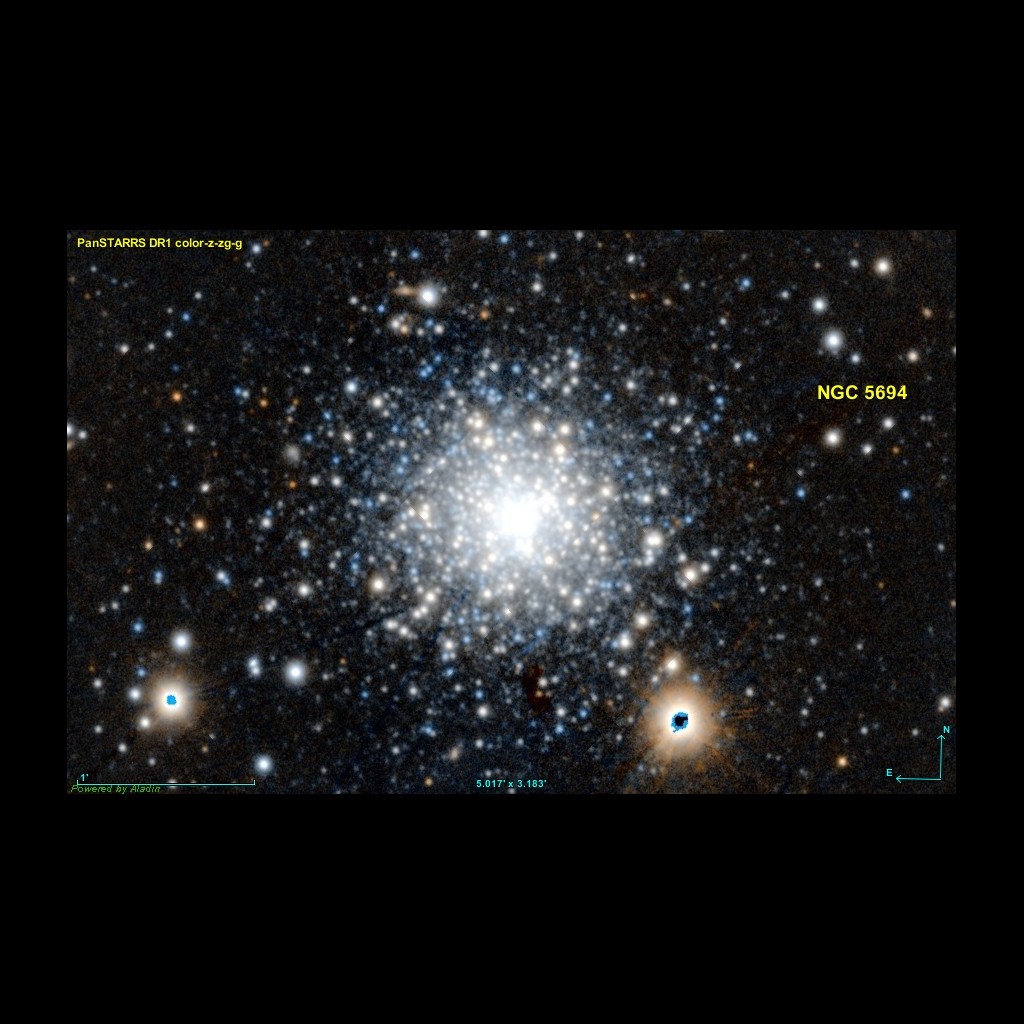
Donald Pelletier / PanSTARRS - CC SA
| Type | Globular Cluster | Constellation | Hya |
|---|---|---|---|
| Magnitude | 10.2 | Size | 3.6′ |
| Distance | 113,000 light-years | Best Month | May |
| Visibility | Global | Difficulty | Challenging (level 4/4) |
| Min. Aperture | 8-inch | RA / Dec | 14h 39m 37.1s · -26° 32' 17" |
| Discovered by | William Herschel, 1784 | ||
Donald Pelletier / PanSTARRS - CC SA
Caldwell 66, also known as NGC 5694, was discovered by William Herschel in 1784 and is one of the oldest, most remote globular clusters in our galaxy. Located roughly 114,000 light-years from Earth in the constellation Hydra, this dense collection of stars appears very faint in the sky with an apparent magnitude of 10.2. Because of its extreme distance—further from the Sun than the diameter of the Milky Way’s main disk—a small telescope is required just to spot the cluster as a "fuzzy star," and even large amateur instruments struggle to resolve its individual members, which shine at a dim 16th magnitude. It is best viewed from southern locations in the Northern Hemisphere during late spring and from the Southern Hemisphere in the autumn.
While most of the 150+ globular clusters in our galaxy are permanent residents that orbit the galactic center in stable ellipses, astronomers suspect that Caldwell 66 is a "visitor" on a one-way trip. Moving at a blistering speed of approximately 170 miles per second relative to the galactic core, the cluster appears to be traveling on an unbound, hyperbolic path. This means it is likely making its first and only pass through the Milky Way; it is only loosely gripped by our galaxy's gravity and possesses more than enough kinetic energy to eventually escape into intergalactic space forever.
Further deepening its mystery, chemical analysis suggests C66 is a "foster son" of the Milky Way rather than a native. Its stars are unusually "metal-poor" but enriched in alpha elements at levels more similar to the Sun than to other ancient clusters in our galactic halo. This unique signature implies it may be the surviving heart of a long-vanished dwarf galaxy that was cannibalized by our own billions of years ago. This specific image was created using the Aladin Sky Atlas and data from the Pan-STARRS (Panoramic Survey Telescope And Rapid Response System) survey, which utilizes its wide-field imaging capabilities to map the deep-sky objects across the northern three-quarters of the sky with unprecedented detail.
| Star | Bayer | Mag | Spectral Type | Distance | Meaning |
|---|---|---|---|---|---|
| Menkent | β Cen | 2.06 | K0 · Orange giant | 61 ly | Arabic Mankib Qanṭūris, 'Shoulder of the Centaur' — one of the brightest southern stars, marking the centaur's right shoulder. |
| Zubenelgenubi | α Lib | 2.75 | A3 · White binary | 77 ly | Arabic Al-Zubānā al-Janūbī, 'The Southern Claw' — Libra was once the claws of Scorpius in Greek astronomy before becoming the Scales. |