ESO
| Type | Planetary Nebula | Constellation | Aqr |
|---|---|---|---|
| Magnitude | 7.3 | Size | 25.0′ |
| Distance | 655 light-years | Best Month | October |
| Visibility | Global | Difficulty | Easy (level 2/4) |
| Min. Aperture | binoculars | RA / Dec | 22h 29m 34.8s · -20° 49' 48" |
| Discovered by | Karl Ludwig Harding, 1824 | ||
ESO
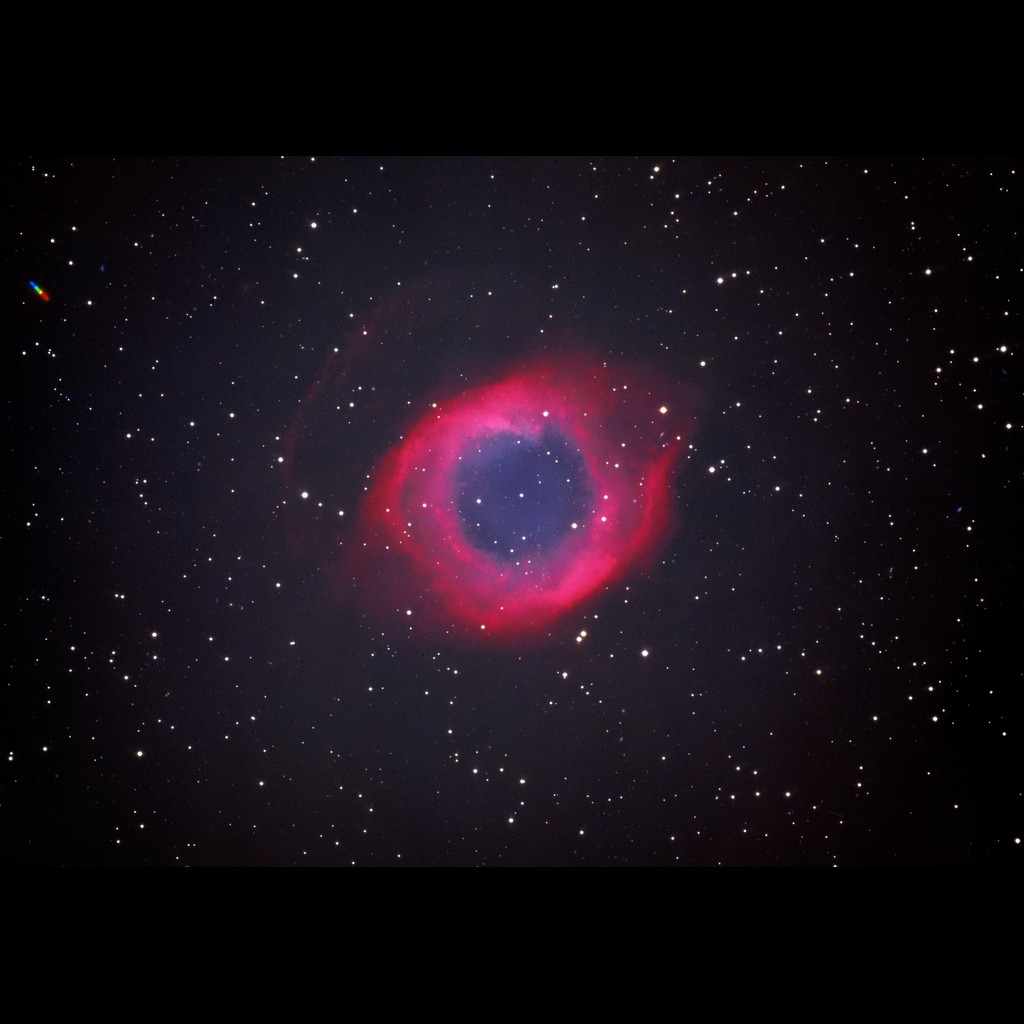
The Helix Nebula (Caldwell 63 / NGC 7293) is a vast and iconic planetary nebula located in the constellation Aquarius. Discovered by Karl Ludwig Harding before 1824, it stands as one of the closest examples of a dying star to Earth, situated at a distance of roughly 700 light-years (215 parsecs). Because of its proximity, it covers a significant patch of the sky—nearly half the width of the full moon—allowing astronomers to study its intricate "cometary knots," which are finger-like filaments of gas spanning trillions of miles.
While it bears a striking resemblance to the Ring Nebula (M57), the Helix is actually much larger and older. Its appearance as a glowing ring is a matter of perspective; we are looking almost directly down the "pole" of a cylinder of glowing gas. If viewed from the side, its structure would likely resemble the bipolar shape of the Dumbbell Nebula (M27). This particular equatorial viewing angle, combined with the bright central white dwarf, has earned it the popular nickname "The Eye of God" in modern culture.
This image highlights the complex layers of gas ejected by the central star during its final transition from a red giant to a white dwarf. The intense ultraviolet radiation from the exposed core ionizes the surrounding shell, causing the Hydrogen (red) and Oxygen (blue-green) to glow brilliantly. For observers at the Martz-Kohl Observatory, the Helix is a rewarding but subtle target; its light is spread over such a large area that a low-power, wide-field eyepiece and an OIII filter are often necessary to truly appreciate its ghostly, eye-like form.
Navigate from Enif toward Aquarius. From Enif, sweep 13° south-southeast into Aquarius.
| Star | Bayer | Mag | Spectral Type | Distance | Meaning |
|---|---|---|---|---|---|
| Fomalhaut | — | 1.17 | A3 · White main sequence | 25 ly | Arabic Fam al-Hūt, 'Mouth of the Fish' — one of the four Royal Stars of antiquity. Has a visible debris disk containing a possible planet. |