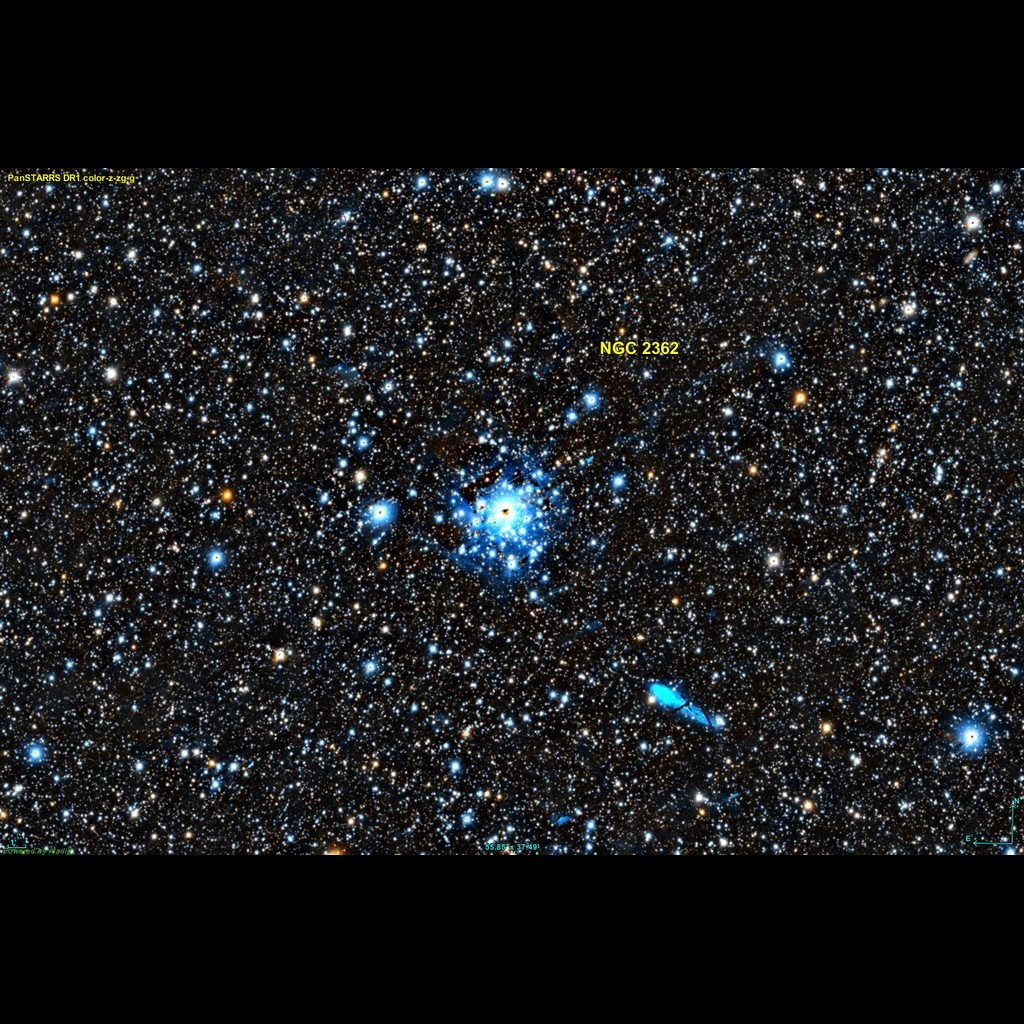
Donald Pelletier / PanSTARRs - CC SA
| Type | Open Cluster | Constellation | CMa |
|---|---|---|---|
| Magnitude | 3.8 | Size | 8.0′ |
| Distance | 3,200 light-years | Best Month | February |
| Visibility | Global | Difficulty | Easiest (level 1/4) |
| Min. Aperture | naked eye | RA / Dec | 07h 19m 04.8s · -24° 56' 60" |
| Discovered by | Giovanni Batista Hodierna, 1654 | ||
Donald Pelletier / PanSTARRs - CC SA
Caldwell 64, also known as NGC 2362 or the Tau Canis Majoris Cluster, is a stunningly young and compact open cluster located in the constellation Canis Major. The cluster is dominated by its brightest member, Tau Canis Majoris, a massive O-type multiple star system that shines with the brilliance of 50,000 suns. This central star is so luminous that it often masks the dozens of fainter, blue-white companions that huddle closely around it, creating a visual effect that early observers likened to a bright white star surrounded by a rich gathering of minute companions. The Pan-STARRS (Panoramic Survey Telescope and Rapid Response System) view of C64 provides a high-resolution look at this stellar laboratory, where the stars are estimated to be only 4 to 5 million years old.
Despite their extreme youth, the cluster is notably devoid of the natal gas and dust typically found in active star-forming regions, indicating that the powerful stellar winds from Tau Canis Majoris and its massive neighbors have already swept the area clean. This lack of obscuring material allows for a crystal-clear view of the cluster's members, which are primarily high-mass B-type stars still in the earliest stages of their cosmic lives. Pre-main-sequence stars have been identified in the cluster through X-ray and infrared surveys, confirming that NGC 2362 captures a stellar population at the very dawn of its existence.
Located approximately 4,800 light-years away, Caldwell 64 is a favorite for amateur astronomers because it is easily found near the bright star Wezen (Delta Canis Majoris). In small telescopes the cluster takes on a triangular or slightly elongated shape, with the dazzling central star surrounded by a tight spray of fainter companions that become more numerous as aperture increases. The striking contrast — a single, overwhelming beacon of light anchoring a tight-knit family of young stars — makes NGC 2362 one of the most visually rewarding winter clusters in the southern part of the sky.
Navigate from Alhena toward Canis Major. From Alhena, sweep 22° south — Tau CMa (the cluster's central star) is magnitude 4.4 and easily visible naked eye.
| Star | Bayer | Mag | Spectral Type | Distance | Meaning |
|---|---|---|---|---|---|
| Sirius | α CMa | -1.44 | A0 · Blue-white main sequence | 8.6 ly | Greek for 'Glowing' or 'Scorching' — the brightest star in the night sky. The ancient Egyptians timed the Nile flood by its heliacal rising. |
| Adhara | ε CMa | 1.50 | B2 · Blue-white supergiant | 430 ly | Arabic for 'Virgins' — part of a group of stars once seen as a constellation of maidens guarding the sky. |
| Wezen | η CMa | 1.83 | F8 · Yellow-white supergiant | 1600 ly | Arabic Al-Wazn, 'The Weight' — a yellow-white supergiant so massive that it barely moves across the sky, giving rise to its name. |
| Mirzam | β CMa | 1.98 | B1 · Blue-white giant | 500 ly | Arabic Al-Mirzam, 'The Announcer' — rises just before Sirius, heralding the arrival of the brightest star in the sky. |
| Aludra | — | 2.45 | B5 · Blue supergiant | 3190 ly | Arabic Al-'Adhārā, 'The Virgins' — one of a group of stars in Canis Major representing maidens. An enormous blue supergiant. |