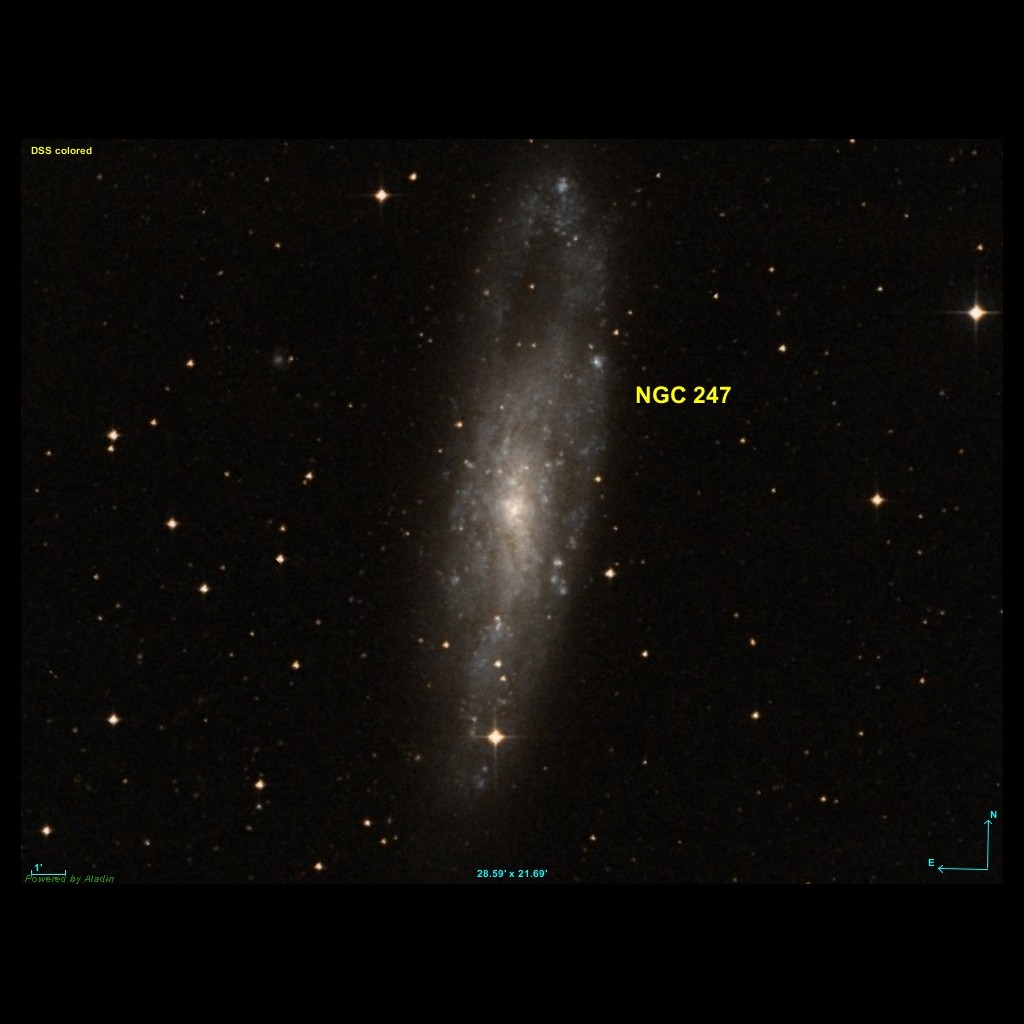
Donald Pelletier - Digital Sky Survey (DSS) - CC SA
| Type | Galaxy | Constellation | Cet |
|---|---|---|---|
| Magnitude | 8.9 | Size | 21.4′ |
| Distance | 11.1 million light-years | Best Month | November |
| Visibility | Global | Difficulty | Moderate (level 3/4) |
| Min. Aperture | binoculars | RA / Dec | 00h 47m 13.2s · -20° 45' 00" |
| Discovered by | William Herschel, 1784 | ||
Donald Pelletier - Digital Sky Survey (DSS) - CC SA
Caldwell 62, NGC 247, is a large but low-surface-brightness spiral galaxy located approximately 11 million light-years away in the constellation Cetus. A prominent member of the Sculptor Group, it is tilted at a steep angle from our perspective, giving it a highly elongated appearance. One of its most distinctive features is a large, nearly empty void on one side of its disk—an area lacking the bright stars and glowing gas found elsewhere in the galaxy. This unusual gap has earned it the nickname the "Needle's Eye" galaxy, suggesting a cosmic tear in its otherwise delicate spiral structure.
The galaxy is a laboratory for studying star formation under unique conditions. While much of the disk appears "dusty" and disorganized compared to the symmetrical arms of the Milky Way, high-resolution views reveal intense pockets of star birth. These regions are populated by massive, hot blue stars that have recently emerged from their natal cocoons of gas. The interaction between these young stars and the surrounding interstellar medium creates a complex web of dark dust lanes that silhouettes against the older, yellowish population of stars making up the galaxy's core.
This image of NGC 247 highlights the "long" nature of the object, which spans nearly 20 arcminutes in the sky—about two-thirds the width of a full moon. Because its light is spread over such a large area, it remains a challenging target for observers in light-polluted areas, requiring the dark, steady skies of a site like the Martz-Kohl Observatory to reveal its subtle textures. Capturing the "Needle's Eye" and the faint outer fringes of the disk requires long-exposure imaging to overcome the low contrast of the galaxy against the background of deep space.
Navigate from Enif toward Cetus. From Enif, sweep 20° south into Cetus — a low southern object from northern latitudes.
| Star | Bayer | Mag | Spectral Type | Distance | Meaning |
|---|---|---|---|---|---|
| Diphda | β Phe | 2.04 | K0 · Orange giant | 96 ly | Arabic Al-Difdi' al-Thānī, 'The Second Frog' — the brightest star in Cetus the Sea Monster, though it marks the whale's tail. |