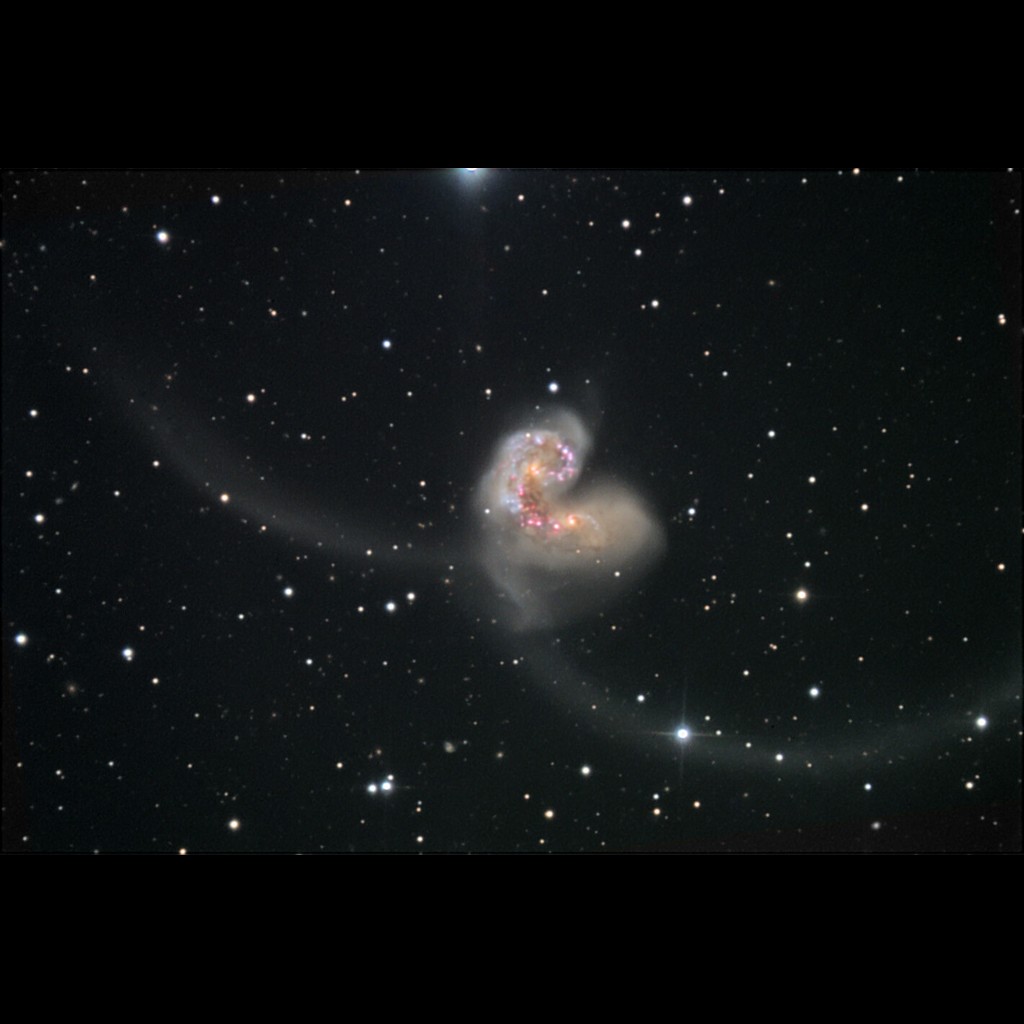
KPNO/NOIRLab/NSF/AURA/Bob and Bill Twardy/Adam Block
| Type | Galaxy | Constellation | Crv |
|---|---|---|---|
| Magnitude | 10.3 | Size | 3.1′ |
| Distance | 45.0 million light-years | Best Month | April |
| Visibility | Global | Difficulty | Challenging (level 4/4) |
| Min. Aperture | 6in | RA / Dec | 12h 01m 19.2s · -18° 52' 48" |
| Discovered by | William Herschel, 1785 | ||
KPNO/NOIRLab/NSF/AURA/Bob and Bill Twardy/Adam Block
Caldwell 60, encompassing the duo NGC 4038 and NGC 4039, represents a collision on the grandest scale. These two galaxies are currently in the process of merging, providing us with a spectacular vantage point of galactic evolution from a distance of 65 million light-years. In the nuclei of these galaxies, massive amounts of gas and dust are being compressed and mixed, which dramatically colors the light from the star-forming regions in the interior. While the clusters of hot new stars are naturally blue, the intervening dust and gas redden this light, producing the distinct shades of yellow and brown seen churning in the center.
Beyond the bright central chaos, there are two massive, faint arcs stretching away from the core—a feature that gives this pair its nickname, the "Antennae Galaxies." These arcs are comprised of millions of stars that have been violently flung into intergalactic space by the intense gravitational tidal forces of the collision. To see these delicate stellar streams in your web app's preview, users will likely need to view the screen in a dark room. This interaction is a preview of the fate of our own Milky Way, which will eventually undergo a similar merger with the Andromeda Galaxy. Other famous examples of such interacting systems include the Whirlpool Galaxy (M51) and the Siamese Twins (NGC 4567/4568).
This image was taken as part of the Advanced Observing Program (AOP) at the Kitt Peak Visitor Center during 2014. By using the high-altitude, clear-sky advantages of Kitt Peak, this AOP capture reveals both the vibrant, high-energy starburst regions at the heart of the collision and the incredibly faint tidal tails that characterize this iconic deep-sky object.
Navigate from Spica toward Corvus. Immediately adjacent to C60 — same field of view.
| Star | Bayer | Mag | Spectral Type | Distance | Meaning |
|---|---|---|---|---|---|
| Gienah Ghurab | γ Crv | 2.58 | B8 · Blue-white giant | 165 ly | Arabic Al-Janāh al-Ghurāb, 'Wing of the Crow' — the brightest star in Corvus, marking the raven's right wing. |
| Kraz | — | 2.65 | G5 · Yellow-white giant | 146 ly | Origin uncertain. Marks the tail of Corvus the Crow, the fainter of the two named stars in this compact southern constellation. |
| Algorab | δ Crv | 2.94 | B9 · Blue-white giant | 87 ly | Arabic Al-Ghurāb, 'The Crow' — named for the constellation itself. A wide double star with a faint optical companion. |