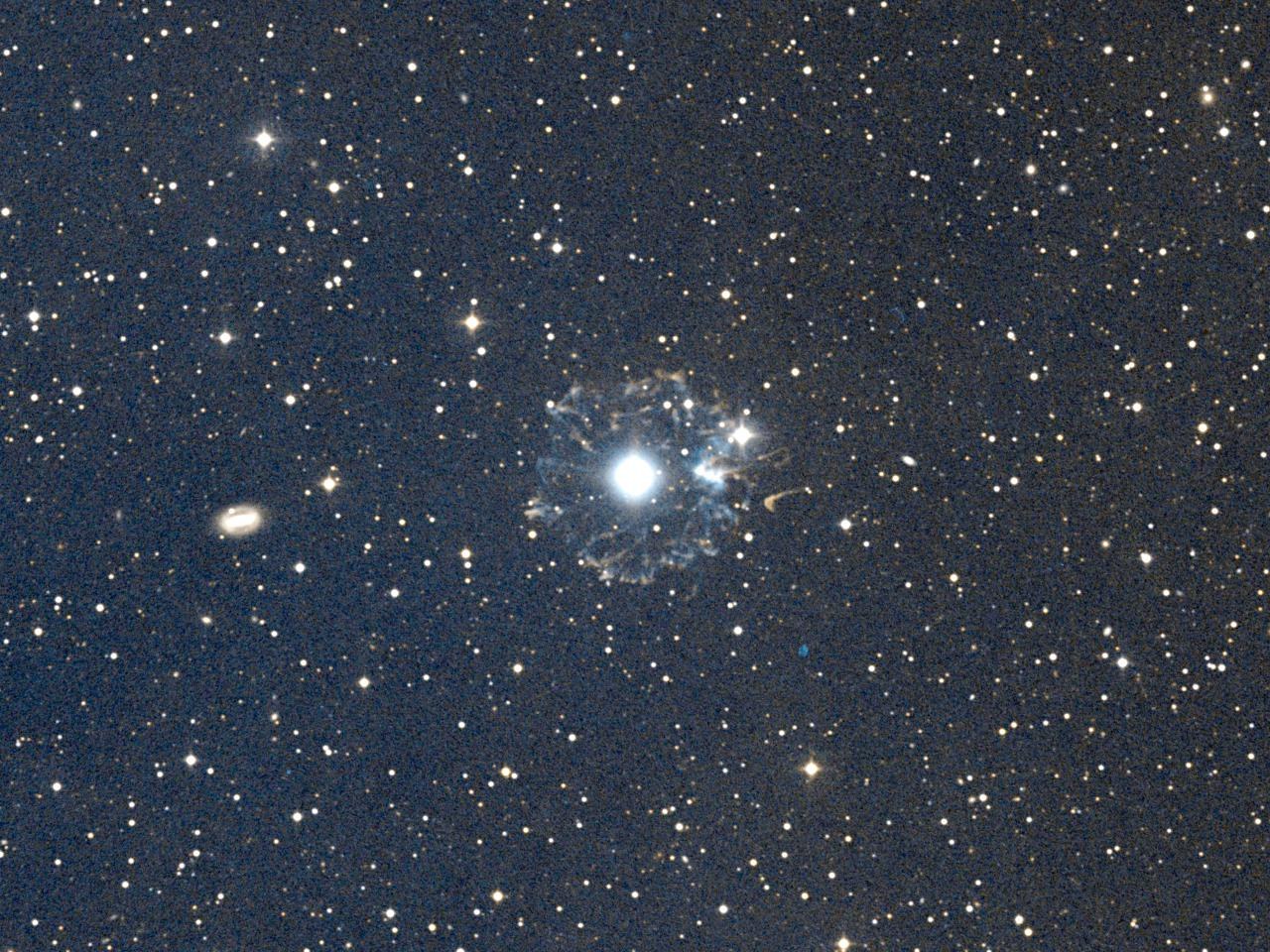
ESA/Euclid/EuclidConsortium/NASA/NAOJ/AndreaLuck CC BY
| Type | Planetary Nebula | Constellation | Dra |
|---|---|---|---|
| Magnitude | 8.1 | Size | 0.3′ |
| Distance | 3,300 light-years | Best Month | July |
| Visibility | Northern | Difficulty | Moderate (level 3/4) |
| Min. Aperture | 3in | RA / Dec | 17h 58m 30.0s · +66° 37' 48" |
| Discovered by | William Herschel, 1786 | ||
ESA/Euclid/EuclidConsortium/NASA/NAOJ/AndreaLuck CC BY
Caldwell 6, better known as the Cat's Eye Nebula (NGC 6543), is one of the most famous and structurally complex planetary nebulae in the sky. Located about 3,000 light-years away in the constellation Draco, this object represents the final, dramatic act of a sun-like star. As the central star sheds its outer layers it creates a series of intricate, concentric shells and gaseous knots, which combined with the complex dynamics of the dying star's winds result in the vibrant, eye-like symmetry visible through telescopes. As a planetary nebula, NGC 6543 represents the glowing remains of a dying star — a stark contrast to the Iris Nebula (Caldwell 4), which is a reflection nebula illuminated by a young, living star. Its mesmerizing structure offers a fascinating look at stellar lifecycles, making it a favorite high-detail target for observers who want to push the resolution limits of their equipment.
High-resolution Hubble Space Telescope imaging has resolved NGC 6543 into one of the most complex planetary nebulae known, revealing at least eleven concentric rings around the main nebular body, along with jets, knots, and sinuous arc-shaped structures. These rings are thought to represent successive shells of material shed by the central star at roughly 1,500-year intervals, driven by thermal pulses during the asymptotic giant branch phase. The central star — one of the brightest known nuclei of a planetary nebula at magnitude 11.4 — drives a fast bipolar wind that sculpts the inner cavity. X-ray observations by the Chandra observatory detect shocked million-degree gas produced where this fast wind collides with the slower-moving outer shell.
For amateur astronomers, the Cat's Eye is one of the most rewarding planetary nebulae in the sky, easily located in Draco and bright enough for small telescopes to show the distinctive greenish disk. At low magnification it resembles a faint star, but increasing magnification reveals the nebular disk clearly. Under good seeing with apertures of 8 inches or more, the slightly oval shape and the bright central star can both be appreciated. An OIII narrowband filter enhances the contrast of the nebula against the sky background, bringing out additional detail in the outer shell.
Navigate from Eltanin toward Draco. From Eltanin (Gamma Draconis), move 6° north-northeast toward the Dragon's head.
| Star | Bayer | Mag | Spectral Type | Distance | Meaning |
|---|---|---|---|---|---|
| Kochab | β UMi | 2.07 | K4 · Orange giant | 131 ly | Arabic Al-Kawkab, simply 'The Star' — the brighter of the two outer bowl stars of the Little Dipper. Was the North Star around 1500 BCE. |