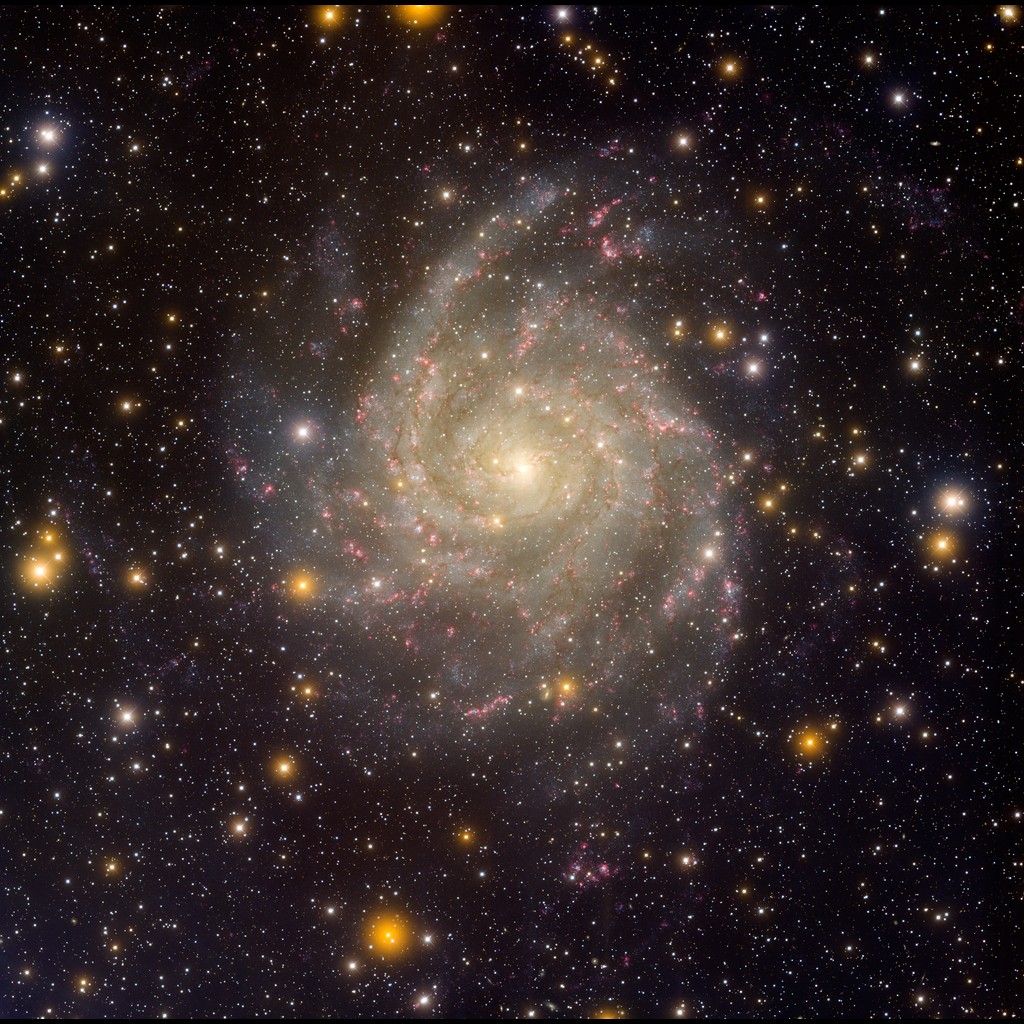
NOIRLab/NSF/AURA/T.A. Rector (NSF NOIRLab/University of Alaska Anchorage) & H. Schweiker (WIYN/NSF NOIRLab)
| Type | Galaxy | Constellation | Cam |
|---|---|---|---|
| Magnitude | 8.4 | Size | 21.4′ |
| Distance | 11.0 million light-years | Best Month | November |
| Visibility | Northern | Difficulty | Moderate (level 3/4) |
| Min. Aperture | binoculars | RA / Dec | 03h 46m 01.2s · +68° 05' 60" |
| Discovered by | William Frederick Denning, 1895 | ||
NOIRLab/NSF/AURA/T.A. Rector (NSF NOIRLab/University of Alaska Anchorage) & H. Schweiker (WIYN/NSF NOIRLab)
Spiral galaxy IC 342 is located roughly 11 million light-years from Earth in the constellation Camelopardalis, "the giraffe." Its face-on orientation — as opposed to the tilted or edge-on views we have of many other nearby spirals — makes IC 342 a prime target for studies of star formation and astrochemistry. The image was obtained in late 2006 using the 64-megapixel Mosaic-1 digital imager on the Mayall 4-meter telescope at Kitt Peak National Observatory, and was the subject of NOAO press release 07-03.
Despite being one of the largest and brightest spiral galaxies in our cosmic neighborhood, IC 342 is notoriously difficult to observe because it lies almost directly behind the plane of the Milky Way. Intervening dust from our own galaxy dims IC 342 by more than a magnitude and gives it a reddish cast, robbing it of the surface brightness that would otherwise make it a spectacular naked-eye object. If this galaxy lay in a direction clear of the Milky Way, it would be one of the most prominent galaxies in the night sky, comparable in apparent size to the Andromeda Galaxy.
IC 342 is the dominant member of the IC 342/Maffei Group, one of the nearest galaxy groups to our own Local Group. Its grand design spiral structure is clearly revealed in deep images like this one, with prominent dust lanes winding outward from an active star-forming nucleus and well-defined spiral arms peppered with pink emission nebulae — vast clouds of ionized hydrogen marking the birthplaces of new stars. The nucleus itself shows signs of a circumnuclear starburst ring, and the galaxy hosts some of the most intensely studied giant molecular clouds outside the Milky Way.
Navigate from Mirfak toward Camelopardalis. From Mirfak in Perseus, sweep 20° north through Camelopardalis.