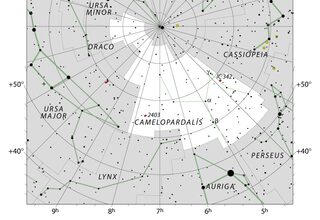
 IAU Chart
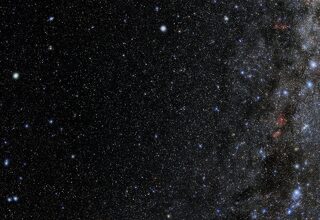 NOIRLab Images
 Stellarium Images
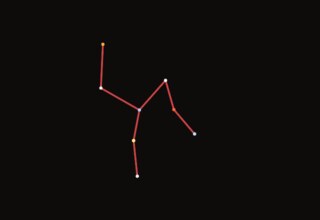 Stars and Sticks
| Abbreviation | Cam |
|---|---|
| Meaning | Giraffe |
| Pronunciation Guide is based on “Pronouncing Astronomical Names,” published in 1943 by the American Astronomical Society. | cuh-MEL-oh-PAR-duh-liss |
| Genitive The genitive is the Latin possessive form used in star names. For example, Alpha Orionis means “the Alpha of Orion.” | kuh-mel-oh-PAR-duh-lis |
| Best Month | February |
| Visibility | Northern |
| Origin | ModernAdded between the 17th and 18th centuries by astronomers like Hevelius or Plancius to define faint star clusters ignored by the ancients. |
| Author | PlanciusA Dutch cartographer who mapped southern stars and added biblical or symbolic figures like the Dove and the Unicorn. |
| Type | constellation |
| Difficulty | Expert |
| Description | This enormous but faint constellation was introduced by the Dutch cartographer Petrus Plancius in 1612, filling the large blank area around the north celestial pole. The name comes from the Greek for 'giraffe' — a compound of 'kamelos' (camel) and 'pardalis' (leopard) — because early Europeans described giraffes as having the long neck of a camel and the spots of a leopard. Despite covering a large area of sky, it contains no star brighter than magnitude 4, making it nearly invisible to the naked eye in anything but perfectly dark skies. The brightest star, Beta Camelopardalis, is a yellow supergiant about 1,000 light-years away and roughly 3,000 times more luminous than the Sun. |
Click a thumbnail to view full-size. Plain and Annotated versions available on the image page.
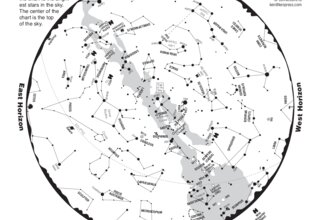
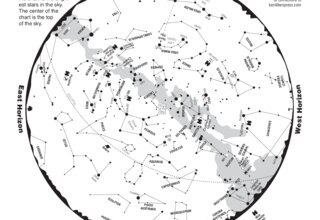
Monthly sky charts courtesy of What's Out Tonight? — Copyright ©2026 Ken Graun. Star charts are optimized for mid-latitudes of the Northern Hemisphere. Click a chart to view or download the PDF. For guidance on using the chart, or to purchase a planisphere and astronomy books, visit kenpress.com.
Images: NOIRLab/NSF/AURA/E. Slawik · IAU and Sky & Telescope · Stellarium — Full credits →