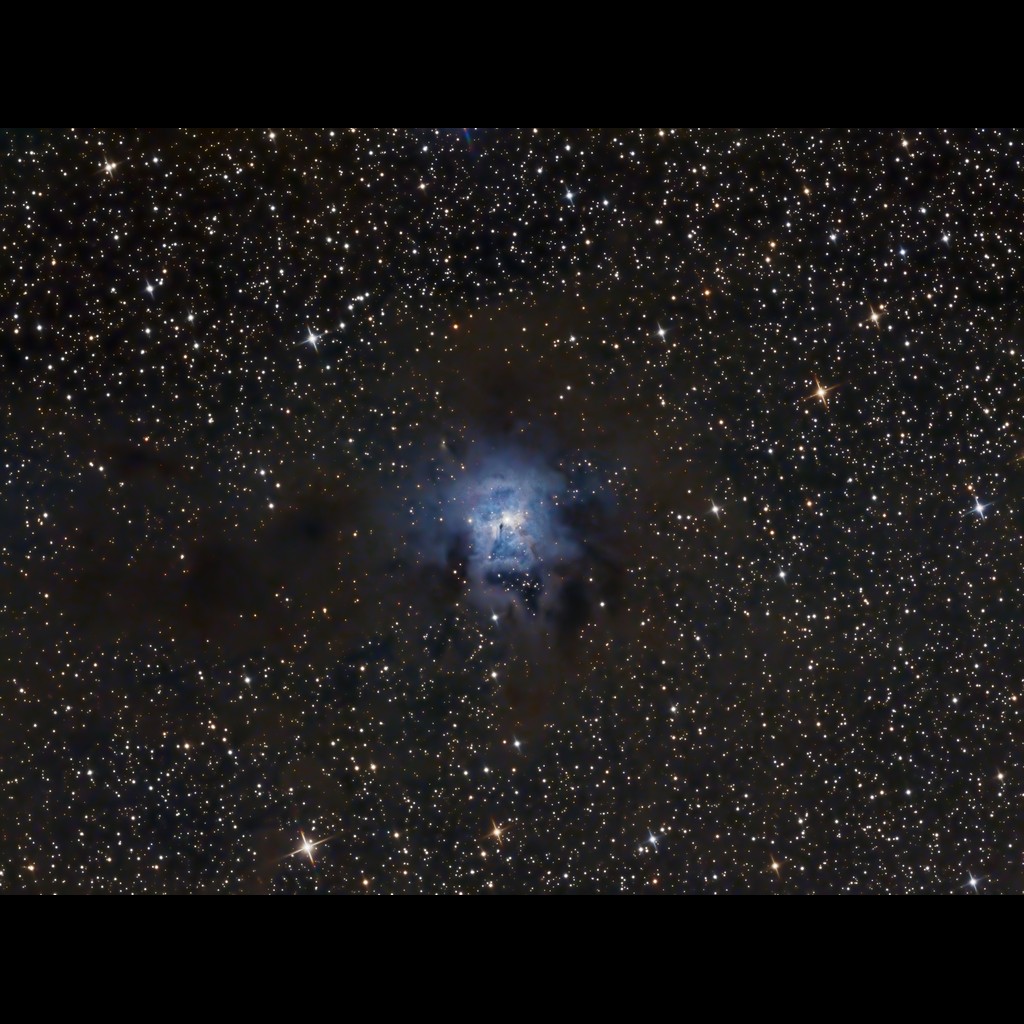
Keith Steffens CC BY-SA 4 license
| Type | Reflection Nebula | Constellation | Cep |
|---|---|---|---|
| Magnitude | 6.8 | Size | 18.0′ |
| Distance | 1,300 light-years | Best Month | September |
| Visibility | Northern | Difficulty | Moderate (level 3/4) |
| Min. Aperture | 3in | RA / Dec | 21h 01m 37.2s · +68° 10' 12" |
| Discovered by | William Herschel, 1794 | ||
Keith Steffens CC BY-SA 4 license
Caldwell 4, better known as the Iris Nebula (NGC 7023), is a stunning reflection nebula located approximately 1,300 light-years away in the constellation Cepheus. Spanning roughly six light-years across, this celestial flower earns its name from the intricate, petal-like filaments of gas and dust that appear to bloom around its luminous core. Unlike emission nebulae that create their own light through ionization, the Iris Nebula shines by reflecting the intense radiation of a young, hot central star, HD 200775. This starlight scatters off the surrounding clouds of fine interstellar dust — a process similar to how Earth's atmosphere scatters sunlight to produce a blue sky — resulting in the nebula's characteristic ethereal cerulean glow. The region is further framed by complex, dark lanes of dense dust that provide a stark contrasting backdrop, making it both a challenging and deeply rewarding target for amateur observers and astrophotographers alike.
The dark material surrounding the Iris is not merely backdrop — it is part of the vast Cepheus molecular cloud, one of the most extensive star-forming complexes within 1,500 light-years of Earth. Infrared observations by the Spitzer Space Telescope revealed complex organic molecules, particularly polycyclic aromatic hydrocarbons (PAHs), embedded in these dust clouds. These molecules are excited by the ultraviolet radiation from HD 200775 and fluoresce in the near-infrared, making NGC 7023 one of the most-studied reflection nebulae for understanding photodissociation regions — the transition zones where ultraviolet starlight transforms the chemistry of interstellar gas and dust.
For visual observers, the Iris Nebula is a satisfying target in medium-aperture telescopes from a dark site. The central star, at 7th magnitude, is easily located, and even small instruments at low power reveal a subtle blue glow surrounding it. Larger apertures bring out more of the nebulosity and hint at the dark lanes that define its petals. The surrounding molecular cloud, opaque in visible light, blocks many background stars and creates a distinctive hollow in the star field that frames the nebula beautifully in wide-field photographs.
Navigate from Deneb toward Cepheus. From Deneb, sweep 15° north into Cepheus toward the bright star at the nebula's core.
| Star | Bayer | Mag | Spectral Type | Distance | Meaning |
|---|---|---|---|---|---|
| Alderamin | α Cep | 2.45 | A7 · White subgiant | 49 ly | Arabic Al-Dhirā' al-Yamīn, 'The Right Arm' of Cepheus. Due to precession, it will become the North Star around 7500 CE. |