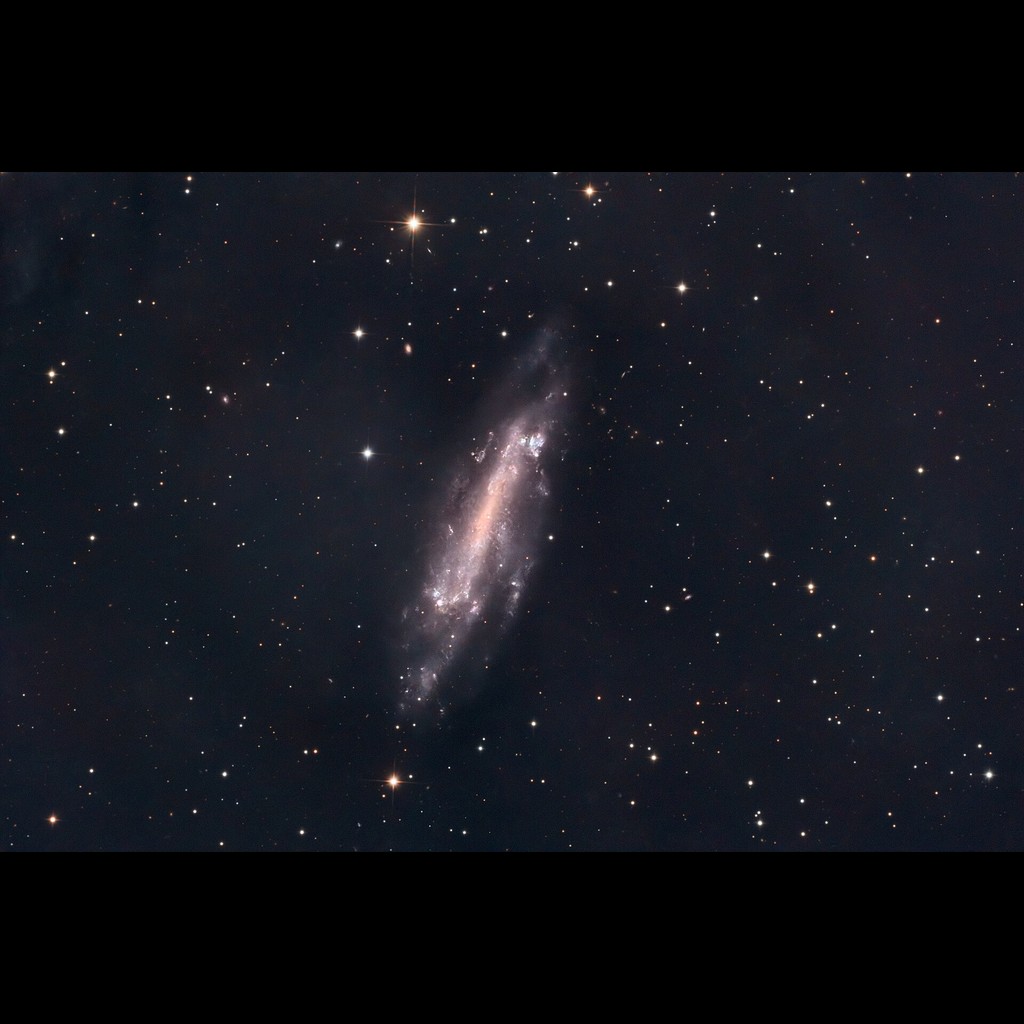
Matt Smith Licensed under CC BY-SA 4.0
| Type | Galaxy | Constellation | Dra |
|---|---|---|---|
| Magnitude | 9.7 | Size | 21.9′ |
| Distance | 14.5 million light-years | Best Month | April |
| Visibility | Northern | Difficulty | Challenging (level 4/4) |
| Min. Aperture | 6in | RA / Dec | 12h 16m 37.2s · +69° 27' 36" |
| Discovered by | William Herschel, 1793 | ||
Matt Smith Licensed under CC BY-SA 4.0
NGC 4236 is a tenth magnitude barred spiral galaxy in Draco that's visible through small telescopes, although best seen with larger instruments. The galaxy was discovered by German born British astronomer William Herschel on April 6, 1793 and is a member of the Ursa Major or M81 group of galaxies that contains at least 34 galaxies, including spectacular M81 (Bode's galaxy) and M82 (Cigar galaxy).
NGC 4236 is located in the far northern constellation of Draco about 15 degrees north of the seven stars that form the famous "Plough" or "Big Dipper" asterism of Ursa Major. The galaxy is positioned two-thirds of the way along an imaginary line connecting stars lambda Dra (λ Dra - mag. +3.8) and kappa Dra (κ Dra - mag. +3.9). Star HD 106574 (mag +5.7) is 0.75 degrees directly north of NGC 4236.
Due to its high northerly declination, NGC 4236 is a Northern Hemisphere object. The best months to look for it are March, April or May although from most northern locations it's visible all year round and never sets. It can be seen from the Southern Hemisphere but only from latitudes north of 20 degrees south and even then appears low down above the northern horizon at best.
Navigate from Eltanin toward Draco. From Eltanin (Gamma Draconis), sweep 9° west-northwest along the body of Draco.
| Star | Bayer | Mag | Spectral Type | Distance | Meaning |
|---|---|---|---|---|---|
| Dubhe | α UMa | 1.81 | F7 · Orange giant | 124 ly | Arabic Zahr al-Dubb al-Akbar, 'Back of the Greater Bear' — one of the two pointer stars that lead to Polaris, the North Star. |
| Merak | δ UMa | 2.34 | A1 · Blue-white main sequence | 79 ly | Arabic Al-Maraqq, 'The Loins of the Bear' — one of the two pointer stars of the Big Dipper that guide observers to Polaris. |
| Megrez | β UMa | 3.32 | A3 · White main sequence | 81 ly | Arabic Al-Maghriz, 'Root of the Bear's Tail' — the faintest of the seven Big Dipper stars, where the handle meets the bowl. |
| Thuban | λ Dra | 3.67 | A0 · White giant | 303 ly | Arabic Al-Thubbān, 'The Dragon' — served as the North Pole Star around 2700 BCE during the age of the Egyptian pyramid builders. |