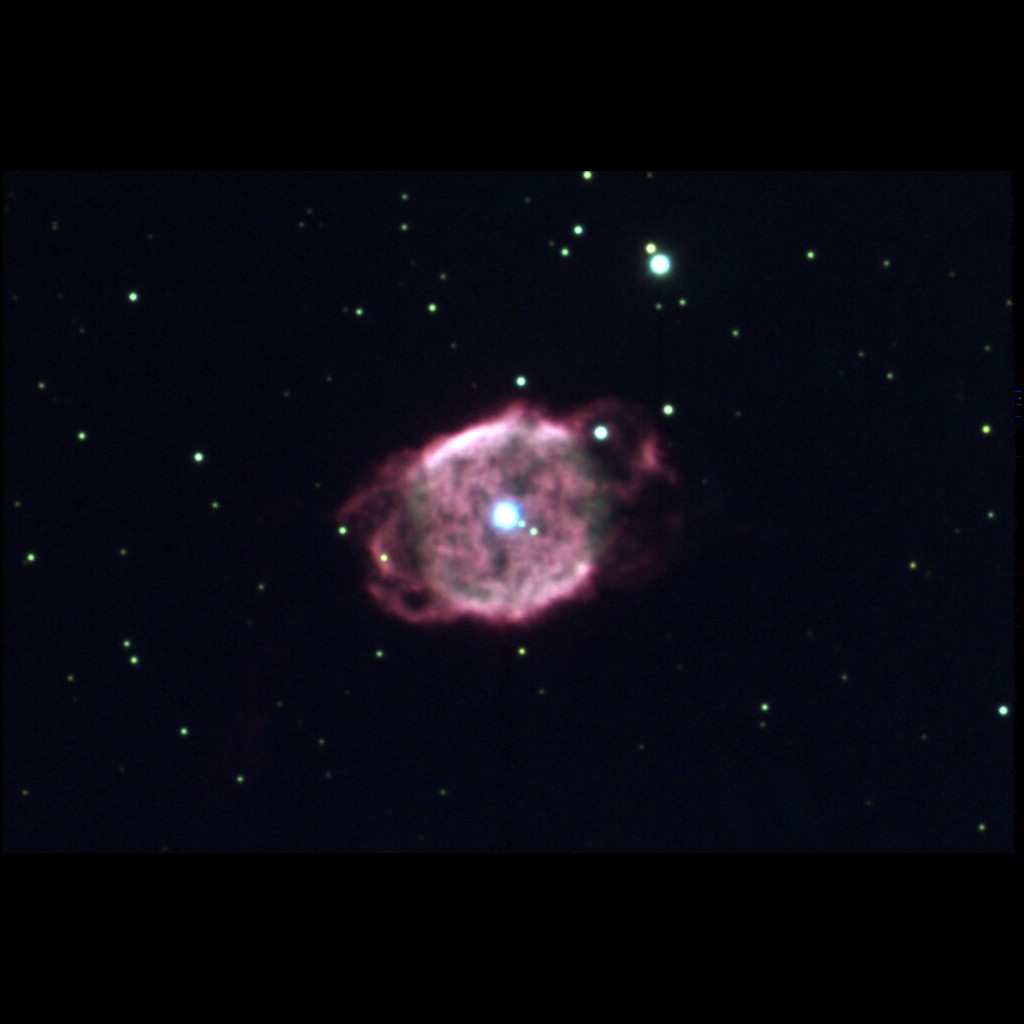
WIYN/NOIRLab/NSF
| Type | Planetary Nebula | Constellation | Cep |
|---|---|---|---|
| Magnitude | 10.7 | Size | 0.6′ |
| Distance | 3,500 light-years | Best Month | October |
| Visibility | Northern | Difficulty | Challenging (level 4/4) |
| Min. Aperture | 6in | RA / Dec | 00h 12m 46.8s · +72° 31' 48" |
| Discovered by | William Herschel, 1788 | ||
WIYN/NOIRLab/NSF
This image of NGC 40 is a combination of seven exposures through B, V, and R filters taken in November 1996 at the 3.5-meter WIYN telescope. NGC 40 is a low-excitation planetary nebula in the constellation Cepheus, about 4,000 light-years from Earth. The central star is relatively bright at magnitude 11.6, with a mass of around 0.7 solar masses and a surface temperature near 90,000 degrees — far hotter than the ionization state of the surrounding nebula would suggest. This discrepancy hints at dense shielding material between the star and its glowing shell, possibly concentrated at the shock interface between the star's fast outflowing wind (around 1,800 km/s) and the slower nebular shells. The nebular material covers roughly 25% of the sky as seen from the central star, implying asymmetric mass-loss during the star's asymptotic giant branch phase, and an extended halo beyond the main shell — not visible here — points to even earlier episodes of mass ejection.
NGC 40 spans roughly 38 arcseconds on the sky, making it a compact target that benefits from moderate to high magnification. In amateur telescopes of 6 inches or larger it appears as a slightly elliptical disk with the bright central star clearly visible, glowing in the warm red-orange light of ionized hydrogen and nitrogen. Discovered by William Herschel in 1788, the nebula has earned the informal nickname "Bow-Tie Nebula" from observers who notice its subtle elongation through larger apertures.
Patrick Moore included NGC 40 as the second entry in his Caldwell catalog, ensuring northern observers would seek out this compact example of stellar recycling. Despite its modest size, NGC 40 rewards careful observation: the offset between the central star's temperature and the nebula's ionization state, the asymmetric shell structure, and the deep halo make it one of the more scientifically interesting planetary nebulae in the northern sky.
From Caph: From Caph (Beta Cassiopeiae), sweep 8° southeast into Cepheus.
| Star | Bayer | Mag | Spectral Type | Distance | Meaning |
|---|---|---|---|---|---|
| Cih | α Cas | 2.15 | B0 · Blue-white supergiant | 550 ly | Chinese name meaning 'The Whip' — the middle star of Cassiopeia's W, marking the queen's waist. A luminous blue variable. |
| Shedir | γ Cas | 2.24 | K0 · Orange giant | 229 ly | Arabic Al-Sadr, 'The Breast' — marks the heart of Cassiopeia the Queen on her throne. A slowly varying orange giant. |
| Caph | β Cas | 2.28 | F2 · White giant | 54 ly | Arabic Al-Kaff, 'The Hand' or 'The Palm' — marks the tip of the W-shape of Cassiopeia. A pulsating variable star. |
| Ruchbah | δ Cas | 2.66 | A5 · White giant binary | 99 ly | Arabic Al-Rukbah, 'The Knee' of Cassiopeia — one of the W-shaped stars of the queen, an eclipsing binary that dips in brightness periodically. |