NOIRLab/NSF/AURA
| Type | Open Cluster | Constellation | Cep |
|---|---|---|---|
| Magnitude | 8.1 | Size | 13.0′ |
| Distance | 5,000 light-years | Best Month | October |
| Visibility | Northern | Difficulty | Moderate (level 3/4) |
| Min. Aperture | 3in | RA / Dec | 00h 39m 10.8s · +85° 19' 48" |
| Discovered by | Caroline Herschel, 1787 | ||
NOIRLab/NSF/AURA
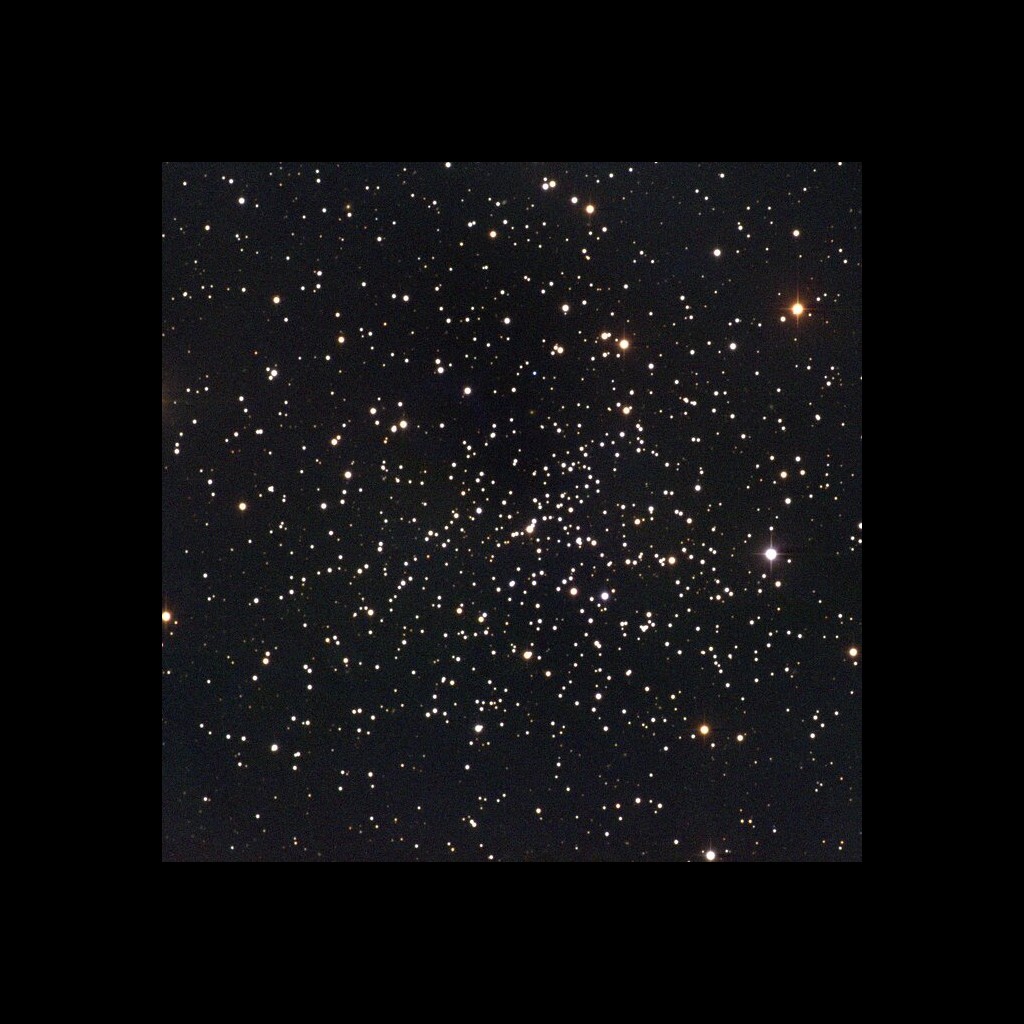
NGC 188 is an open star cluster in the constellation Cepheus, remarkable for being one of the oldest known open clusters in the Milky Way. With a membership of around 120 stars, age estimates have ranged widely — from as little as five billion years to earlier claims exceeding twenty billion years (an obvious anomaly given current estimates of the age of the universe). Modern photometric studies favor an age of approximately 6.8 billion years, making NGC 188 a valuable reference point for stellar evolution models. It was first recorded by John Herschel before 1833 and was later included by Patrick Moore as the first entry in his Caldwell catalog of challenging objects for observers seeking targets beyond the Messier list.
The cluster's great age has profound consequences for its stellar population. The younger, more massive blue stars have long since evolved off the main sequence, leaving a mix of yellow subgiants, red giants, and lower-mass stars dominating the membership. Color-magnitude diagram studies of NGC 188 have been used for decades to calibrate stellar evolution theory, particularly the behavior of stars near the main-sequence turnoff point. Its location only about five degrees from the North Celestial Pole means it is circumpolar from most northern latitudes, visible on every clear night of the year.
This image was taken with the WIYN 0.9-meter telescope at the Kitt Peak National Observatory on the night of December 19, 2002 UT. The image spans approximately 21.5 arcminutes on the sky. In moderate telescopes, NGC 188 presents a rich but unassuming scatter of faint stars that rewards patient observation — a quiet gathering of stellar veterans that have endured long after most open clusters have dissolved back into the background of the Milky Way.
Navigate from Polaris toward Cepheus. From Polaris, sweep 4° south-southwest. The cluster sits between Polaris and the main body of Cepheus.