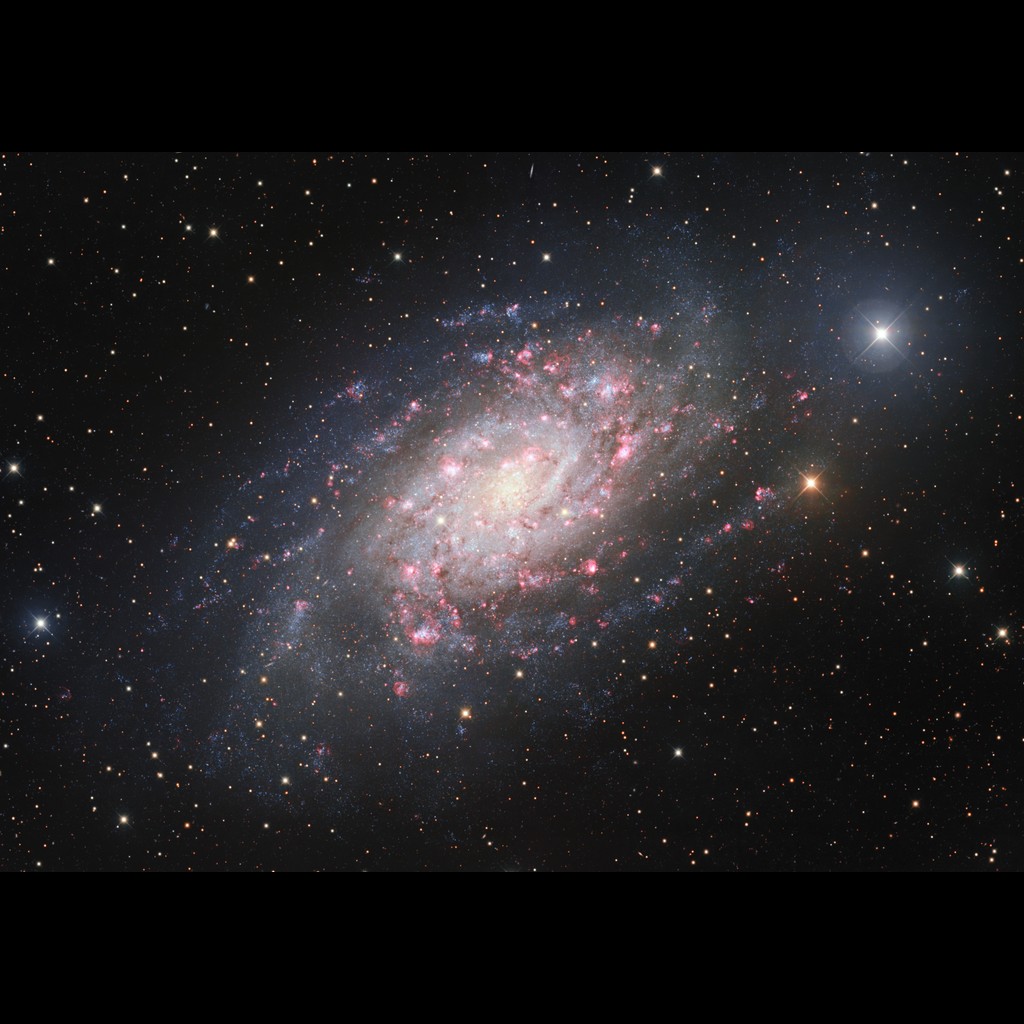
KPNO/NOIRLab/NSF/AURA/M. T. Patterson (New Mexico State University)
| Type | Galaxy | Constellation | Cam |
|---|---|---|---|
| Magnitude | 8.4 | Size | 23.4′ |
| Distance | 10.0 million light-years | Best Month | December |
| Visibility | Northern | Difficulty | Easy (level 2/4) |
| Min. Aperture | binoculars | RA / Dec | 07h 37m 01.2s · +65° 35' 60" |
| Discovered by | William Herschel, 1788 | ||
KPNO/NOIRLab/NSF/AURA/M. T. Patterson (New Mexico State University)
Caldwell 7, cataloged as NGC 2403, is a striking intermediate spiral galaxy located approximately 10 million light-years away in the constellation Camelopardalis. Captured here by the Nicholas U. Mayall 4-meter Telescope at Kitt Peak National Observatory, the galaxy's structure is punctuated by vivid red spots — these are HII regions, massive clouds of ionized hydrogen gas where new, hot stars are actively forming. NGC 2403 belongs to the M81 Group and is one of the closest large spiral galaxies beyond our Local Group, making it large and bright enough to be seen in binoculars from a dark site as an elongated glow spanning roughly 22 arcminutes.
NGC 2403 is also famous for hosting supernova SN 2004dj, one of the brightest and nearest stellar deaths observed this century. Because the progenitor star was documented in pre-explosion archival images and monitored closely in the months following the event, SN 2004dj provided astronomers with a rare and detailed timeline of a massive star's final moments and the subsequent evolution of its remnant. The galaxy's proximity and favorable inclination mean that individual supergiants, star clusters, and emission nebulae can be resolved in professional images — a level of detail normally reserved for the Magellanic Clouds and the closest Local Group members.
In photographs, NGC 2403 resembles a scaled-down version of the Triangulum Galaxy (M33), with patchy, loosely wound spiral arms rich in star-forming complexes and separated by dusty inter-arm regions. Long-exposure images in hydrogen-alpha light reveal the full extent of the HII region network, tracing the galaxy's ongoing star formation across its disk. Together, its active star-forming regions, resolved stellar populations, and well-documented supernovae history make NGC 2403 one of the most scientifically valuable nearby galaxies and a beautiful object in its own right.
Navigate from Dubhe toward Camelopardalis. From Dubhe, sweep 10° northwest into Camelopardalis.