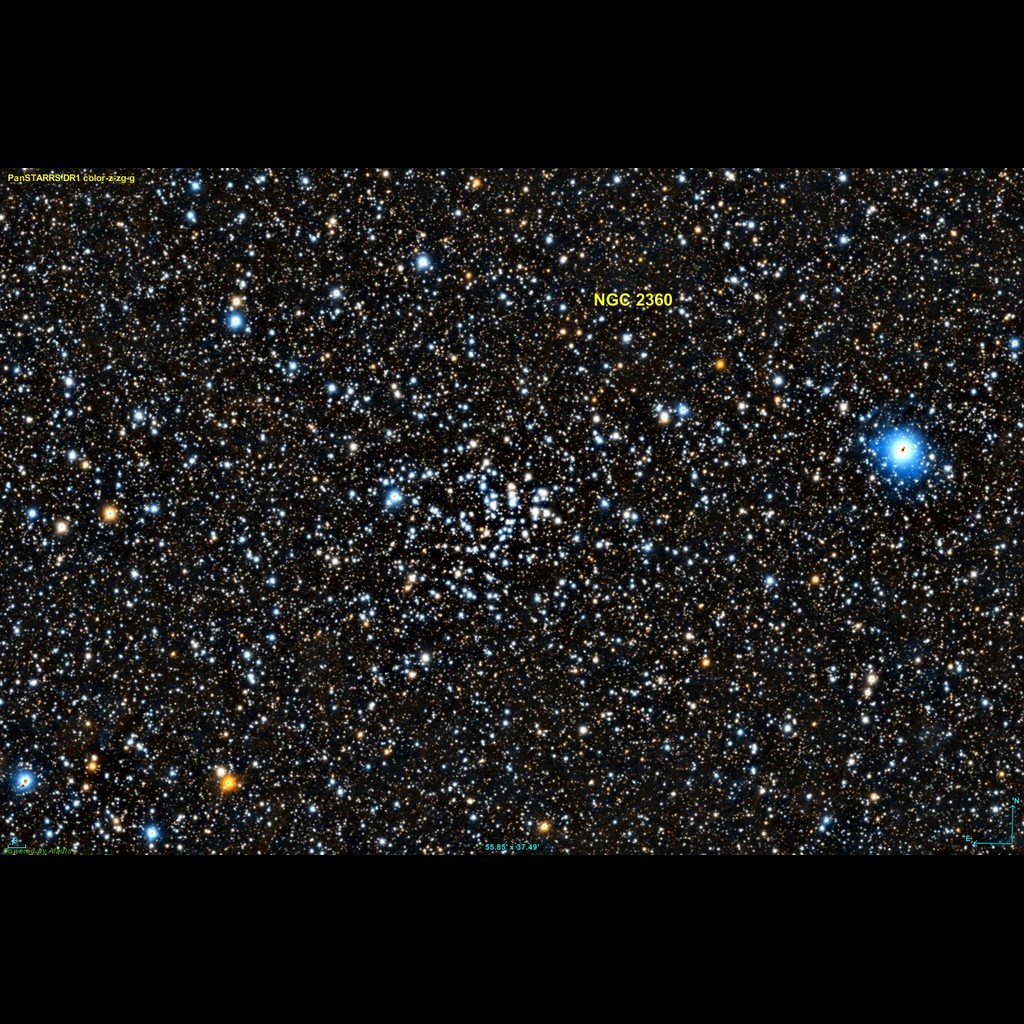
Donald Pelletier / Pan-STARRS - CC SA
| Type | Open Cluster | Constellation | CMa |
|---|---|---|---|
| Magnitude | 7.2 | Size | 13.0′ |
| Distance | 3,700 light-years | Best Month | February |
| Visibility | Global | Difficulty | Easy (level 2/4) |
| Min. Aperture | binoculars | RA / Dec | 07h 17m 49.2s · -15° 37' 48" |
| Discovered by | Caroline Herschel, 1783 | ||
Donald Pelletier / Pan-STARRS - CC SA
Caldwell 58, widely known as Caroline's Cluster (NGC 2360), is a brilliant open star cluster located in the constellation Canis Major. It was discovered by Caroline Herschel on February 26, 1783, using a small Newtonian sweeper telescope. In her records, she described it as a "memorable cluster of stars," and it holds historical significance as one of the many deep-sky objects she discovered independently of her brother, William. Located approximately 3,700 light-years away, this cluster sits about 3.5 degrees east of Gamma Canis Majoris, appearing as a compact, rich gathering of stars that stands out beautifully against the surrounding velvet of the winter Milky Way.
The cluster is composed of several hundred stars, ranging from 9th to 12th magnitude, which create a fairly uniform "salt and pepper" appearance in moderate-sized amateur telescopes. Astronomically, Caroline’s Cluster is of great interest because it is relatively old for an open cluster, with an estimated age of 2.2 billion years. Unlike younger clusters that are dominated by hot, blue stars, C58 has had enough time for its most massive members to evolve; consequently, it contains several red giant stars that have exhausted their core hydrogen. This advanced age means the cluster has survived many orbits around the galactic center without being fully disrupted by tidal forces, a testament to its initial density.
Through a small telescope or high-powered binoculars, Caldwell 56 appears as a hazy, shimmering patch, but larger apertures reveal a structure that is somewhat elongated in an east-west direction. The stars are concentrated toward a central core but lack a singular bright central member, giving the impression of a democratic assembly of suns. It serves as an excellent target for discussing the life cycles of stars and the important, often overlooked contributions of Caroline Herschel to the original New General Catalogue (NGC) foundations
Navigate from Alhena toward Canis Major. From Alhena, sweep 18° south into Canis Major.
| Star | Bayer | Mag | Spectral Type | Distance | Meaning |
|---|---|---|---|---|---|
| Sirius | α CMa | -1.44 | A0 · Blue-white main sequence | 8.6 ly | Greek for 'Glowing' or 'Scorching' — the brightest star in the night sky. The ancient Egyptians timed the Nile flood by its heliacal rising. |
| Wezen | η CMa | 1.83 | F8 · Yellow-white supergiant | 1600 ly | Arabic Al-Wazn, 'The Weight' — a yellow-white supergiant so massive that it barely moves across the sky, giving rise to its name. |
| Mirzam | β CMa | 1.98 | B1 · Blue-white giant | 500 ly | Arabic Al-Mirzam, 'The Announcer' — rises just before Sirius, heralding the arrival of the brightest star in the sky. |