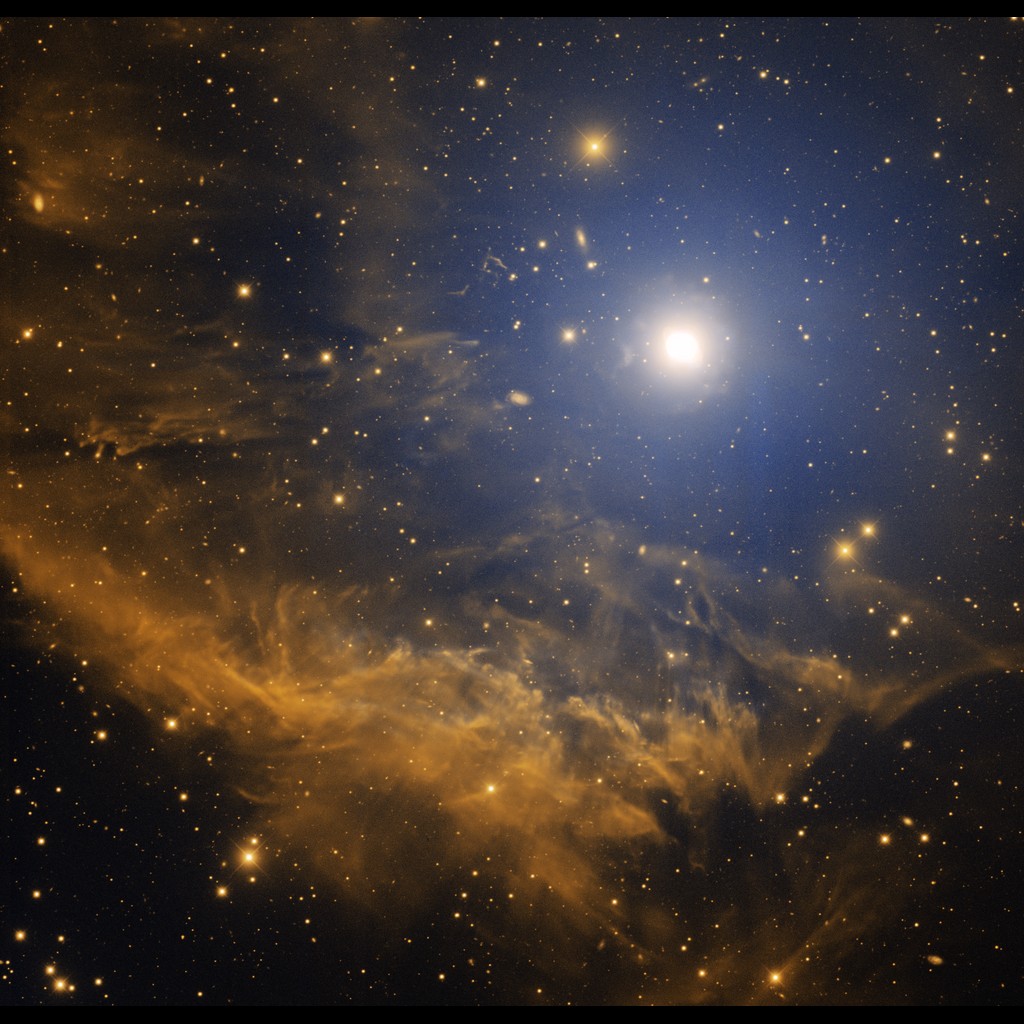
T.A. Rector/University of Alaska Anchorage, H. Schweiker/WIYN and NOIRLab/NSF/AURA/, L. Frattare and Z. Levay/STScI/AURA/NASA
| Type | Planetary Nebula | Constellation | Hya |
|---|---|---|---|
| Magnitude | 7.7 | Size | 0.7′ |
| Distance | 1,400 light-years | Best Month | March |
| Visibility | Global | Difficulty | Easy (level 2/4) |
| Min. Aperture | binoculars | RA / Dec | 10h 24m 46.8s · -18° 37' 48" |
| Discovered by | William Herschel, 1785 | ||
T.A. Rector/University of Alaska Anchorage, H. Schweiker/WIYN and NOIRLab/NSF/AURA/, L. Frattare and Z. Levay/STScI/AURA/NASA
Caldwell 59, NGC 3242, is a striking planetary nebula in the constellation Hydra, famously known as the “Ghost of Jupiter” due to its similar apparent size and blue-green hue to the giant planet. This wide-field image, obtained with the Mosaic Camera on the Mayall 4-meter telescope at Kitt Peak National Observatory on December 15th, 2006, reveals the nebula as the bright, structured object just to the upper-right of center. While the nebula itself is a favorite for amateur observers, this professional view highlights a much more mysterious feature: a vast, extended cloud of gas surrounding the main structure.
The nature of this extended nebulosity is not yet fully understood by astronomers. It may represent an ancient shell of gas that was ejected by the progenitor star long ago during its red giant phase, preceding the formation of the nebula we see today. Alternatively, it could be a nearby cloud of interstellar gas—not physically part of the star's evolution—that is simply being illuminated by the intense radiation of the planetary nebula's central white dwarf. By observing through narrowband filters of Oxygen [OIII] (rendered in blue) and Hydrogen-Alpha (rendered in orange), researchers can trace the different ionization levels and temperatures within these ghostly wisps.
In this orientation, North is to the left and East is down. The Ghost of Jupiter serves as a prime example of the final stages of life for sun-like stars, where the outer layers are cast off into space, creating a complex laboratory of gas and radiation. For your web app, this image provides a rare perspective, showing that these objects are often much larger and more involved with their surroundings than they appear through a typical eyepiece, where only the bright inner core is visible.
Navigate from Regulus toward Hydra. From Regulus, sweep 12° south-southwest into Hydra.
| Star | Bayer | Mag | Spectral Type | Distance | Meaning |
|---|---|---|---|---|---|
| Alphard | α Hya | 1.99 | K3 · Orange giant | 177 ly | Arabic Al-Fard, 'The Solitary One' — the only bright star in Hydra, sitting alone in a sparse region of the sky. |