Local Group Galaxies Survey Team/NOIRLab/NSF/AURA
| Type | Galaxy | Constellation | Sgr |
|---|---|---|---|
| Magnitude | 8.7 | Size | 15.5′ |
| Distance | 1.63 million light-years | Best Month | August |
| Visibility | Global | Difficulty | Challenging (level 4/4) |
| Min. Aperture | 6in | RA / Dec | 19h 26m 49.2s · -14° 48' 00" |
| Discovered by | Edward Emerson Barnard, 1884 | ||
Local Group Galaxies Survey Team/NOIRLab/NSF/AURA
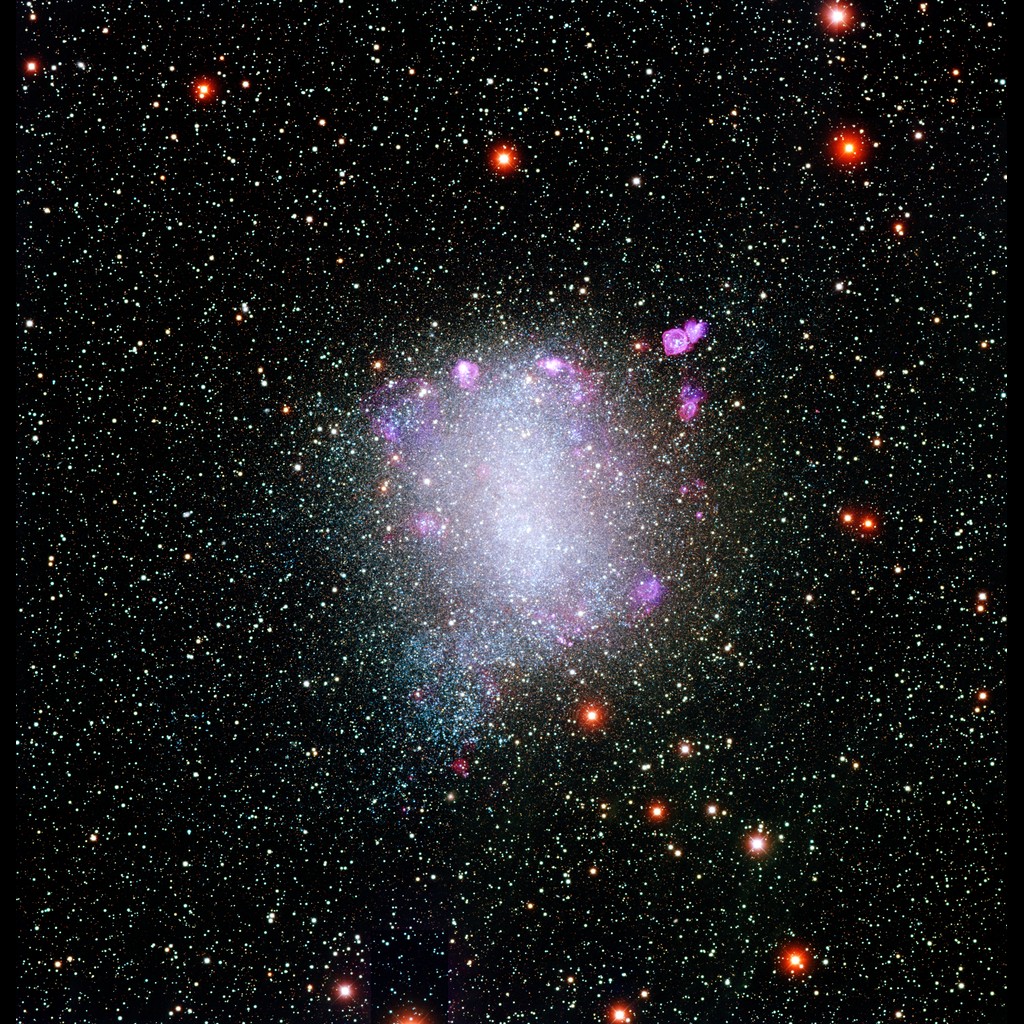
Caldwell 57, also known as NGC 6822 or Barnard's Galaxy, is a standout example of a nearby irregular galaxy. A new color image of this neighbor shows a myriad of hot blue massive stars and several famous nebulae in impressive detail. Located approximately 1.6 million light-years from Earth in the constellation Sagittarius, it is a prominent member of our Local Group. It was discovered by E.E. Barnard in the early 1880s, but it played a pivotal role in 20th-century astronomy when Edwin P. Hubble conducted the first detailed investigation of the galaxy in 1925 using the 100-inch telescope on Mount Wilson. Hubble’s detection of Cepheid variables in NGC 6822 was a landmark moment, providing some of the first definitive proof that "spiral nebulae" were actually distant "island universes" far beyond the Milky Way.
Despite its early importance, an analysis of Hubble’s plates by then-graduate student Susan E. Kayser in 1966 remained the most complete study of this galaxy for decades. This recent investigative leap utilized the National Science Foundation's Blanco 4-meter telescope at Cerro Tololo Inter-American Observatory (CTIO) in Chile. The high-resolution survey reveals the galaxy's chaotic, non-spherical structure, which is characteristic of irregular galaxies that lack a central bulge or spiral arms. Within its boundaries, the intense pinkish-red glows of Hydrogen-alpha regions highlight active star-forming nurseries, where the "hot blue massive stars" mentioned are currently being born from vast clouds of interstellar gas.
This stunning color representation was put together by Travis Rector (NRAO), combining images taken in seven filters: U (violet), B (blue), V (green), R (orange), I (red), Hydrogen-Alpha (red), and Oxygen [OIII] (blue). The data was obtained by CTIO staff members Knut Olsen and Chris Smith, who—along with a distinguished team of astronomers from Lowell Observatory, the University of Washington, and STScI—comprise the "Local Group Galaxies Survey Team." Their work under the NOAO Local Group Galaxies Survey provides a modern, multi-wavelength look at a galaxy that served as a fundamental yardstick in our initial understanding of the scale of the universe.
Navigate from Vega toward Sagittarius. A difficult southern object from mid-northern latitudes — low on the horizon in summer.
| Star | Bayer | Mag | Spectral Type | Distance | Meaning |
|---|---|---|---|---|---|
| Nunki | ζ Sgr | 2.05 | B2 · Blue-white main sequence | 228 ly | Babylonian origin — one of the oldest known star names, from the Babylonian star catalogue. Associated with the sacred city of Eridu. |
| Kaus Borealis | — | 2.82 | K1 · Orange giant | 78 ly | Hybrid Arabic-Latin, 'Northern Bow' — marks the top of the Archer's bow in Sagittarius. Part of the Teapot asterism. |