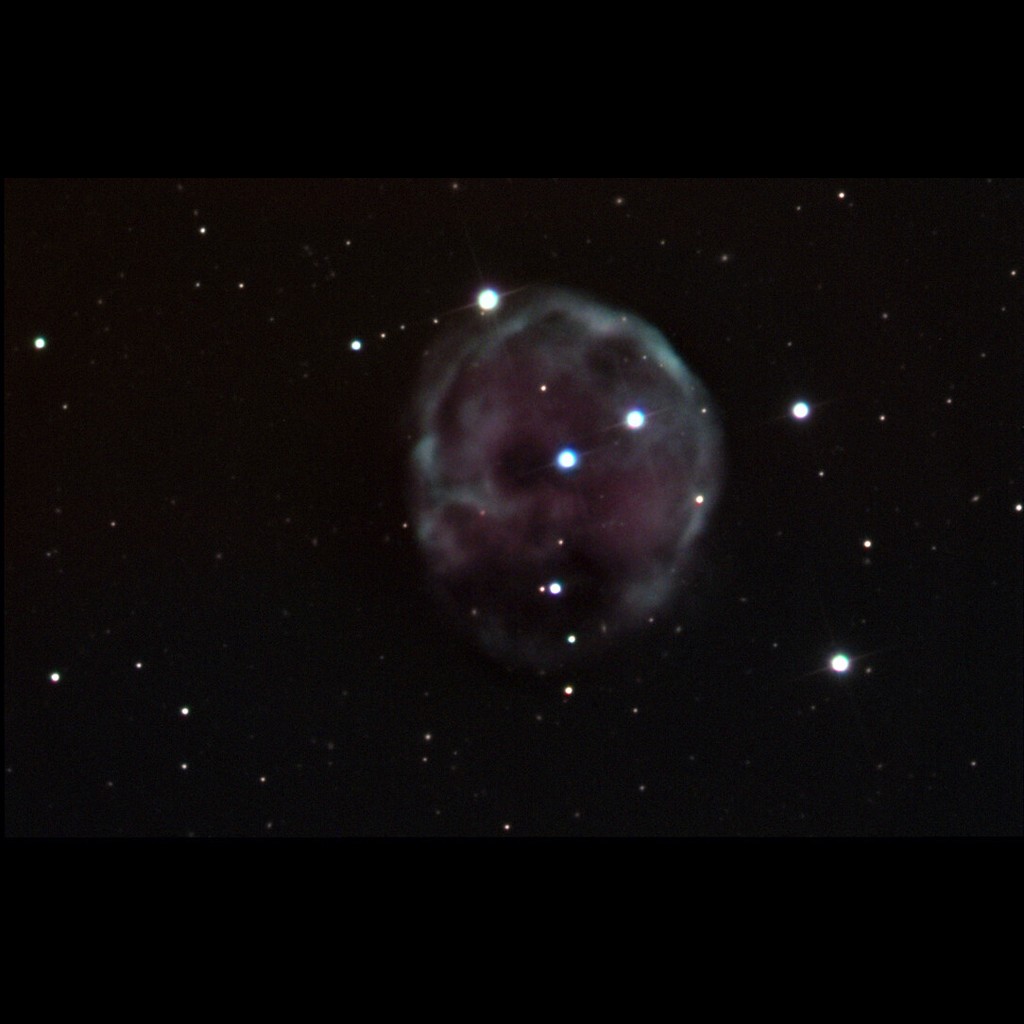
KPNO/NOIRLab/NSF/AURA/Jeff Cremer/Adam Block
| Type | Planetary Nebula | Constellation | Cet |
|---|---|---|---|
| Magnitude | 10.9 | Size | 3.8′ |
| Distance | 1,600 light-years | Best Month | November |
| Visibility | Global | Difficulty | Challenging (level 4/4) |
| Min. Aperture | 6in | RA / Dec | 00h 47m 16.8s · -11° 52' 12" |
| Discovered by | William Herschel, 1785 | ||
KPNO/NOIRLab/NSF/AURA/Jeff Cremer/Adam Block
Caldwell 56, NGC 246 is a rather lonely and large planetary nebula in Cetus. In this example the distorted sphere of gas has many thin and thicker regions giving it an irregular "texture." Like most spherical clouds of gas the outer edges seem brighter than the center which appears void. This is a perspective effect in that more line-of-sight gas is observed towards the outer portions. This phenomenon, known as limb brightening, occurs because the shell of gas is optically thin; looking at the edges, you are peering through a "thicker" wall of the expanding shell than when looking directly through the hollow center.
This specific nebula is often nicknamed the "Skull Nebula" due to the arrangement of internal gas knots and its three central stars, which can appear like eyes and a mouth in amateur telescopes. The central star of C56 is a white dwarf that is exceptionally hot, emitting intense ultraviolet radiation that causes the surrounding gas—ejected thousands of years ago—to glow. Interestingly, NGC 246 is one of the few planetary nebulae known to be associated with a hierarchical triple star system, which likely contributed to the "irregular" and "distorted" texture you noted in the gas clouds.
This image was taken as part of Advanced Observing Program (AOP) program at Kitt Peak Visitor Center during 2014. The AOP is renowned for allowing guests to utilize professional-grade equipment on the mountain to capture deep-sky objects with high clarity, revealing the intricate variations in density that make this nebula stand out against the sparse star field of Cetus..
Navigate from Enif toward Cetus. From Enif, sweep 18° south into Cetus.
| Star | Bayer | Mag | Spectral Type | Distance | Meaning |
|---|---|---|---|---|---|
| Diphda | β Phe | 2.04 | K0 · Orange giant | 96 ly | Arabic Al-Difdi' al-Thānī, 'The Second Frog' — the brightest star in Cetus the Sea Monster, though it marks the whale's tail. |