NOIRLab/NSF/AURA
| Type | Planetary Nebula | Constellation | Aqr |
|---|---|---|---|
| Magnitude | 8.0 | Size | 0.5′ |
| Distance | 2,000 light-years | Best Month | September |
| Visibility | Global | Difficulty | Easy (level 2/4) |
| Min. Aperture | binoculars | RA / Dec | 21h 04m 22.8s · -11° 22' 12" |
| Discovered by | William Herschel, 1782 | ||
NOIRLab/NSF/AURA
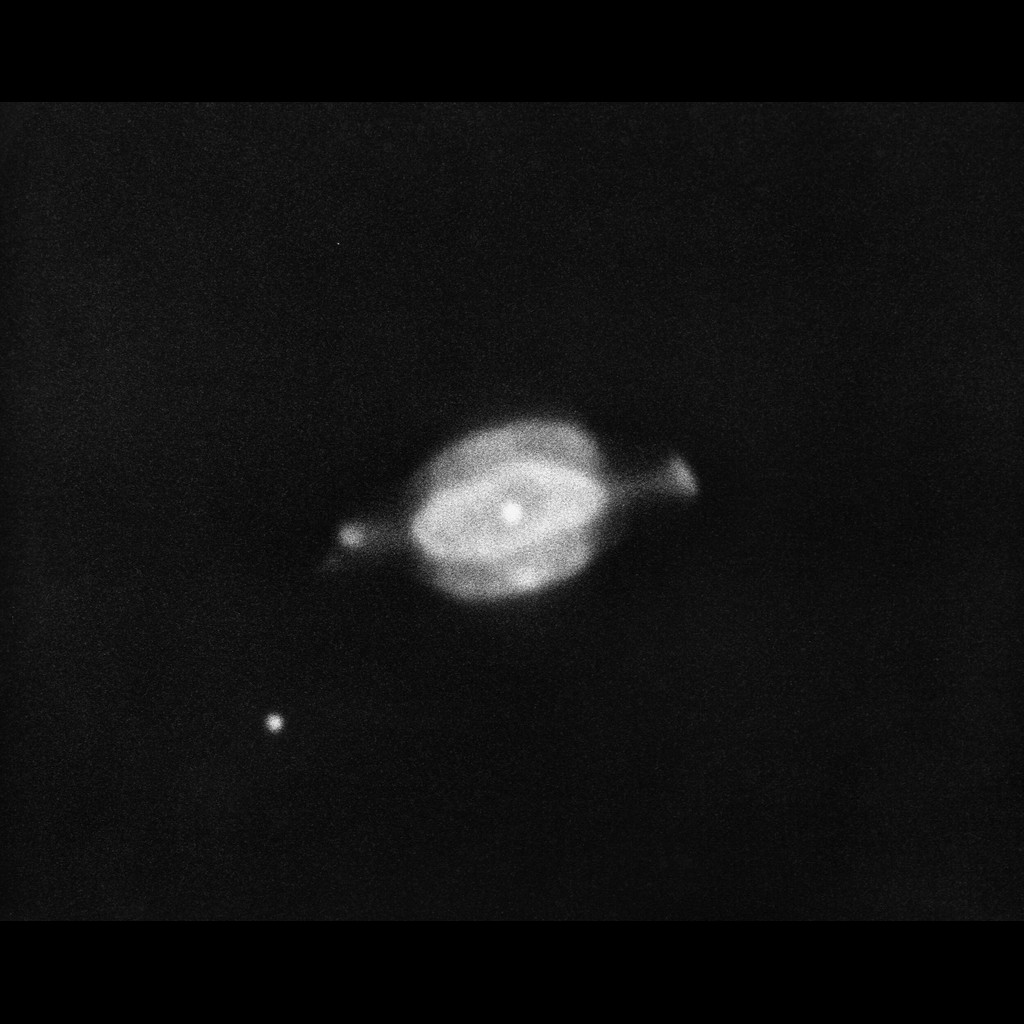
Caldwell 55, NGC 7009, popularly known as the Saturn Nebula, is a stunning planetary nebula located approximately 3,900 light-years away in the constellation Aquarius. It earned its nickname from the 19th-century astronomer Lord Rosse, who noted its striking resemblance to the ringed planet Saturn. This visual illusion is created by "ansae"—lateral extensions or "handles" of glowing gas that project outward from the central nebula, mimicking the appearance of planetary rings viewed edge-on.
Spanning roughly half a light-year in diameter, the nebula is a testament to the dramatic end-of-life stages of a Sun-like star. As the central star exhausted its fuel, it expelled its outer layers into space, which were then ionized by the remaining core’s intense ultraviolet radiation. This process creates the vibrant green and blue hues often seen in images, primarily caused by the glow of doubly ionized oxygen. The nebula is structurally complex, featuring multiple shells of gas, supersonic "fliers" of material, and a hot, brilliant central star.
This iconic view was captured by the KPNO 2.1-meter telescope in 1975, showcasing the nebula's distinct shape and high surface brightness. For observers, Caldwell 55 is one of the brightest planetary nebulae in the sky, appearing as a vivid, slightly elongated disk in small telescopes. Larger apertures and high magnification are required to resolve the delicate ansae that define its namesake "rings," making it a favorite target for testing the limits of atmospheric stability and optical resolution.
Navigate from Enif toward Aquarius. From Enif, sweep 10° south-southeast into Aquarius.
| Star | Bayer | Mag | Spectral Type | Distance | Meaning |
|---|---|---|---|---|---|
| Sadalsuud | α Aqr | 2.90 | G0 · Yellow supergiant | 610 ly | Arabic Sa'd al-Su'ūd, 'Luckiest of the Lucky' — the brightest star in Aquarius, heralding the spring season in ancient Babylonian and Arabian astronomy. |
| Sadalmelik | β Aqr | 2.95 | G2 · Yellow supergiant | 520 ly | Arabic Sa'd al-Malik, 'Lucky Stars of the King' — one of several 'lucky star' names in Aquarius, associated with the spring rains in ancient Arabia. |