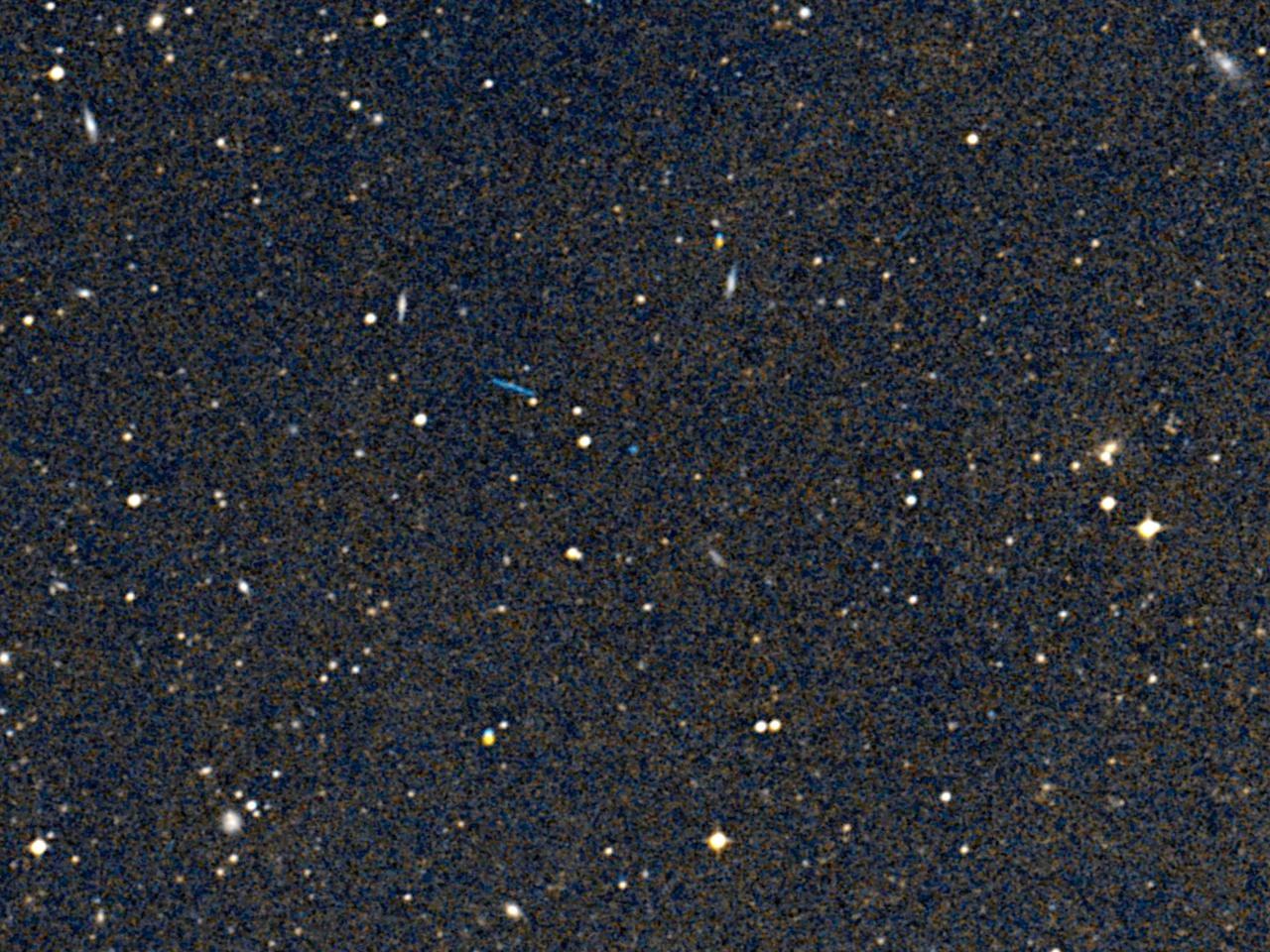
Donald Pelletier / Pan-STARRS - CC SA
| Type | Open Cluster | Constellation | Mon |
|---|---|---|---|
| Magnitude | 7.6 | Size | 7.0′ |
| Distance | 10,000 light-years | Best Month | February |
| Visibility | Global | Difficulty | Moderate (level 3/4) |
| Min. Aperture | 3in | RA / Dec | 08h 00m 10.8s · -10° 46' 12" |
| Discovered by | William Herschel, 1791 | ||
Donald Pelletier / Pan-STARRS - CC SA
Caldwell 54, or NGC 2506, is a beautiful and scientifically significant open star cluster located approximately 11,000 light-years away in the constellation Monoceros. Discovered by William Herschel in 1783, it sits within the outer disk of the Milky Way. Unlike many young, scattered open clusters, NGC 2506 is relatively old, with an estimated age of about two billion years. This maturity makes it a "middle-aged" cluster, offering astronomers a rare look at how groups of stars evolve and eventually disperse over billions of years of galactic rotation.
The cluster is remarkably dense for its type, containing hundreds of stars tightly packed into a region about 12 light-years across. Because of its age and distance from the chaotic galactic center, it has retained a large population of low-mass stars that might have been stripped away in a more crowded environment. It is also a well-known host for several "Blue Stragglers"—stars that appear younger and hotter than they should be for the cluster's age, likely the result of stellar collisions or mass transfers between binary star systems.
For observers, Caldwell 54 is a rich and rewarding target that requires a telescope to truly appreciate. At a magnitude of 7.6, it appears as a shimmering, compressed cloud of stars that stands out well against the background of the winter Milky Way. In larger apertures, the cluster resolves into a complex, "V-shaped" arrangement of stars, revealing its dense core and the subtle variations in stellar color that trace the chemical history of this ancient cosmic family.
Navigate from Alhena toward Monoceros. From Alhena, sweep 12° south into Monoceros.