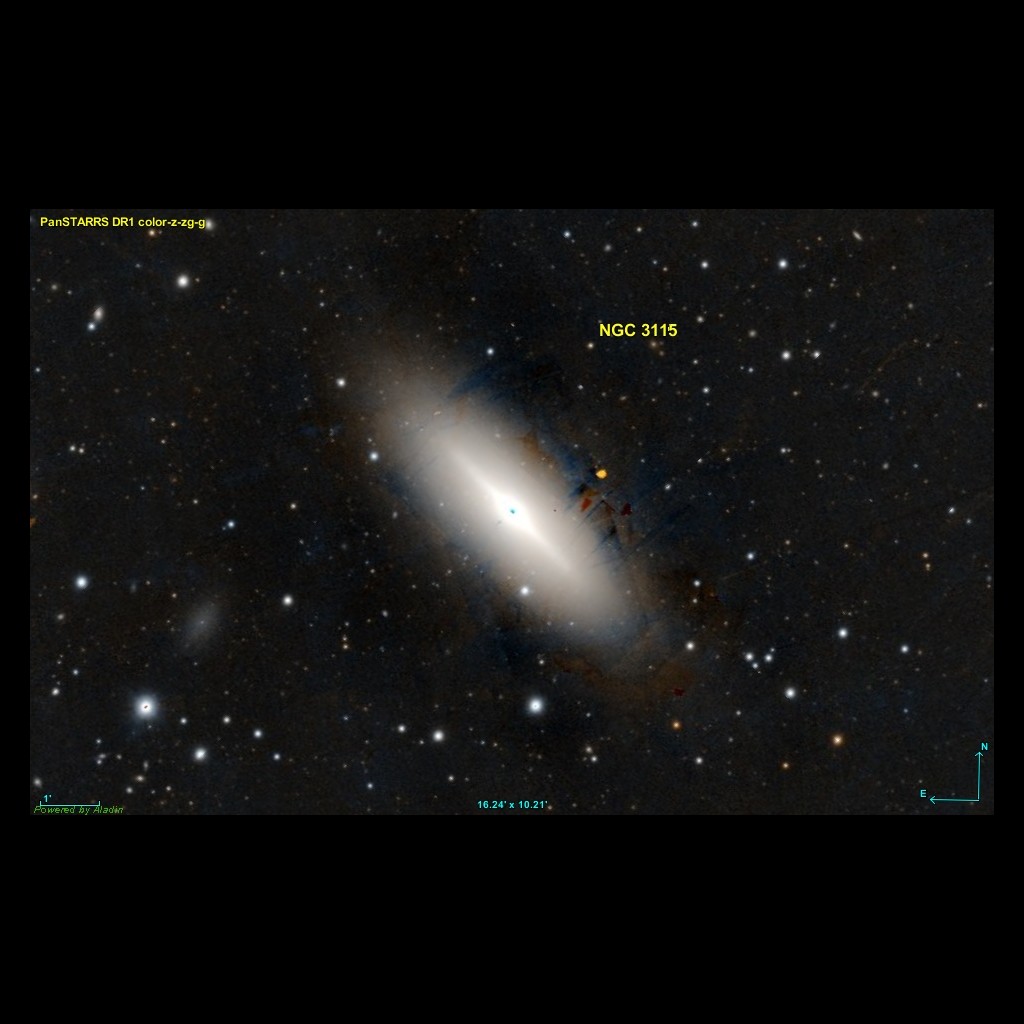
Donald Pelletier / Pan-STARRS - CC SA
| Type | Galaxy | Constellation | Sex |
|---|---|---|---|
| Magnitude | 8.9 | Size | 7.2′ |
| Distance | 32.0 million light-years | Best Month | March |
| Visibility | Global | Difficulty | Easy (level 2/4) |
| Min. Aperture | binoculars | RA / Dec | 10h 05m 06.0s · -07° 43' 12" |
| Discovered by | William Herschel, 1787 | ||
Donald Pelletier / Pan-STARRS - CC SA
Caldwell 53, popularly known as the Spindle Galaxy, is a brilliant lenticular galaxy located about 32 million light-years away in the constellation Sextans. Viewed nearly perfectly edge-on, it appears as a sharp, glowing sliver of light with a prominent central bulge, earning its nickname from its resemblance to a weaver's spindle. Unlike spiral galaxies with gas-rich arms, lenticular galaxies like NGC 3115 have used up or lost most of their interstellar matter, resulting in a disk composed primarily of aging, golden stars with very little ongoing star formation.
At the heart of this "stellar spindle" lies a massive cosmic secret: a supermassive black hole weighing approximately one billion times the mass of our Sun. When it was discovered, it was the most massive black hole known in its weight class relative to the galaxy's total size. Astronomers find NGC 3115 particularly fascinating because the black hole is "dormant," meaning there is very little gas nearby for it to consume, allowing researchers to study the gravitational environment of a black hole without the obscuring glare of an active galactic nucleus.
For observers, Caldwell 53 is a highlight of the spring sky due to its high surface brightness. It is bright enough to be spotted with binoculars under dark skies and reveals its elegant, tapered shape through even modest telescopes. Because it lacks the dust lanes often found in edge-on spirals, the galaxy has a remarkably clean and smooth appearance, serving as a perfect example of a galaxy in a transitional state between a spiral and an elliptical form.,
From Regulus: From Regulus, sweep 11° south into Sextans.
| Star | Bayer | Mag | Spectral Type | Distance | Meaning |
|---|---|---|---|---|---|
| Regulus | α Leo | 1.36 | B7 · Blue-white main sequence | 79 ly | Latin for 'Little King' — one of the four Royal Stars of antiquity, the heart of Leo the Lion. It spins so fast it is noticeably oblate. |
| Alphard | α Hya | 1.99 | K3 · Orange giant | 177 ly | Arabic Al-Fard, 'The Solitary One' — the only bright star in Hydra, sitting alone in a sparse region of the sky. |