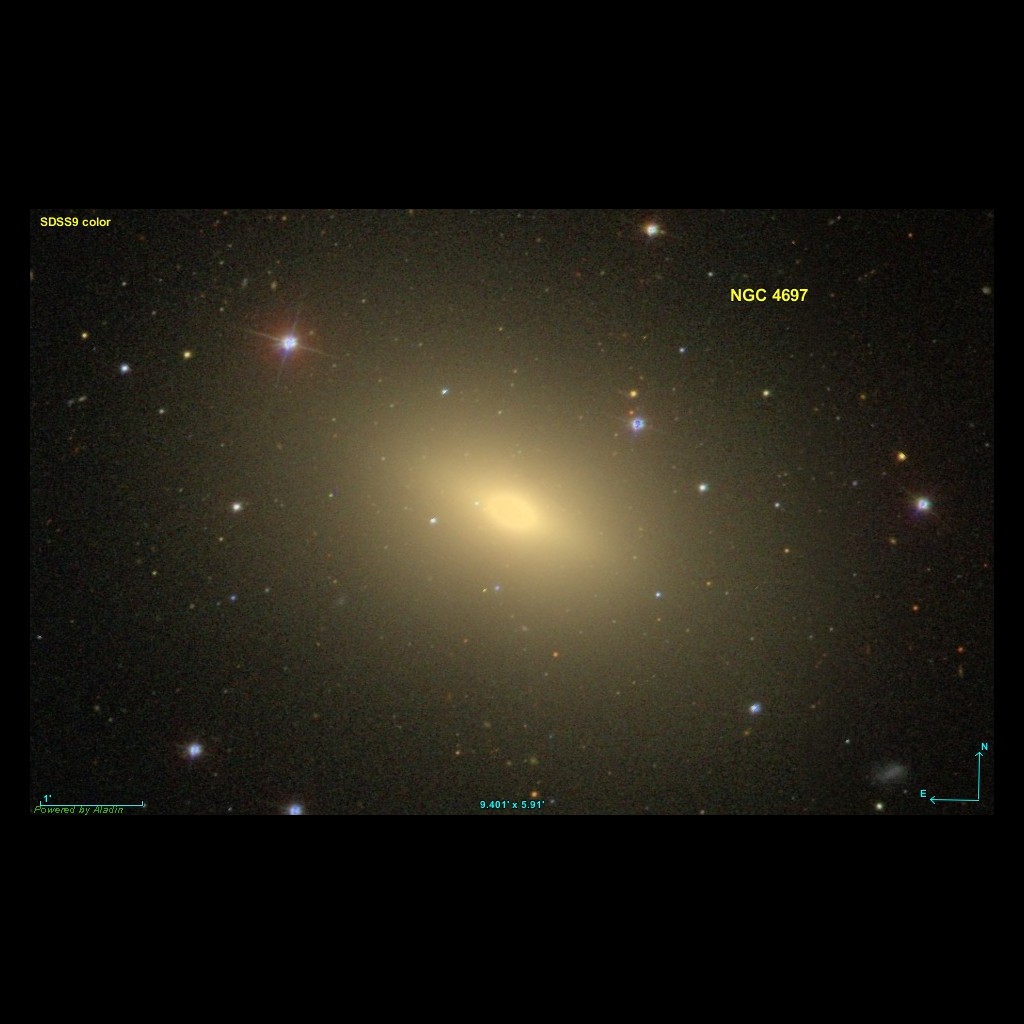
Donald Pelletier / Sloan Digital Sky Survey - CC SA
| Type | Galaxy | Constellation | Vir |
|---|---|---|---|
| Magnitude | 9.3 | Size | 6.0′ |
| Distance | 54.0 million light-years | Best Month | April |
| Visibility | Global | Difficulty | Moderate (level 3/4) |
| Min. Aperture | 3in | RA / Dec | 12h 49m 12.0s · -05° 47' 60" |
| Discovered by | William Herschel, 1784 | ||
Donald Pelletier / Sloan Digital Sky Survey - CC SA
Caldwell 52, cataloged as NGC 4697, is a bright elliptical galaxy located approximately 38 million light-years away in the constellation Virgo. Unlike the dramatic spiral arms seen in many other Caldwell objects, NGC 4697 has a smooth, featureless appearance typical of elliptical systems. It is the dominant member of its own small group of galaxies, known as the NGC 4697 group, and stands out as one of the largest and most luminous elliptical galaxies in the southern part of the Virgo Supercluster.
Despite its outward calm, the galaxy is a center of intense gravitational and high-energy activity. Observations from the Chandra X-ray Observatory have revealed a vast population of "low-mass X-ray binaries"—pairs of stars where a compact object, like a neutron star or black hole, is actively pulling material from a companion star. These sources are scattered throughout the galaxy's ancient stellar population, indicating a complex history of stellar evolution and interactions within its dense core.
For observers, Caldwell 52 is a rewarding target due to its high surface brightness, which makes it easier to spot than many other galaxies at a similar distance. In a telescope, it appears as a glowing, elongated oval that gradually brightens toward a sharp, brilliant nucleus. Astronomers use galaxies like NGC 4697 to study the distribution of dark matter; by measuring the motion of the globular clusters and planetary nebulae orbiting far from its center, they can calculate the invisible mass holding the galaxy together.
From Spica: From Spica, sweep 8° northwest into central Virgo.
| Star | Bayer | Mag | Spectral Type | Distance | Meaning |
|---|---|---|---|---|---|
| Spica | α Vir | 0.98 | B1 · Blue-white binary | 250 ly | Latin for 'Ear of Grain' — Virgo holds a sheaf of wheat. One of the four Royal Stars of antiquity, used by Hipparchus to discover the precession of the equinoxes. |
| Gienah Ghurab | γ Crv | 2.58 | B8 · Blue-white giant | 165 ly | Arabic Al-Janāh al-Ghurāb, 'Wing of the Crow' — the brightest star in Corvus, marking the raven's right wing. |
| Porrima | — | 2.74 | F0 · Yellow-white binary | 38 ly | Named for Porrima, Roman goddess of prophecy. One of the finest equal double stars in the sky — twin yellow-white stars orbiting each other. |
| Algorab | δ Crv | 2.94 | B9 · Blue-white giant | 87 ly | Arabic Al-Ghurāb, 'The Crow' — named for the constellation itself. A wide double star with a faint optical companion. |