DES/DOE/Fermilab/NCSA & CTIO/NOIRLab/NSF/AURA
| Type | Galaxy | Constellation | Cet |
|---|---|---|---|
| Magnitude | 9.3 | Size | 16.2′ |
| Distance | 2.4 million light-years | Best Month | October |
| Visibility | Global | Difficulty | Challenging (level 4/4) |
| Min. Aperture | 8-inch | RA / Dec | 01h 04m 48.0s · +02° 07' 05" |
| Discovered by | Max Wolf, 1906 | ||
DES/DOE/Fermilab/NCSA & CTIO/NOIRLab/NSF/AURA
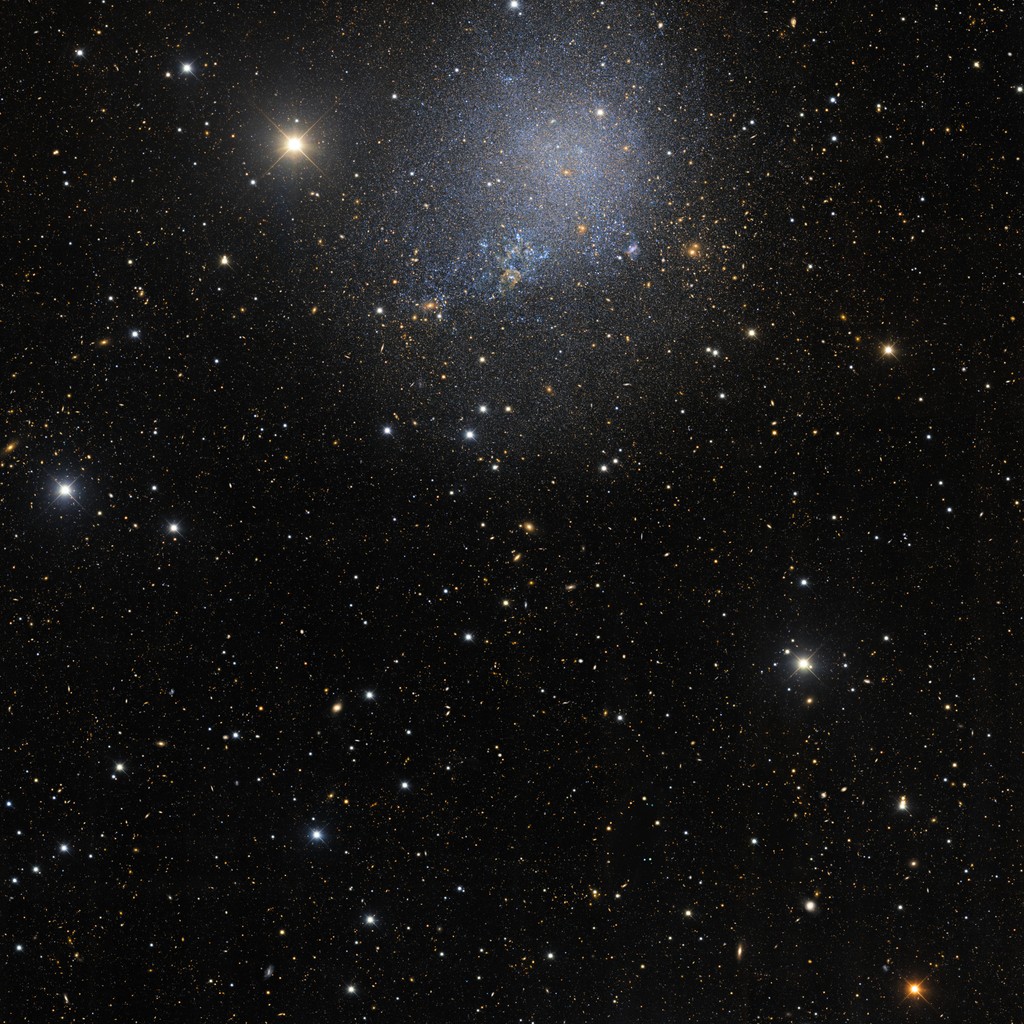
Caldwell 51, or IC 1613, is an irregular dwarf galaxy located approximately 2.3 million light-years away in the constellation Cetus. Containing roughly 100 million stars, it is a vital member of our Local Group, the small neighborhood of galaxies that includes the Milky Way, Andromeda, and the Magellanic Clouds. Because it is relatively nearby and lacks the obscuring dust found in many other galaxies, IC 1613 provides astronomers with an unusually clear window into the lifecycle of stars and the chemical evolution of dwarf systems.
This pristine view is an excerpt from the Dark Energy Survey (DES), a massive global collaboration involving Fermilab, NCSA, and NSF’s NOIRLab. The data was captured using the Dark Energy Camera (DECam), a high-performance instrument fabricated by the Department of Energy and mounted on the Víctor M. Blanco 4-meter Telescope in Chile. The survey's primary mission is to map hundreds of millions of galaxies to better understand the expansion of the universe, but its depth also allows for these incredibly detailed portraits of our closest galactic neighbors.
Beyond its place in the Local Group, IC 1613 is scientifically significant because it contains several types of "standard candles," including Cepheid variables and RR Lyrae stars. These pulsating stars allow astronomers to calibrate the cosmic distance ladder with high precision. Its "irregular" classification comes from its lack of a distinct spiral or elliptical shape; instead, it appears as a scattered, glowing cloud of stars, serving as a reminder of the diverse structures that galaxies can take within our local cosmic backyard.