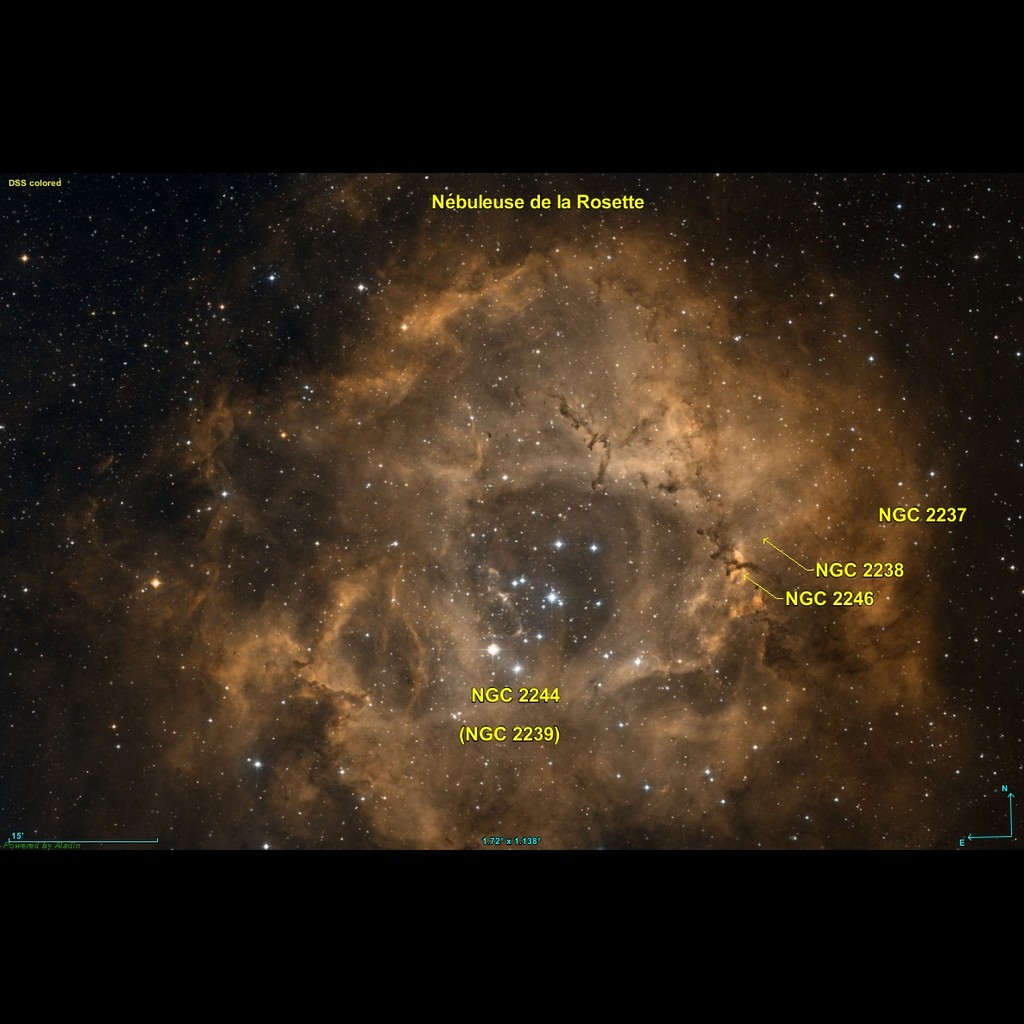
Donald Pelletier - CC BY-SA
| Type | Open Cluster | Constellation | Mon |
|---|---|---|---|
| Magnitude | 4.8 | Size | 24.0′ |
| Distance | 5,200 light-years | Best Month | February |
| Visibility | Northern | Difficulty | Easy (level 2/4) |
| Min. Aperture | binoculars | RA / Dec | 06h 31m 58.8s · +04° 52' 48" |
| Discovered by | John Flamsteed, 1690 | ||
Donald Pelletier - CC BY-SA
Caldwell 50, cataloged as NGC 2244, is the brilliant open star cluster that powers the heart of the Rosette Nebula. Located approximately 5,200 light-years away in Monoceros, these hot, young O-type stars were born from the surrounding nebula roughly two million years ago. Their intense radiation and powerful stellar winds have sculpted the central "hole" in the gas cloud, pushing the material outward and creating the hollowed-out appearance of the celestial rose.
While the Rosette Nebula itself is composed of several cataloged regions—including NGC 2237, 2238, and 2246—Caldwell 50 is the gravitational and energetic anchor of the entire complex. These different NGC designations actually refer to various bright patches of the same continuous cloud of ionized hydrogen. The stars of NGC 2244 are so luminous that they can be seen with the naked eye under dark skies, even when the faint, sprawling nebula remains invisible without a telescope or camera.
For observers and photographers, the interaction between Caldwell 50 and the surrounding gas is a spectacular display of cosmic feedback. The stellar winds from the cluster compress the edges of the neighboring NGC 2237 and 2238 regions, triggering the birth of even newer generations of stars within dark, dense dust lanes. This dynamic relationship makes the entire Rosette complex one of the most famous and photographed deep-sky objects, serving as a perfect laboratory for studying how massive star clusters transform their birth environments.
From Betelgeuse: From Betelgeuse, sweep 12° south-southeast — the cluster is the brightest concentration in this area of Monoceros.
| Star | Bayer | Mag | Spectral Type | Distance | Meaning |
|---|---|---|---|---|---|
| Procyon | β CMi | 0.40 | F5 · Yellow-white main sequence | 11 ly | Greek for 'Before the Dog' — it rises just before Sirius, the Dog Star. One of the three vertices of the Winter Triangle. |
| Betelgeuse | α Ori | 0.45 | M2 · Red supergiant | 700 ly | Arabic Ibt al-Jauzā, 'Armpit of the Central One' — the right shoulder of Orion, a red supergiant expected to explode as a supernova. |
| Bellatrix | γ Ori | 1.64 | B2 · Blue-white giant | 250 ly | Latin for 'Female Warrior' — the left shoulder of Orion. Known in Arabic as Al-Najid, 'The Conqueror.' |
| Alnilam | ε Ori | 1.69 | B0 · Blue-white supergiant | 2000 ly | Arabic Al-Nilam, 'String of Pearls' — the central and brightest of Orion's three belt stars, one of the most luminous stars known. |
| Alnitak | β Tau | 1.74 | O9 · Blue supergiant | 1260 ly | Arabic Al-Nitāq, 'The Girdle' — the easternmost of Orion's three belt stars, near the famous Horsehead Nebula. |
| Alhena | — | 1.93 | A0 · White giant | 109 ly | Arabic Al-Han'ah, 'The Brand' or 'The Mark on a camel's neck.' Marks the foot of Pollux in the Gemini twins. |
| Mintaka | — | 2.25 | O9 · Blue-white giant | 900 ly | Arabic Al-Mintaqa, 'The Belt' or 'The Girdle' — the westernmost of Orion's three belt stars, almost exactly on the celestial equator. |
| Gomeisa | α CMi | 2.89 | B8 · Blue-white main sequence | 170 ly | Arabic Al-Ghumaysā', 'The Weeping One' — in Arabic legend, one of two sisters mourning the death of a great star. The fainter companion to Procyon. |