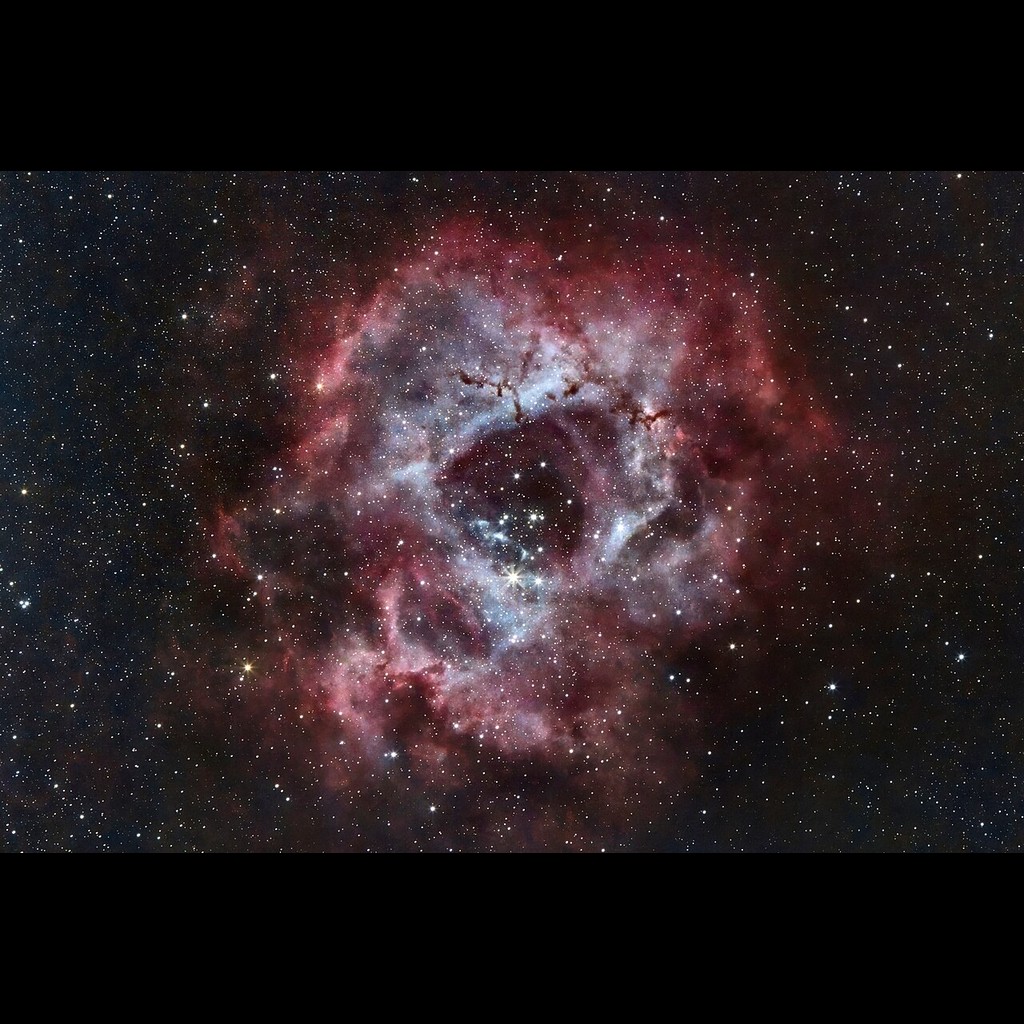
Nialbellcom - CC BY-SA
| Type | Emission Nebula | Constellation | Mon |
|---|---|---|---|
| Magnitude | 6.0 | Size | 80.0′ |
| Distance | 5,200 light-years | Best Month | February |
| Visibility | Northern | Difficulty | Moderate (level 3/4) |
| Min. Aperture | binoculars | RA / Dec | 06h 31m 58.8s · +04° 58' 12" |
| Discovered by | John Flamsteed, 1690 | ||
Nialbellcom - CC BY-SA
Caldwell 49, famously known as the Rosette Nebula, is a colossal star-forming region located approximately 5,200 light-years away in the constellation Monoceros. This stunning emission nebula is shaped like a giant celestial flower, spanning roughly 130 light-years across. The vibrant red glow that defines its "petals" is caused by hydrogen gas being energized by the intense ultraviolet radiation from the hot, young stars nestled at its center.
At the heart of the Rosette lies NGC 2244, an open cluster of massive O-type stars that were born from the nebula's own gas. These stars act like a cosmic wind, blowing a "hole" in the center of the nebula and creating a hollowed-out appearance. The dark, vein-like structures visible throughout the nebula are dense lanes of dust and gas called Bok globules, which are the actual birthplaces where new stars are currently collapsing into existence.
For astrophotographers, Caldwell 49 is a crown jewel of the winter sky. While the nebula itself is quite faint and difficult to see with the naked eye, long-exposure photography reveals its intricate filaments and vast scale. Because it is so large—covering an area of the sky more than three times the diameter of the full moon—it is an ideal target for wide-field telescopes and dedicated nebula filters, which help isolate the specific light of the glowing hydrogen.
From Betelgeuse: From Betelgeuse, sweep 12° south-southeast into Monoceros; the central cluster NGC 2244 is the guide.
| Star | Bayer | Mag | Spectral Type | Distance | Meaning |
|---|---|---|---|---|---|
| Procyon | β CMi | 0.40 | F5 · Yellow-white main sequence | 11 ly | Greek for 'Before the Dog' — it rises just before Sirius, the Dog Star. One of the three vertices of the Winter Triangle. |
| Betelgeuse | α Ori | 0.45 | M2 · Red supergiant | 700 ly | Arabic Ibt al-Jauzā, 'Armpit of the Central One' — the right shoulder of Orion, a red supergiant expected to explode as a supernova. |
| Bellatrix | γ Ori | 1.64 | B2 · Blue-white giant | 250 ly | Latin for 'Female Warrior' — the left shoulder of Orion. Known in Arabic as Al-Najid, 'The Conqueror.' |
| Alnilam | ε Ori | 1.69 | B0 · Blue-white supergiant | 2000 ly | Arabic Al-Nilam, 'String of Pearls' — the central and brightest of Orion's three belt stars, one of the most luminous stars known. |
| Alnitak | β Tau | 1.74 | O9 · Blue supergiant | 1260 ly | Arabic Al-Nitāq, 'The Girdle' — the easternmost of Orion's three belt stars, near the famous Horsehead Nebula. |
| Alhena | — | 1.93 | A0 · White giant | 109 ly | Arabic Al-Han'ah, 'The Brand' or 'The Mark on a camel's neck.' Marks the foot of Pollux in the Gemini twins. |
| Mintaka | — | 2.25 | O9 · Blue-white giant | 900 ly | Arabic Al-Mintaqa, 'The Belt' or 'The Girdle' — the westernmost of Orion's three belt stars, almost exactly on the celestial equator. |
| Gomeisa | α CMi | 2.89 | B8 · Blue-white main sequence | 170 ly | Arabic Al-Ghumaysā', 'The Weeping One' — in Arabic legend, one of two sisters mourning the death of a great star. The fainter companion to Procyon. |