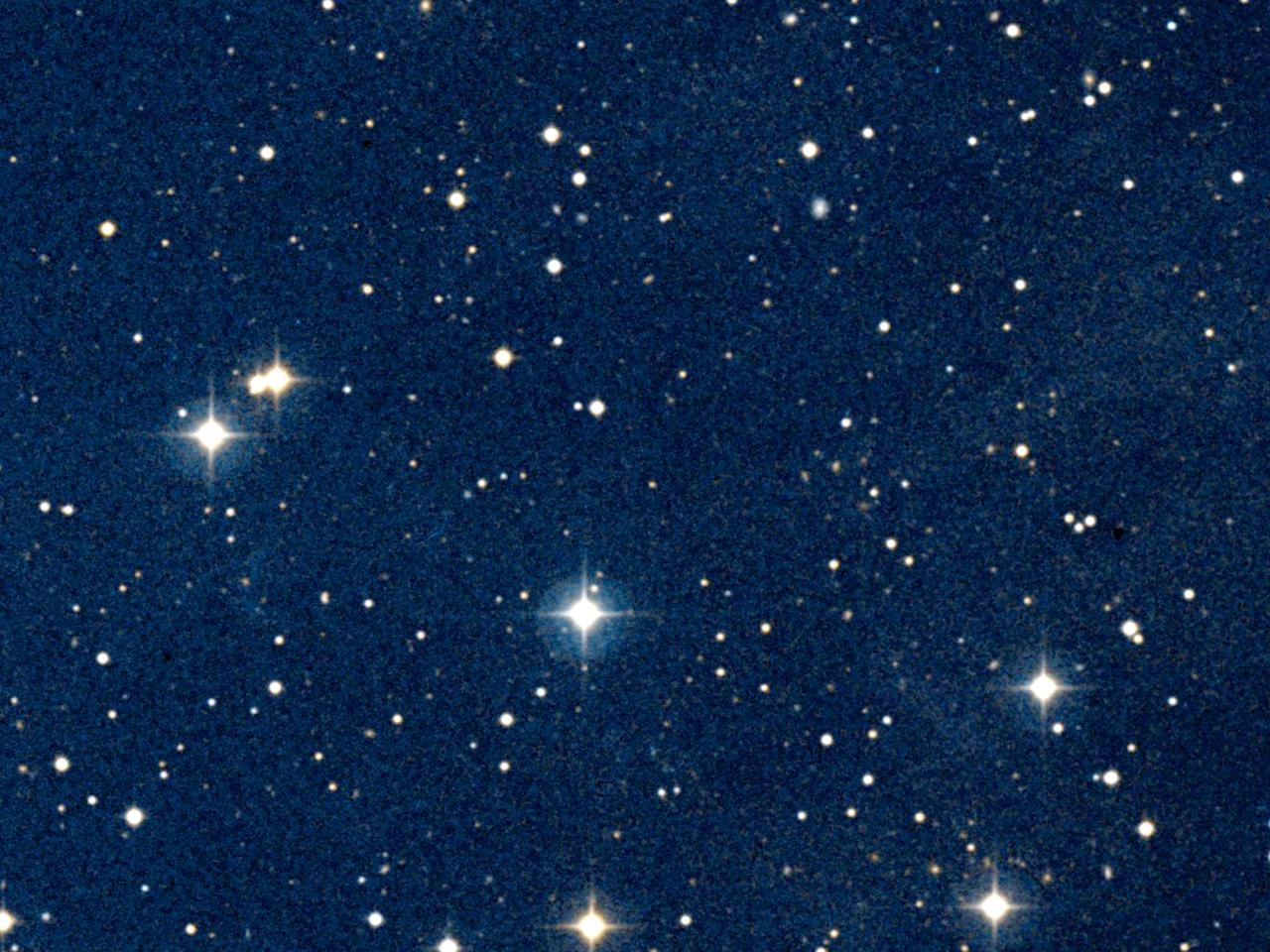
Roberto Mura - CCASA 3.0
| Type | Open Cluster | Constellation | Vul |
|---|---|---|---|
| Magnitude | 8.1 | Size | 7.0′ |
| Distance | 1,800 light-years | Best Month | August |
| Visibility | Northern | Difficulty | Moderate (level 3/4) |
| Min. Aperture | 3in | RA / Dec | 20h 11m 60.0s · +26° 28' 48" |
| Discovered by | William Herschel, 1784 | ||
Roberto Mura - CCASA 3.0
Caldwell 37, cataloged as NGC 6885, is a small, compact open cluster in the constellation Vulpecula, centered on the bright foreground star 20 Vulpeculae. The cluster is sometimes considered to include a larger, sparser grouping designated NGC 6882 in the same field of view, though the relationship between the two is debated. At approximately 1,800 light-years distant and magnitude 8.1, NGC 6885 is a moderately challenging binocular object and is best appreciated with a small telescope at moderate magnification, where its tight core of a dozen or so brighter members begins to stand out against the rich Milky Way background.
The dominant naked-eye star 20 Vul (magnitude 5.9) can make it tricky to gauge the true extent of the cluster, as its brightness tends to overwhelm the fainter members in small instruments. At higher magnification, the cluster reveals a scattering of 7th- to 10th-magnitude stars arranged in a loose grouping around the bright central star. The surrounding field in Vulpecula is exceptionally rich, with dense Milky Way star clouds providing a dramatic backdrop.
NGC 6885 lies in a rewarding region for sweeping — the same area of Vulpecula contains the famous Dumbbell Nebula (M27), making it an easy star-hop target. Patrick Moore included it in the Caldwell catalog as an underappreciated object worth seeking out in this busy stretch of the summer sky, where it rewards observers who take the time to look beyond the more celebrated showpieces nearby.
From Sadr: From Sadr (Gamma Cygni), sweep 6° south into Vulpecula.
| Star | Bayer | Mag | Spectral Type | Distance | Meaning |
|---|---|---|---|---|---|
| Sadr | γ Cyg | 2.23 | F8 · Yellow-white supergiant | 1800 ly | Arabic Al-Sadr, 'The Breast' — marks the center of Cygnus the Swan, where the Northern Cross intersects. Surrounded by the North America Nebula. |
| Gienah | — | 2.48 | K0 · Blue-white giant | 1520 ly | Arabic Al-Janāh, 'The Wing' — marks the wing of Cygnus the Swan, one of several stars sharing this name across different constellations. |
| Tarazed | γ Aql | 2.72 | K3 · Orange giant | 460 ly | Persian Tarāzad, possibly 'The Beam of the Scales' — flanks Altair in Aquila, the bright orange counterpart to the white eagle star. |
| Albireo | β Cyg | 3.05 | K3 · Orange giant + blue companion | 430 ly | Origin uncertain, possibly corrupted Latin or Arabic. Famous as one of the most beautiful double stars in the sky — gold and blue. |
| Sheliak | γ Lyr | 3.52 | A8 · Blue-white eclipsing binary | 960 ly | Arabic Al-Sheliak, 'The Tortoise' or 'The Lyre' — an eclipsing binary in Lyra that was one of the first variable stars discovered, in 1784. |