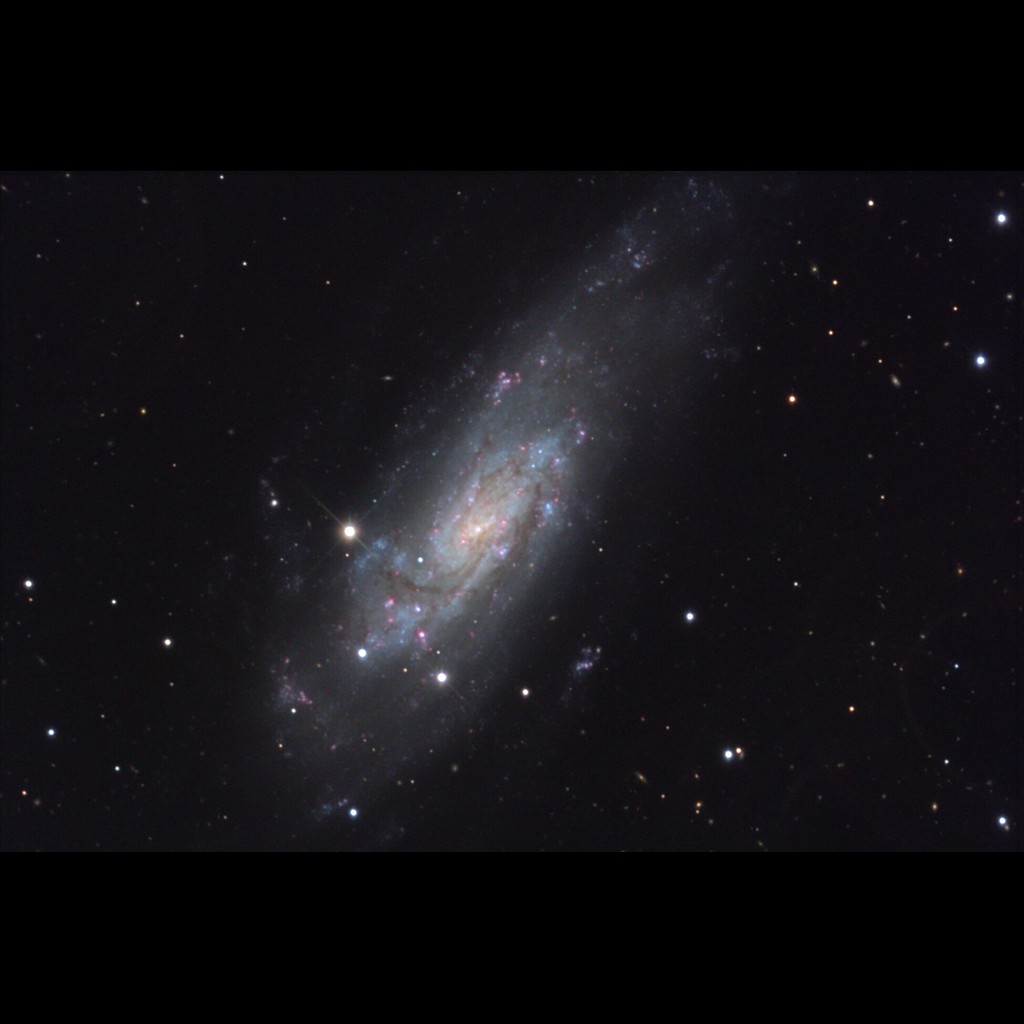
KPNO/NOIRLab/NSF/AURA/Jeff Hapeman/Adam Block
| Type | Galaxy | Constellation | Com |
|---|---|---|---|
| Magnitude | 9.8 | Size | 10.7′ |
| Distance | 29.0 million light-years | Best Month | April |
| Visibility | Northern | Difficulty | Moderate (level 3/4) |
| Min. Aperture | 3in | RA / Dec | 12h 35m 52.8s · +27° 58' 12" |
| Discovered by | William Herschel, 1785 | ||
KPNO/NOIRLab/NSF/AURA/Jeff Hapeman/Adam Block
NGC 4559 is a barred spiral galaxy located approximately 35 million light-years away in the direction of Coma Berenices. Its disk is inclined at roughly 65 degrees to our line of sight, offering an oblique view of the spiral structure that reveals both the sweeping blue arms and the prominent central bar in the same frame. Like many nearby spirals, NGC 4559 displays vivid HII regions — compact, pink star-forming clouds scattered through its arms — as well as extensive dark dust lanes that trace the denser regions of the interstellar medium. A type II supernova (SN 1941A) was observed in this galaxy; from its peak brightness, astronomers estimated a distance of 20 to 30 million light-years, in reasonable agreement with the redshift-based value of roughly 35 million light-years.
The broader field around NGC 4559 is rich with background galaxies and more distant galaxy groups, visible as faint smudges scattered beyond the spiral's disk. The galaxy is a member of the Coma I Cloud, a loose grouping of galaxies in Coma Berenices distinct from the far more massive Coma Cluster lying hundreds of millions of light-years farther away. Deep surveys of the NGC 4559 system have also detected extended X-ray emission from hot gas in the halo above and below the disk, driven outward by the energy of supernova explosions occurring along the star-forming arms.
This image was taken as part of the Advanced Observing Program at the Kitt Peak Visitor Center during 2014. In amateur telescopes, NGC 4559 appears as an elongated oval glow with a brighter core, spanning about 10 arcminutes along its major axis. Moderate apertures of 8 inches or more begin to reveal the mottled texture of its star-forming arms under dark skies, and the galaxy's tilted orientation gives it a distinctive appearance that distinguishes it clearly from more face-on spirals in the rich Coma Berenices field.
Navigate from Arcturus toward Coma Berenices. From Arcturus, sweep 23° west-northwest into the Coma Berenices galaxy field.
| Star | Bayer | Mag | Spectral Type | Distance | Meaning |
|---|---|---|---|---|---|
| Cor Caroli | — | 2.89 | A0 · White main sequence | 110 ly | Latin for 'Heart of Charles' — named to honor King Charles II of England. The brightest star in Canes Venatici. |