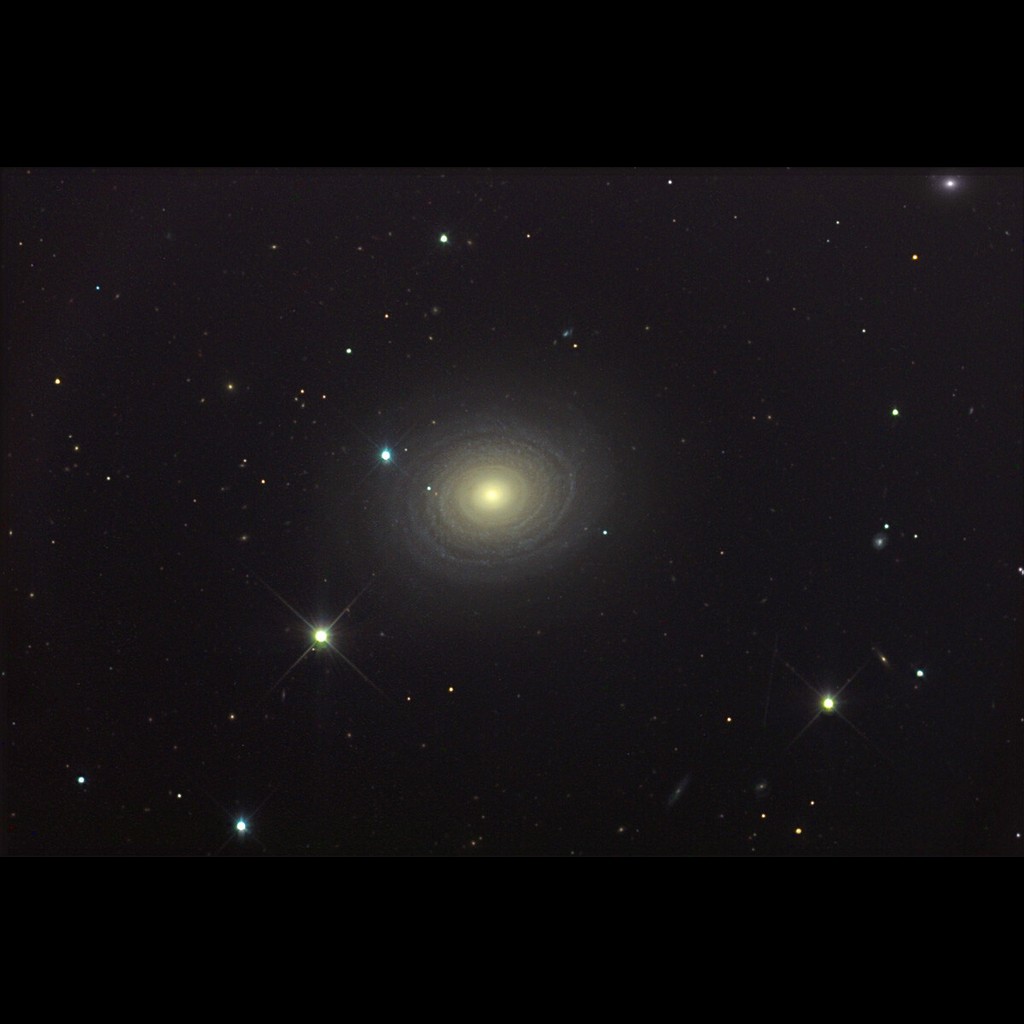
KPNO/NOIRLab/NSF/AURA/Tony Kriz/Adam Block
| Type | Galaxy Cluster | Constellation | Com |
|---|---|---|---|
| Magnitude | 11.4 | Size | 2.0′ |
| Distance | 308.0 million light-years | Best Month | April |
| Visibility | Northern | Difficulty | Challenging (level 4/4) |
| Min. Aperture | 10in | RA / Dec | 13h 00m 00.0s · +27° 58' 12" |
| Discovered by | William Herschel, 1785 | ||
KPNO/NOIRLab/NSF/AURA/Tony Kriz/Adam Block
At an estimated distance of 90 million light years away NGC 488 is an intriguing galaxy despite its distance from us. This galaxy displays subtle and tightly wound blue spiral arms with a yellowish core. Astronomers that have recently observed this galaxy note that the stars in the disk are orbiting the galaxy at a break-neck speed of 360km/s. If this number seems large to you- bear in mind you are orbiting the center of the Milky Way at 220 km/s. By studying the velocity distribution of stars in a galaxy like this astronomers attempt to answer fundamental questions concerning the structure of spiral galaxies. For example, observations of this galaxy confirm that it is the process of star formation (molecular clouds) and not the kinematic motions of stars that determine the spiral appearance of spiral galaxies. Other galaxies similar to NGC 488 include NGC 2841 and NGC 7217.
This image was taken as part of Advanced Observing Program (AOP) program at Kitt Peak Visitor Center during 2014.
From Arcturus: From Arcturus, sweep 24° west-northwest into Coma Berenices.
| Star | Bayer | Mag | Spectral Type | Distance | Meaning |
|---|---|---|---|---|---|
| Arcturus | α Boo | -0.05 | K2 · Orange giant | 37 ly | Greek Arktouros, 'Guardian of the Bear' — it follows Ursa Major across the sky. The brightest star in the northern hemisphere. |
| Denebola | — | 2.14 | A3 · White main sequence | 36 ly | Arabic Dhanab al-Asad, 'Tail of the Lion' — marks the lion's tail. One of the few stars where infrared excess suggests a debris disk. |
| Izar | ε Boo | 2.35 | A0 · Orange giant + blue companion | 203 ly | Arabic Al-Izār, 'The Veil' or 'The Loincloth.' One of the finest double stars visible in small telescopes — orange and blue-green. |
| Mufrid | β Boo | 2.68 | G0 · Yellow subgiant | 37 ly | Arabic Al-Mufrid, 'The Solitary Star of the Lancer' — close companion to brilliant Arcturus in the sky, though not physically related. |
| Cor Caroli | — | 2.89 | A0 · White main sequence | 110 ly | Latin for 'Heart of Charles' — named to honor King Charles II of England. The brightest star in Canes Venatici. |