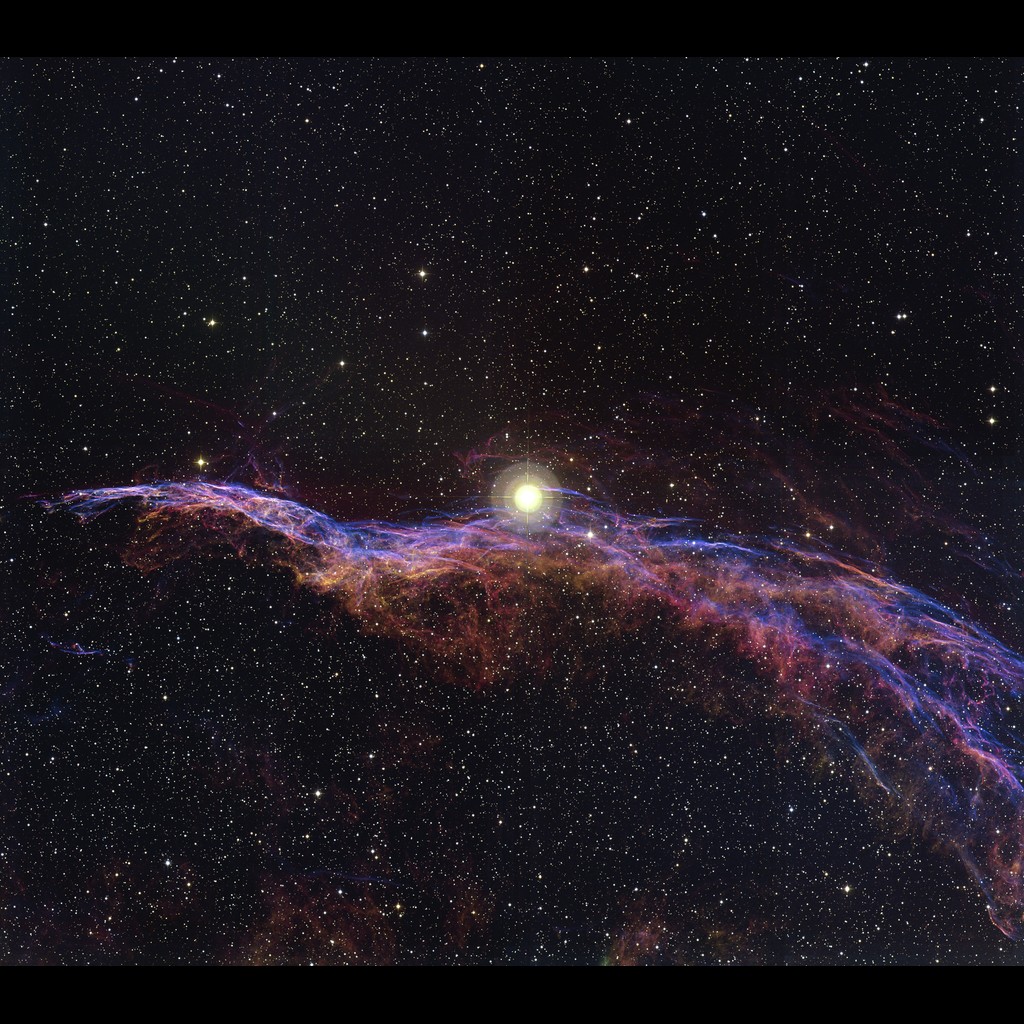
T. A. Rector/University of Alaska Anchorage and WIYN/NOIRLab/NSF/AURA
| Type | Supernova Remnant | Constellation | Cyg |
|---|---|---|---|
| Magnitude | 7.0 | Size | 70.0′ |
| Distance | 2,100 light-years | Best Month | August |
| Visibility | Northern | Difficulty | Easy (level 2/4) |
| Min. Aperture | binoculars | RA / Dec | 20h 45m 32.4s · +30° 43' 12" |
| Discovered by | William Herschel, 1784 | ||
T. A. Rector/University of Alaska Anchorage and WIYN/NOIRLab/NSF/AURA
This image of the Veil Nebula was taken with the Mosaic camera on the WIYN 0.9-meter telescope at Kitt Peak National Observatory. The Veil Nebula (NGC 6960) is part of a supernova remnant known as the Cygnus Loop — the shattered remains of one, and possibly two, supernovae that exploded more than 15,000 years ago at a distance of 2,500 light-years in the direction of the constellation Cygnus. At the time of the original explosion, the dying star would have rivaled the crescent Moon in brightness. The bright star near the center of the image, 52 Cygni, is not associated with the supernova but happens to lie along the same line of sight. The color image was generated from narrowband filters: hydrogen-alpha assigned red, [OIII] blue, and [SII] green. North is to the left and east is down.
The Veil Nebula complex — which includes both this western arc (NGC 6960) and the eastern arc (NGC 6992) — traces the expanding shock front of the Cygnus Loop, which now spans about 3 degrees on the sky, or roughly six times the apparent diameter of the full Moon. As the shock wave travels outward at around 170 kilometers per second, it heats the surrounding interstellar gas to temperatures of millions of degrees, producing X-ray emission, while the optical filaments mark the cooler, compressed edges of the expanding shell. The Cygnus Loop is estimated to be between 10,000 and 20,000 years old and will continue expanding for hundreds of thousands of years before gently merging with the surrounding interstellar medium.
Visually, NGC 6960 is one of the most spectacular objects in the autumn sky when observed with an OIII filter, which suppresses sky glow and dramatically enhances the delicate filamentary nebulosity. The bright star 52 Cygni serves as a convenient finder and anchor for the western arc. Binoculars equipped with an OIII filter reveal the arc on a transparent night; larger telescopes resolve the extraordinary lacework of intersecting filaments that give the Veil its otherworldly visual texture and make it one of the most photographed nebulae in the sky.
From Gienah: From Gienah, move 4° south-southwest — 52 Cygni, the bright star embedded in the nebula, is easy to locate.
| Star | Bayer | Mag | Spectral Type | Distance | Meaning |
|---|---|---|---|---|---|
| Sadr | γ Cyg | 2.23 | F8 · Yellow-white supergiant | 1800 ly | Arabic Al-Sadr, 'The Breast' — marks the center of Cygnus the Swan, where the Northern Cross intersects. Surrounded by the North America Nebula. |
| Gienah | — | 2.48 | K0 · Blue-white giant | 1520 ly | Arabic Al-Janāh, 'The Wing' — marks the wing of Cygnus the Swan, one of several stars sharing this name across different constellations. |
| Albireo | β Cyg | 3.05 | K3 · Orange giant + blue companion | 430 ly | Origin uncertain, possibly corrupted Latin or Arabic. Famous as one of the most beautiful double stars in the sky — gold and blue. |