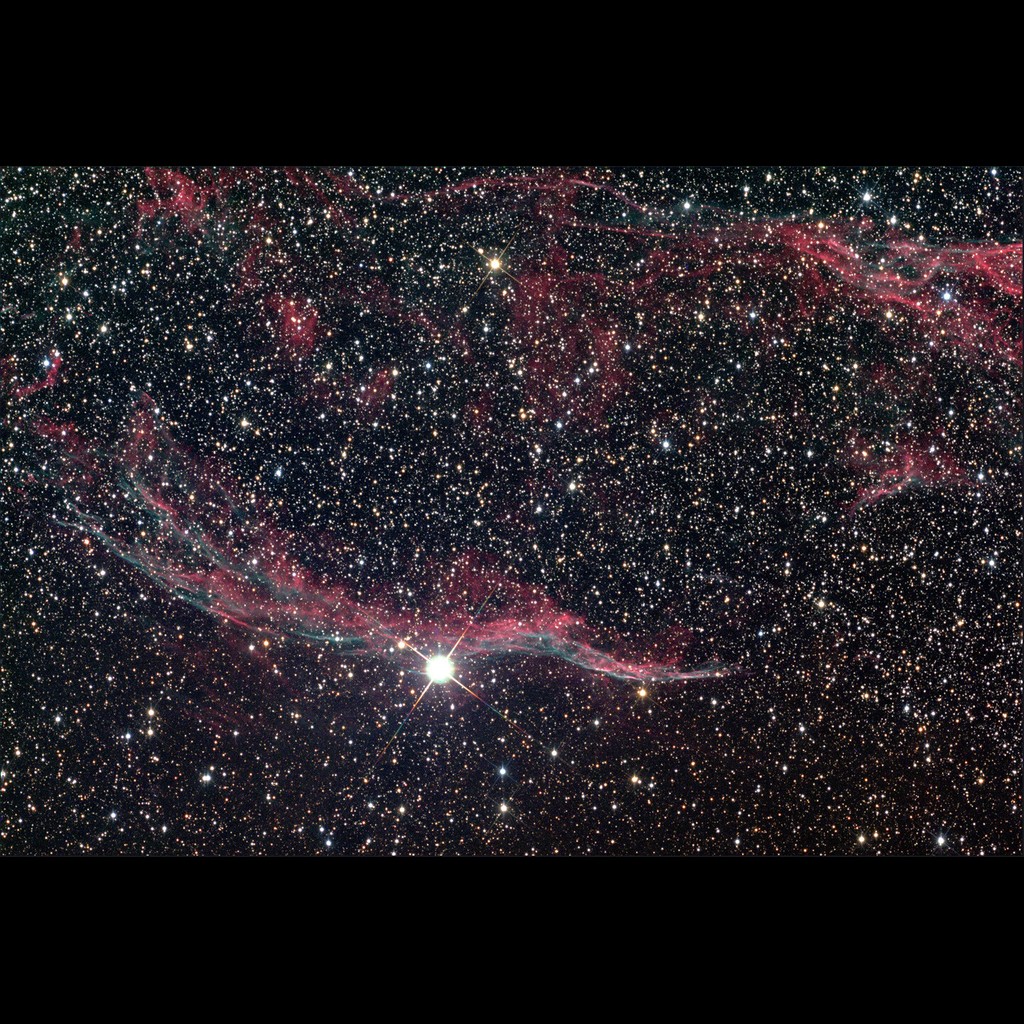
KPNO/NOIRLab/NSF/AURA/Terry Keller/Adam Block
| Type | Supernova Remnant | Constellation | Cyg |
|---|---|---|---|
| Magnitude | 7.0 | Size | 60.0′ |
| Distance | 2,100 light-years | Best Month | August |
| Visibility | Northern | Difficulty | Easy (level 2/4) |
| Min. Aperture | binoculars | RA / Dec | 20h 56m 24.0s · +31° 43' 12" |
| Discovered by | William Herschel, 1784 | ||
KPNO/NOIRLab/NSF/AURA/Terry Keller/Adam Block
Caldwell 33 is the Eastern Veil Nebula, cataloged as NGC 6992, a sweeping arc of glowing filaments forming the eastern portion of the Cygnus Loop supernova remnant. These delicate threads of gas are the expanding shell of material ejected by a massive star that exploded roughly 15,000 to 20,000 years ago, at a distance of approximately 2,600 light-years. The angular extent of the entire Cygnus Loop is enormous — over 3 degrees across — reflecting both its great age and its relatively close proximity, and the Eastern Veil is the brightest and most visually dramatic portion of the remnant. This image was taken as part of the Advanced Observing Program (AOP) at the Kitt Peak Visitor Center in 2014.
The delicate filamentary structure seen in NGC 6992 is the result of the supernova blast wave plowing into the surrounding interstellar medium. Where the shock front meets denser knots of gas, it ionizes the material and causes it to glow — hydrogen in red, oxygen in blue-green — creating the intricate lacework pattern that makes the Veil Nebula one of the most photogenic objects in the sky. In photographs taken through narrowband filters, the structure resolves into extraordinary detail, with braided and twisted filaments that betray the turbulent hydrodynamics of a shock wave that has been expanding for millennia.
The companion object, the Western Veil Nebula (C34, NGC 6960), runs along the bright star 52 Cygni on the opposite side of the loop. Together they form one of the finest supernova remnants accessible to northern observers. Despite the nebula's low surface brightness, the Eastern Veil can be detected in binoculars under dark skies using an OIII filter, and small telescopes reveal the delicate filaments in striking detail — a ghostly reminder that the stars themselves have violent endings.
From Gienah: From Gienah (Epsilon Cygni), sweep 3° south — the Eastern Veil wraps around this area of sky.
| Star | Bayer | Mag | Spectral Type | Distance | Meaning |
|---|---|---|---|---|---|
| Sadr | γ Cyg | 2.23 | F8 · Yellow-white supergiant | 1800 ly | Arabic Al-Sadr, 'The Breast' — marks the center of Cygnus the Swan, where the Northern Cross intersects. Surrounded by the North America Nebula. |
| Gienah | — | 2.48 | K0 · Blue-white giant | 1520 ly | Arabic Al-Janāh, 'The Wing' — marks the wing of Cygnus the Swan, one of several stars sharing this name across different constellations. |