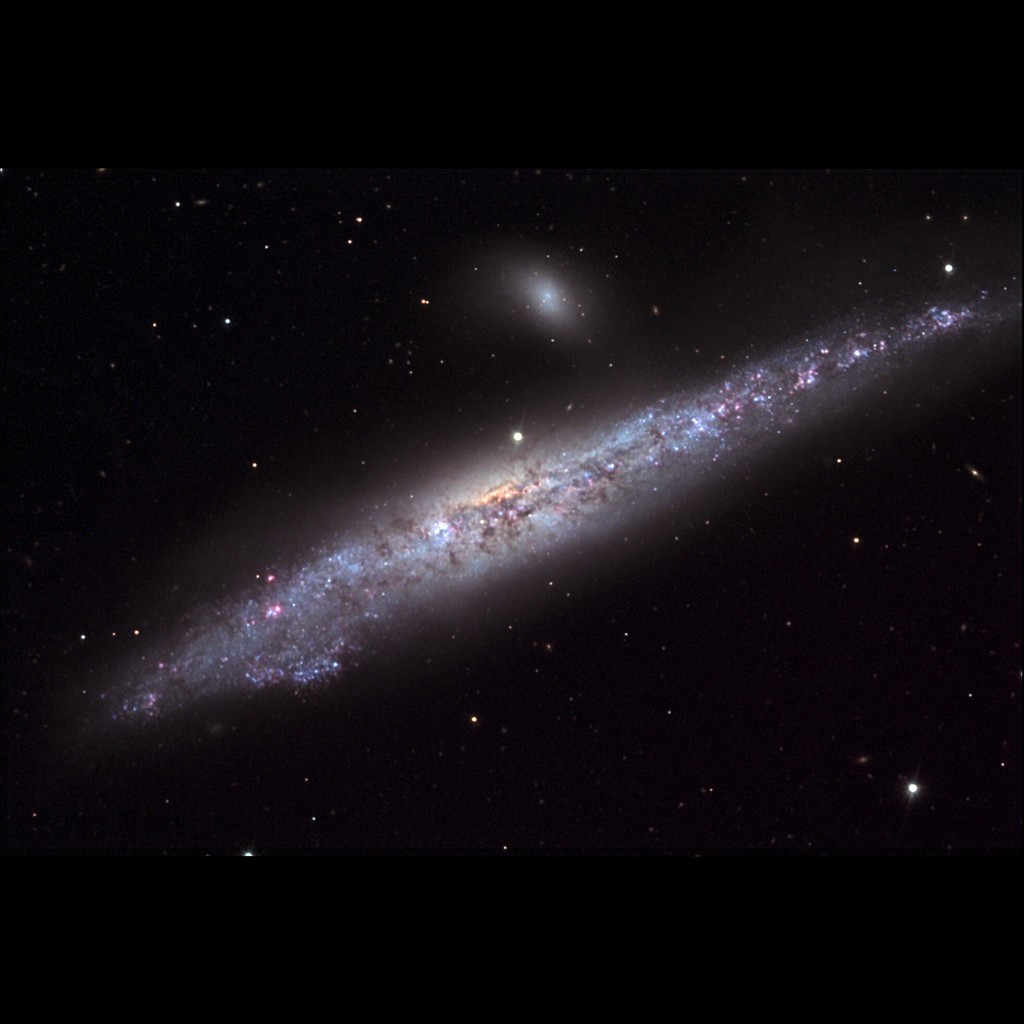
KPNO/NOIRLab/NSF/AURA/John Vickery and Jim Matthes/Adam Block
| Type | Galaxy | Constellation | CVn |
|---|---|---|---|
| Magnitude | 9.3 | Size | 15.1′ |
| Distance | 25.0 million light-years | Best Month | April |
| Visibility | Northern | Difficulty | Easy (level 2/4) |
| Min. Aperture | binoculars | RA / Dec | 12h 42m 28.8s · +32° 31' 48" |
| Discovered by | William Herschel, 1787 | ||
KPNO/NOIRLab/NSF/AURA/John Vickery and Jim Matthes/Adam Block
Caldwell 32, widely known as the Whale Galaxy (NGC 4631), is a magnificent Sc-type spiral galaxy seen nearly edge-on, located roughly 25 to 30 million light-years away. Its distinctive elongated shape is slightly distorted by the gravitational influence of its smaller companion, NGC 4627; together, this pair is cataloged as Arp 281, and keen observers can spot faint tidal tails stretching between them. Further highlighting this region's complex history, the galaxy NGC 4656 — situated to the southeast — shows significant structural distortions also linked to past tidal interactions with the Whale. Detailed surveys have revealed a tenuous bridge of hydrogen gas connecting these systems, providing tangible evidence of their shared gravitational history. This image was captured as part of the 2014 Advanced Observing Program at the Kitt Peak Visitor Center.
The Whale Galaxy shows striking evidence of galactic-scale superwinds driven by its elevated rate of star formation. X-ray and radio observations have detected hot, metal-enriched gas flowing outward perpendicular to the disk — material ejected by the collective pressure of hundreds of supernova remnants scattered along the actively star-forming disk. Deep hydrogen-alpha imaging reveals arching filaments of ionized gas extending tens of thousands of light-years above the plane, connecting the disk to a faint extraplanar halo. The companion NGC 4627 — a small, elongated elliptical galaxy hovering just above the spine of the Whale — is physically bound, and their mutual gravitational interaction has contributed to the Whale's elevated star formation activity.
In moderate amateur telescopes, the Whale Galaxy appears as a spectacular elongated streak of light, brighter toward the center and tapering to pointed ends — recognizable even in a 4-inch instrument from a dark site. Larger apertures reveal the mottled, irregular brightness distribution along its length, hinting at the star-forming knots and dust concentrations that give the Whale its characteristic texture. The small companion NGC 4627 is detectable as a faint smudge just above the disk in 8-inch and larger telescopes, completing the picture of this dynamically active galactic pair in Canes Venatici.
Navigate from Arcturus toward Canes Venatici. From Arcturus, sweep 22° north-northwest into Canes Venatici.
| Star | Bayer | Mag | Spectral Type | Distance | Meaning |
|---|---|---|---|---|---|
| Cor Caroli | — | 2.89 | A0 · White main sequence | 110 ly | Latin for 'Heart of Charles' — named to honor King Charles II of England. The brightest star in Canes Venatici. |