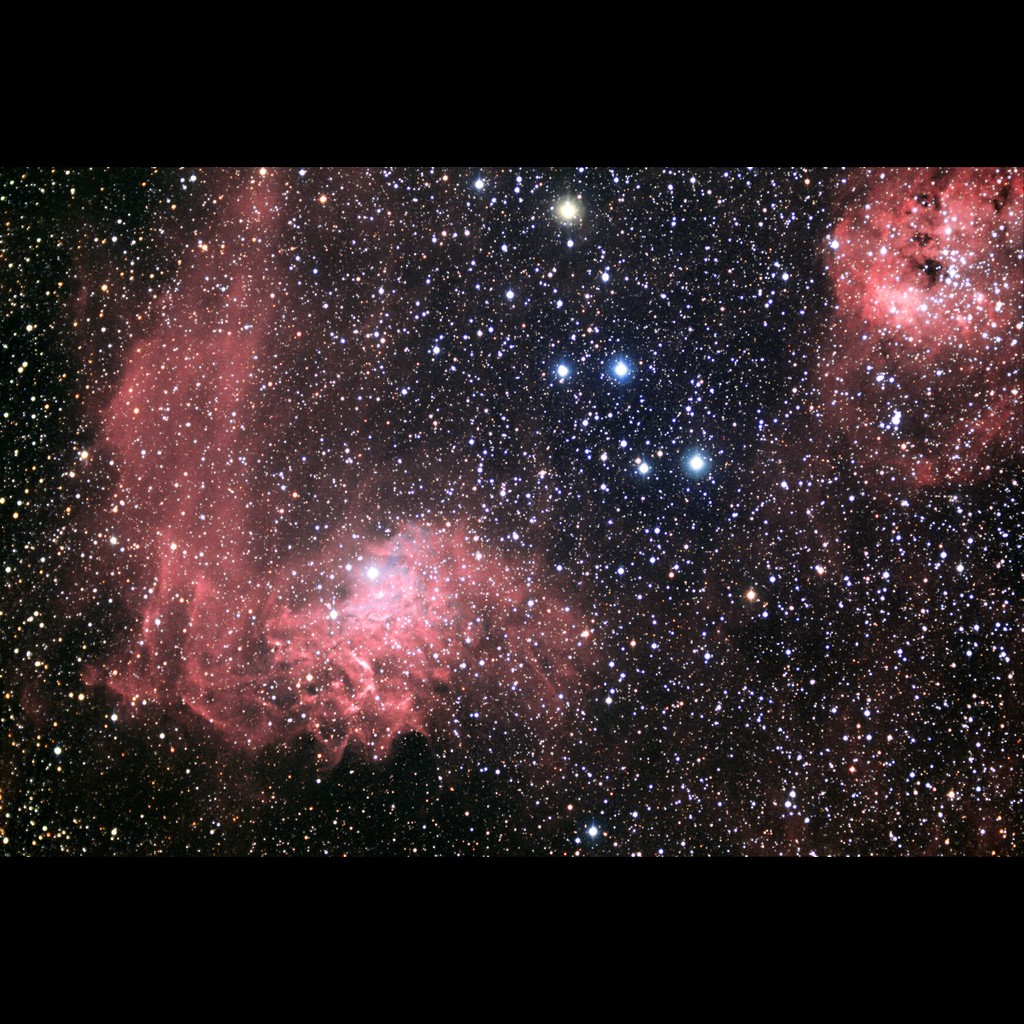
KPNO/NOIRLab/NSF/AURA/Adam Block
| Type | Emission Nebula | Constellation | Aur |
|---|---|---|---|
| Magnitude | 6.0 | Size | 37.0′ |
| Distance | 1,500 light-years | Best Month | January |
| Visibility | Northern | Difficulty | Moderate (level 3/4) |
| Min. Aperture | binoculars | RA / Dec | 05h 16m 04.8s · +34° 16' 12" |
| Discovered by | Wilhelm Tempel, 1892 | ||
KPNO/NOIRLab/NSF/AURA/Adam Block
Caldwell 31, cataloged as IC 405, is a spectacular emission and reflection nebula located in the constellation Auriga, famously known as the Flaming Star Nebula. The nebula is illuminated by the energetic, massive star AE Aurigae, which is currently traversing a dense region of gas and dust, creating the sweeping, flame-like appearance that gives the object its name. The history of this nebula is inextricably linked to the dramatic tale of runaway stars. Approximately 2.7 million years ago, AE Aurigae and another star, Mu Columbae, experienced a violent close encounter within the Great Orion Nebula complex. This event — likely involving a third star — resulted in both objects being ejected at high velocities in opposite directions. Astronomers confirmed their shared origin by tracing their current fast-moving trajectories backward to the same point in space and time. This image was captured as part of the 2014 Advanced Observing Program at the Kitt Peak Visitor Center.
The nebula itself is a complex of both emission and reflection components. The blue regions near AE Aurigae glow by reflecting the star's own light, while the surrounding red areas are excited by the star's intense ultraviolet radiation, causing hydrogen gas to emit its characteristic deep crimson glow. The richly textured surrounding nebulosity is part of a much larger complex of HII regions in Auriga — including the Tadpole Nebula (IC 410) nearby — making this corner of the constellation a rewarding target for wide-field astrophotographers interested in the interplay between young stars and the molecular clouds from which they emerged.
Patrick Moore included the Flaming Star Nebula as the thirty-first entry in his Caldwell catalog, recognizing it as one of the more dramatic emission-reflection nebulae accessible from the northern hemisphere. For visual observers it requires dark skies and moderate aperture to appreciate, but even a glimpse of the faint nebulosity surrounding AE Aurigae rewards the effort. Its combination of colorful emission, blue reflection, and violent stellar backstory makes it one of the most narratively rich objects in the winter sky.
Navigate from Elnath toward Auriga. From Elnath (Beta Tauri), sweep 9° west-northwest into Auriga.
| Star | Bayer | Mag | Spectral Type | Distance | Meaning |
|---|---|---|---|---|---|
| Capella | α Aur | 0.08 | M1 · Yellow giant binary | 43 ly | Latin for 'The Little She-Goat' — the sixth brightest star in the sky, actually a pair of yellow giant stars orbiting each other. |
| Alnath | θ Aur | 1.65 | B7 · Blue-white giant | 134 ly | Arabic Al-Nath, 'The Butting One' — shared with Taurus, marking the tip of the Bull's horn and the foot of Auriga's charioteer. |
| Alnath | θ Aur | 1.65 | B7 · Blue-white giant | 134 ly | Arabic Al-Nath, 'The Butting One' — marks the tip of Taurus's northern horn. It is also shared with Auriga as its foot. |
| Menkalinan | β Aur | 1.90 | A2 · Yellow giant binary | 82 ly | Arabic Mankib dhī al-'Inān, 'Shoulder of the Rein-Holder' — marks Auriga the Charioteer's shoulder. An eclipsing binary pair. |
| Hassaleh | ι Aur | 2.69 | K3 · Yellow supergiant | 870 ly | Arabic Al-Hasalah, possibly 'The Tortoise' — marks the foot of Auriga the Charioteer, a luminous yellow supergiant. |