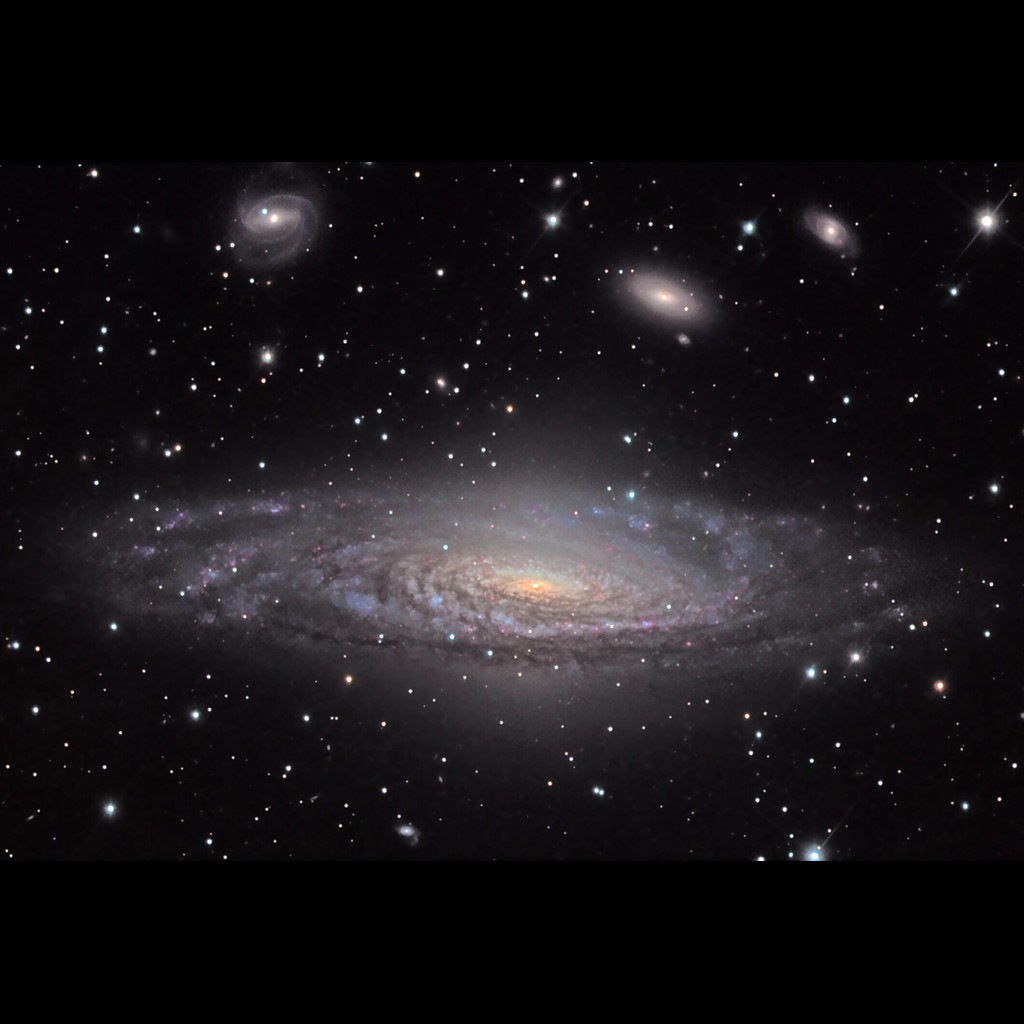
KPNO/NOIRLab/NSF/AURA/Paul Mortfield and Dietmar Kupke/Flynn Haase
| Type | Galaxy | Constellation | Peg |
|---|---|---|---|
| Magnitude | 9.5 | Size | 10.5′ |
| Distance | 49.0 million light-years | Best Month | September |
| Visibility | Northern | Difficulty | Moderate (level 3/4) |
| Min. Aperture | 3in | RA / Dec | 22h 37m 04.8s · +34° 25' 12" |
| Discovered by | William Herschel, 1784 | ||
KPNO/NOIRLab/NSF/AURA/Paul Mortfield and Dietmar Kupke/Flynn Haase
Caldwell 30, cataloged as NGC 7331, is a prominent unbarred spiral galaxy located approximately 49 million light-years away in the constellation Pegasus. Spanning roughly 100,000 light-years in true diameter — comparable in size to the Milky Way — it is often described as one of the finest examples of a large spiral galaxy visible from the northern hemisphere. At magnitude 9.5, it is bright enough to detect in binoculars under dark skies as an elongated patch of light, and a small telescope reveals its bright, star-like nucleus embedded in a soft elliptical haze. This image was captured during the 2014 Advanced Observing Program (AOP) at the Kitt Peak Visitor Center.
One of the most intriguing aspects of NGC 7331 is its unusual rotation: the central bulge rotates in the opposite direction to the disk — a rare kinematic quirk that may trace back to a past merger or the capture of material from a different angular momentum stream. The galaxy also hosts a prominent dust lane along one edge of its inclined disk, and in long-exposure photographs multiple spiral arms can be traced sweeping outward from a well-defined nuclear ring of star formation. A short distance to the southeast in the same field lies the famous Stephan's Quintet (NGC 7317–7320), though that compact galaxy group sits roughly seven times farther away and is unrelated to NGC 7331 physically.
NGC 7331 anchors a small physical group known as the NGC 7331 Group, which includes four smaller lenticular and elliptical galaxies visible in the same field — NGC 7335, 7336, 7337, and 7340 — arranged in a fan shape around the main galaxy. These companions are far enough in the background that they appear comparatively tiny even in deep photographs, offering a satisfying depth-of-field study. For observers progressing through the Caldwell catalog, NGC 7331 is a reliable autumn showpiece that rewards every aperture from binoculars upward.
From Scheat: From Scheat (Beta Pegasi), move 4° north-northwest into northern Pegasus.
| Star | Bayer | Mag | Spectral Type | Distance | Meaning |
|---|---|---|---|---|---|
| Scheat | β Peg | 2.44 | M2 · Red giant | 196 ly | Arabic Al-Sā'id, 'The Upper Arm' — the upper-right corner of the Great Square of Pegasus. A pulsating red giant variable. |
| Matar | ε Peg | 2.93 | G2 · Yellow giant binary | 167 ly | Arabic Al-Maṭar, 'Lucky Stars of Rain' — marks the horse's knee in Pegasus, associated with the rainy season in ancient Arabian astronomy. |