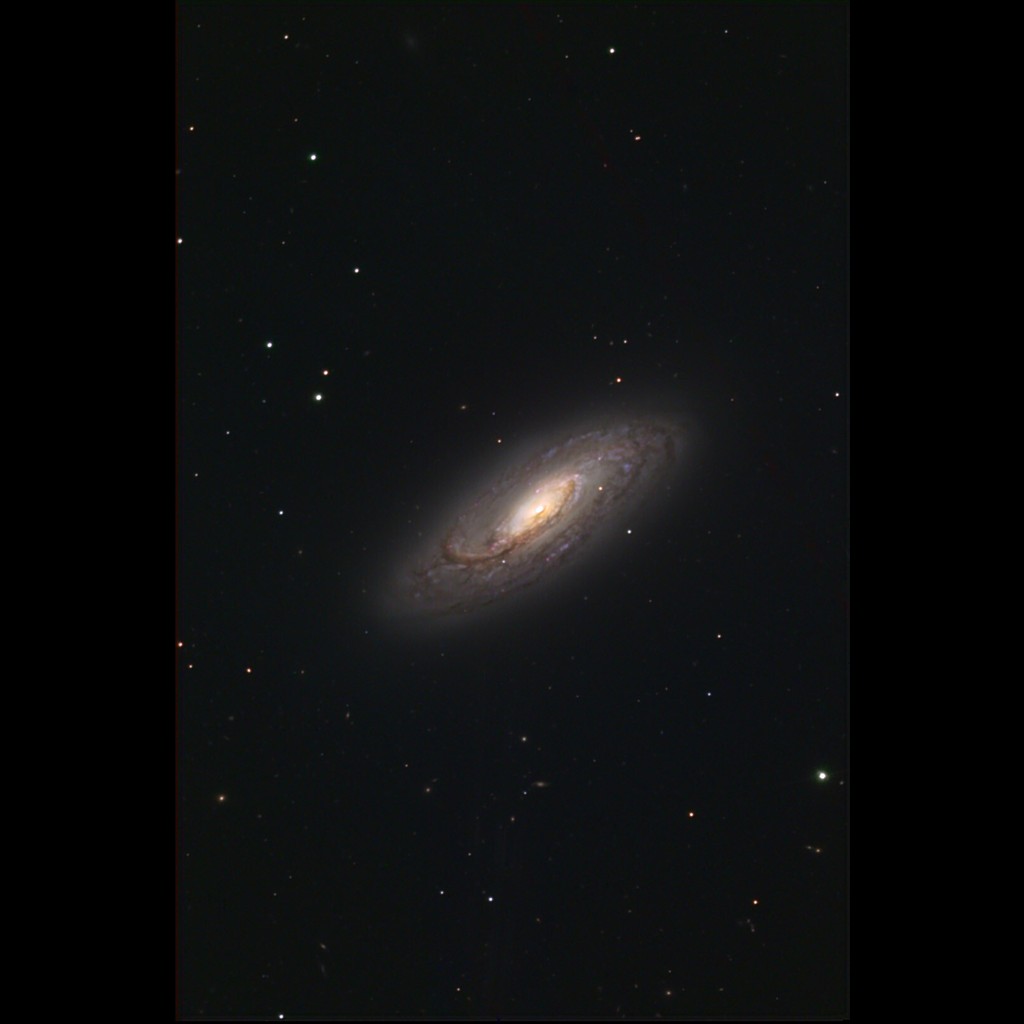
KPNO/NOIRLab/NSF/AURA/Ray and Emily Magnani/Adam Block
| Type | Galaxy | Constellation | CVn |
|---|---|---|---|
| Magnitude | 9.8 | Size | 5.8′ |
| Distance | 65.0 million light-years | Best Month | April |
| Visibility | Northern | Difficulty | Moderate (level 3/4) |
| Min. Aperture | 3in | RA / Dec | 13h 10m 58.8s · +37° 02' 60" |
| Discovered by | William Herschel, 1785 | ||
KPNO/NOIRLab/NSF/AURA/Ray and Emily Magnani/Adam Block
Caldwell 29, cataloged as NGC 5005, is a bright, inclined spiral galaxy situated approximately 65 million light-years away in the constellation Canes Venatici. Renowned for its brilliant, active nucleus and complex, tightly wound spiral arms, it provides a compelling view of galactic morphology, with prominent dust lanes threading through the inner disk that are clearly visible in deep-field photographs. This image was obtained as part of the Advanced Observing Program (AOP) at the Kitt Peak Visitor Center in 2014, highlighting the galaxy's notably high surface brightness and intricate inner structure.
The nucleus of NGC 5005 is classified as a LINER (low-ionization nuclear emission-line region), indicating the presence of a low-level active galactic nucleus powered by accretion onto a central supermassive black hole. This nuclear activity contributes to the galaxy's unusually bright core, which is visible even in small telescopes and makes NGC 5005 stand out among the many galaxies in this part of the spring sky. The tightly wrapped spiral arms, richly laced with dust, are best appreciated in long-exposure photographs that reveal the galaxy's intricate multi-arm pattern and the subtle color gradient from the blue outer arms to the yellow-orange central bulge.
NGC 5005 is a member of a loose group that includes the nearby spiral NGC 5033, which lies just over a degree to the south and fits in the same wide-field eyepiece view. The two make an instructive pair: NGC 5033 is more face-on and shows open spiral arms, while NGC 5005's more inclined angle and tighter winding give it a completely different character. Together they are among the finest galaxy pairs in Canes Venatici, a constellation already rich with showpiece galaxies including M51, M63, and M94.
From Arcturus: From Arcturus, sweep 20° northwest into Canes Venatici.
| Star | Bayer | Mag | Spectral Type | Distance | Meaning |
|---|---|---|---|---|---|
| Arcturus | α Boo | -0.05 | K2 · Orange giant | 37 ly | Greek Arktouros, 'Guardian of the Bear' — it follows Ursa Major across the sky. The brightest star in the northern hemisphere. |
| Alioth | — | 1.76 | A0 · White giant | 83 ly | Arabic origin uncertain, possibly from 'fat tail of a sheep.' The brightest star in Ursa Major and the handle of the Big Dipper. |
| Alkaid | η UMa | 1.85 | B3 · Blue-white main sequence | 101 ly | Arabic Al-Qa'id, 'The Leader of the Daughters of the Bier' — the tip of the Big Dipper's handle, representing the chief mourner in an Arabic funeral procession. |
| Mizar | ζ UMa | 2.23 | A2 · White binary | 83 ly | Arabic Al-Marāq, 'The Groin' — the middle star of the Big Dipper's handle. The first double star discovered through a telescope (1617). |
| Phad | γ UMa | 2.41 | A0 · White main sequence | 84 ly | Arabic Al-Fakhdhah, 'The Thigh of the Bear' — marks the hip of Ursa Major, one of the four bowl stars of the Big Dipper. |
| Mufrid | β Boo | 2.68 | G0 · Yellow subgiant | 37 ly | Arabic Al-Mufrid, 'The Solitary Star of the Lancer' — close companion to brilliant Arcturus in the sky, though not physically related. |
| Cor Caroli | — | 2.89 | A0 · White main sequence | 110 ly | Latin for 'Heart of Charles' — named to honor King Charles II of England. The brightest star in Canes Venatici. |