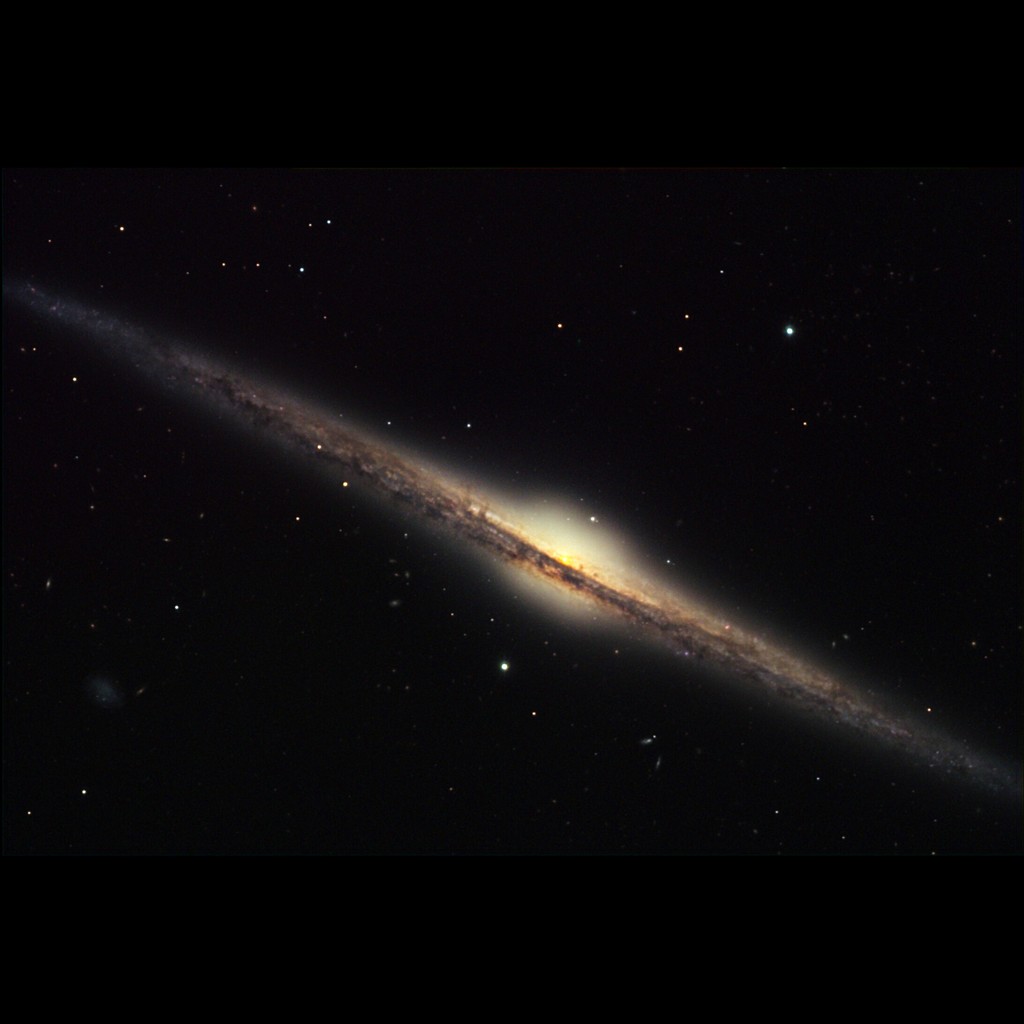
KPNO/NOIRLab/NSF/AURA/Bruce Hugo and Leslie Gaul/Adam Block
| Type | Galaxy | Constellation | Com |
|---|---|---|---|
| Magnitude | 9.6 | Size | 15.9′ |
| Distance | 42.0 million light-years | Best Month | April |
| Visibility | Northern | Difficulty | Moderate (level 3/4) |
| Min. Aperture | 3in | RA / Dec | 12h 36m 10.8s · +25° 58' 48" |
| Discovered by | William Herschel, 1785 | ||
KPNO/NOIRLab/NSF/AURA/Bruce Hugo and Leslie Gaul/Adam Block
Caldwell 38, cataloged as NGC 4565, is one of the finest edge-on spiral galaxies in the sky and is often called the Needle Galaxy for its extraordinarily thin, elongated appearance. Located approximately 49 million light-years away in the constellation Coma Berenices, it spans about 16 arcminutes in its longest dimension — large enough to be detectable in binoculars as a faint smear — and glows at magnitude 9.6. If our own Milky Way were observed from a similar distance and angle, it would present a very similar profile: a bright central bulge bisected by a dark dust lane, flanked by the flat disk of the spiral arms tapering to either side. This image was taken as part of the Advanced Observing Program (AOP) at the Kitt Peak Visitor Center in 2014.
The prominent dark dust lane running along NGC 4565's equatorial plane is one of the defining features of this galaxy in photographs. This lane is the obscuring band of gas and dust that occupies the galactic midplane, reddening and blocking the light from the interior much as the dark rift of our own Milky Way hides portions of the galactic center from view. Above and below this lane, the warmer glow of the galaxy's older stellar population is clearly visible — and careful inspection reveals that the disk is subtly warped on one side, a sign of past gravitational interaction. A small dwarf companion galaxy can also be spotted in deeper images of the field.
NGC 4565 shares its region of the sky with the Needle Galaxy's famous neighbors NGC 891 (C23) and NGC 4244 (C26), forming an informal trio of celebrated edge-on spirals in the spring sky. Of the three, NGC 4565 is the largest and highest surface-brightness, making it the most accessible to visual observers. A 4-inch telescope under dark skies will show its spindle shape clearly; larger instruments reveal the dust lane and the brighter nuclear bulge protruding above and below the disk plane.
Navigate from Arcturus toward Coma Berenices. From Arcturus, sweep 22° west into the Coma Berenices region — the Needle's orientation makes it instantly recognisable.
| Star | Bayer | Mag | Spectral Type | Distance | Meaning |
|---|---|---|---|---|---|
| Denebola | — | 2.14 | A3 · White main sequence | 36 ly | Arabic Dhanab al-Asad, 'Tail of the Lion' — marks the lion's tail. One of the few stars where infrared excess suggests a debris disk. |
| Cor Caroli | — | 2.89 | A0 · White main sequence | 110 ly | Latin for 'Heart of Charles' — named to honor King Charles II of England. The brightest star in Canes Venatici. |