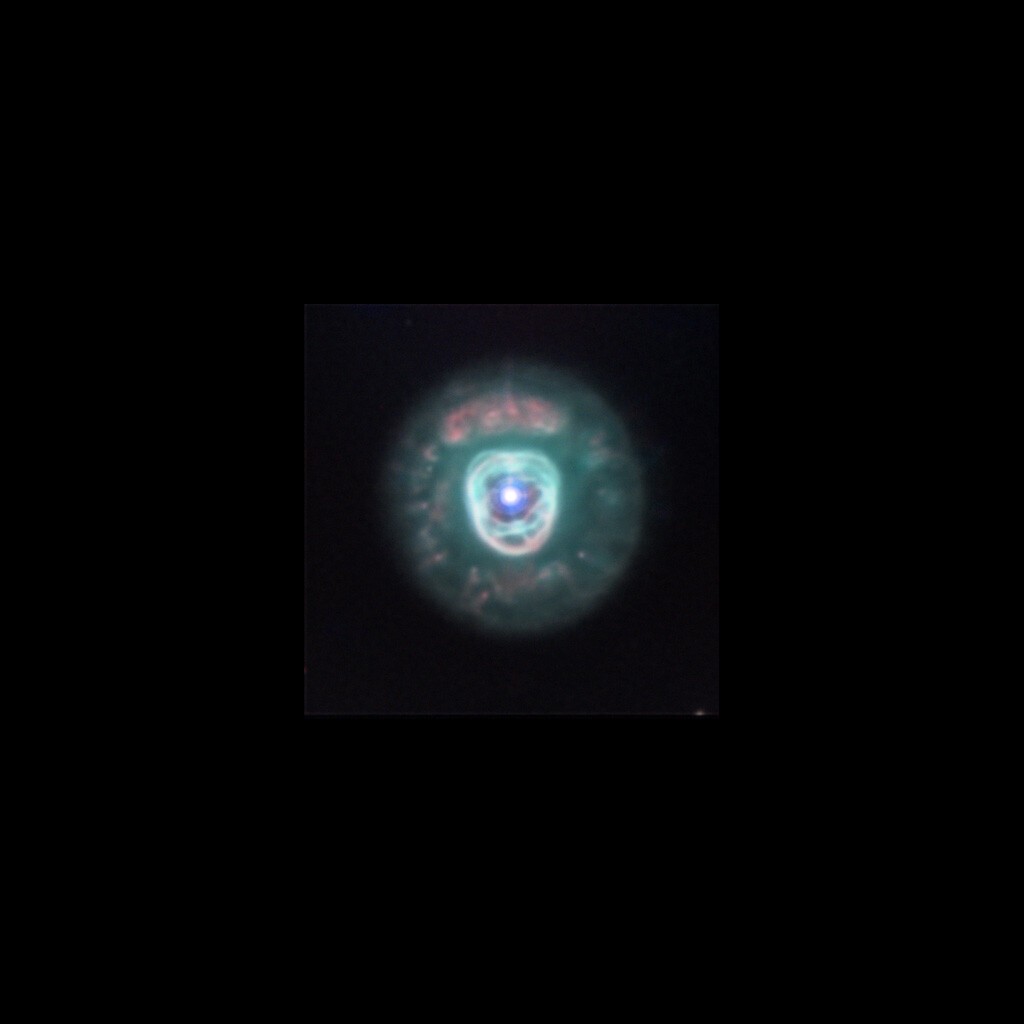
KPNO/NOIRLab/NSF/AURA/Sharon Kempton and Karen Brister/Adam Block
| Type | Planetary Nebula | Constellation | Gem |
|---|---|---|---|
| Magnitude | 9.1 | Size | 0.7′ |
| Distance | 2,870 light-years | Best Month | February |
| Visibility | Northern | Difficulty | Moderate (level 3/4) |
| Min. Aperture | 3in | RA / Dec | 07h 29m 13.2s · +20° 55' 12" |
| Discovered by | William Herschel, 1787 | ||
KPNO/NOIRLab/NSF/AURA/Sharon Kempton and Karen Brister/Adam Block
Caldwell 39, cataloged as NGC 2392, is popularly known as the Eskimo Nebula — named for its resemblance to a face peering out from within a fur-lined parka when seen through a telescope. It is fitting that this planetary nebula rides high in the cold winter sky of the northern hemisphere, shining at magnitude 9.1 from a distance of approximately 3,000 light-years in the constellation Gemini. The bright central star is easily seen even at moderate magnification, surrounded by a well-defined inner disk of ionized gas and the fainter, striated outer shell that forms the "fur" of the parka in the visual analogy.
NGC 2392 is a double-shelled planetary nebula with a complex inner structure. The bright inner disk is sculpted by a fast stellar wind from the central white dwarf, which sweeps outward at roughly 90 km/s and has compressed the surrounding gas into filaments and knots. The outer shell, expanding more slowly, contains a remarkable arrangement of comet-shaped knots — dense clumps of gas with bright heads pointing toward the central star and fainter tails streaming outward — similar in form to the knots seen in the Helix Nebula (C63). This inner-versus-outer shell structure reflects at least two distinct mass-loss episodes in the progenitor star's final years.
This image was taken as part of the Advanced Observing Program (AOP) at the Kitt Peak Visitor Center in 2014. In a small telescope, the Eskimo Nebula appears as a bright blue-green disk — its color coming from doubly ionized oxygen — with the central star visible at around magnitude 10. Under high magnification on a steady night, the inner ring and hints of the outer diffuse halo become apparent, making NGC 2392 one of the most rewarding planetary nebulae to study in detail with a modest instrument.
From Pollux: From Pollux (Beta Geminorum), sweep 3.5° south-southeast into central Gemini.
| Star | Bayer | Mag | Spectral Type | Distance | Meaning |
|---|---|---|---|---|---|
| Pollux | β Gem | 1.16 | K0 · Orange giant | 34 ly | Named for the immortal twin of Greek myth, son of Zeus. The brightest star in Gemini has a confirmed planet — Pollux b — orbiting it. |
| Castor | α Gem | 1.58 | A2 · White sextuple system | 52 ly | Named for one of the divine twins of Greek myth, son of Zeus and brother of Pollux. Actually a sextuple star system — six stars in one. |
| Alhena | — | 1.93 | A0 · White giant | 109 ly | Arabic Al-Han'ah, 'The Brand' or 'The Mark on a camel's neck.' Marks the foot of Pollux in the Gemini twins. |
| Gomeisa | α CMi | 2.89 | B8 · Blue-white main sequence | 170 ly | Arabic Al-Ghumaysā', 'The Weeping One' — in Arabic legend, one of two sisters mourning the death of a great star. The fainter companion to Procyon. |