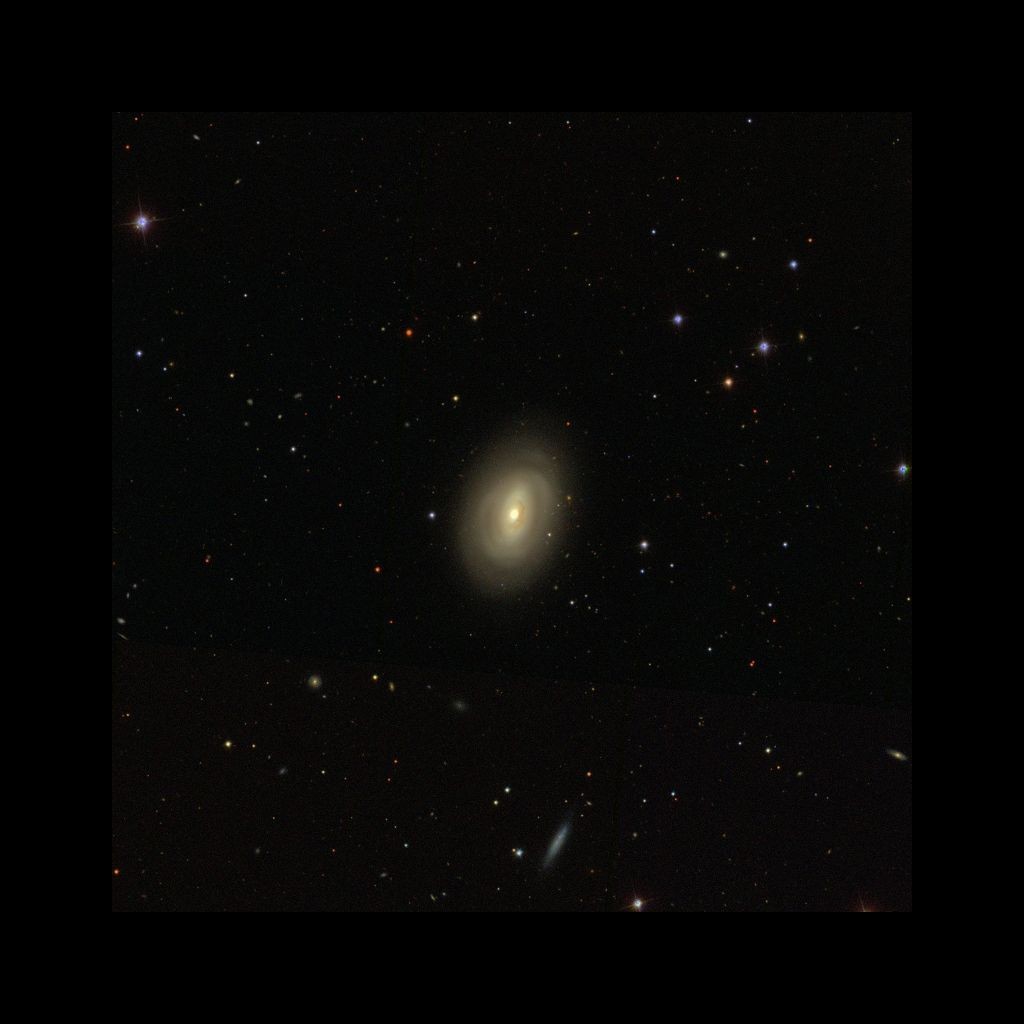
NASA / Sloan Digitalised Sky Survey
| Type | Galaxy | Constellation | Leo |
|---|---|---|---|
| Magnitude | 10.9 | Size | 2.6′ |
| Distance | 70.0 million light-years | Best Month | March |
| Visibility | Northern | Difficulty | Challenging (level 4/4) |
| Min. Aperture | 6in | RA / Dec | 11h 20m 13.2s · +18° 21' 00" |
| Discovered by | William Herschel, 1784 | ||
NASA / Sloan Digitalised Sky Survey
Caldwell 40, also cataloged as NGC 3626, is a medium-sized lenticular galaxy located approximately 70 million light-years away in the constellation Leo. In the cosmic hierarchy, lenticular galaxies like this one occupy the middle ground of the Hubble Sequence; they possess a central bulge and a disk like a spiral galaxy, but they lack the prominent, star-forming arms, giving them a smoother, more aged appearance.
What makes Caldwell 40 particularly fascinating to astronomers is its "counter-rotating" gas. While most of the stars in the galaxy orbit the center in one direction, a significant portion of its neutral hydrogen gas is orbiting in the exact opposite direction. This suggests a turbulent past, likely involving the "cannibalization" of a smaller, gas-rich satellite galaxy or a significant accretion event billions of years ago. Though it appears relatively calm and faint through a small telescope—often seen as a small, bright core with a fuzzy envelope—it is actually a site of complex gravitational history. Its position in the sky makes it a popular target for observers in the spring, residing near the "tail" of Leo.
From Regulus: From Regulus, move 5° northeast along the southern edge of Leo.
| Star | Bayer | Mag | Spectral Type | Distance | Meaning |
|---|---|---|---|---|---|
| Regulus | α Leo | 1.36 | B7 · Blue-white main sequence | 79 ly | Latin for 'Little King' — one of the four Royal Stars of antiquity, the heart of Leo the Lion. It spins so fast it is noticeably oblate. |
| Algieba | ζ Leo | 2.01 | K0 · Orange giant binary | 130 ly | Arabic Al-Jabhah, 'The Forehead' or 'The Mane' of the Lion. A beautiful golden double star visible in small telescopes. |
| Denebola | — | 2.14 | A3 · White main sequence | 36 ly | Arabic Dhanab al-Asad, 'Tail of the Lion' — marks the lion's tail. One of the few stars where infrared excess suggests a debris disk. |
| Zosma | β Leo | 2.56 | A4 · White subgiant | 58 ly | Greek for 'Girdle' — marks the hip of Leo the Lion. An aging star beginning to expand into a subgiant, slowly leaving the main sequence. |
| Ras Elased Australis | ε Leo | 2.97 | G0 · Orange giant | 247 ly | Arabic Ra's al-Asad al-Janūbī, 'Southern Head of the Lion' — marks the lion's mane, one of the sickle stars that form Leo's head. |