Roberto Mura
| Type | Globular Cluster | Constellation | Mus |
|---|---|---|---|
| Magnitude | 7.8 | Size | 18.6′ |
| Distance | 18,900 light-years | Best Month | May |
| Visibility | Southern | Difficulty | Moderate (level 3/4) |
| Min. Aperture | binoculars | RA / Dec | 12h 25m 58.8s · -72° 39' 00" |
| Discovered by | James Dunlop, 1826 | ||
Roberto Mura
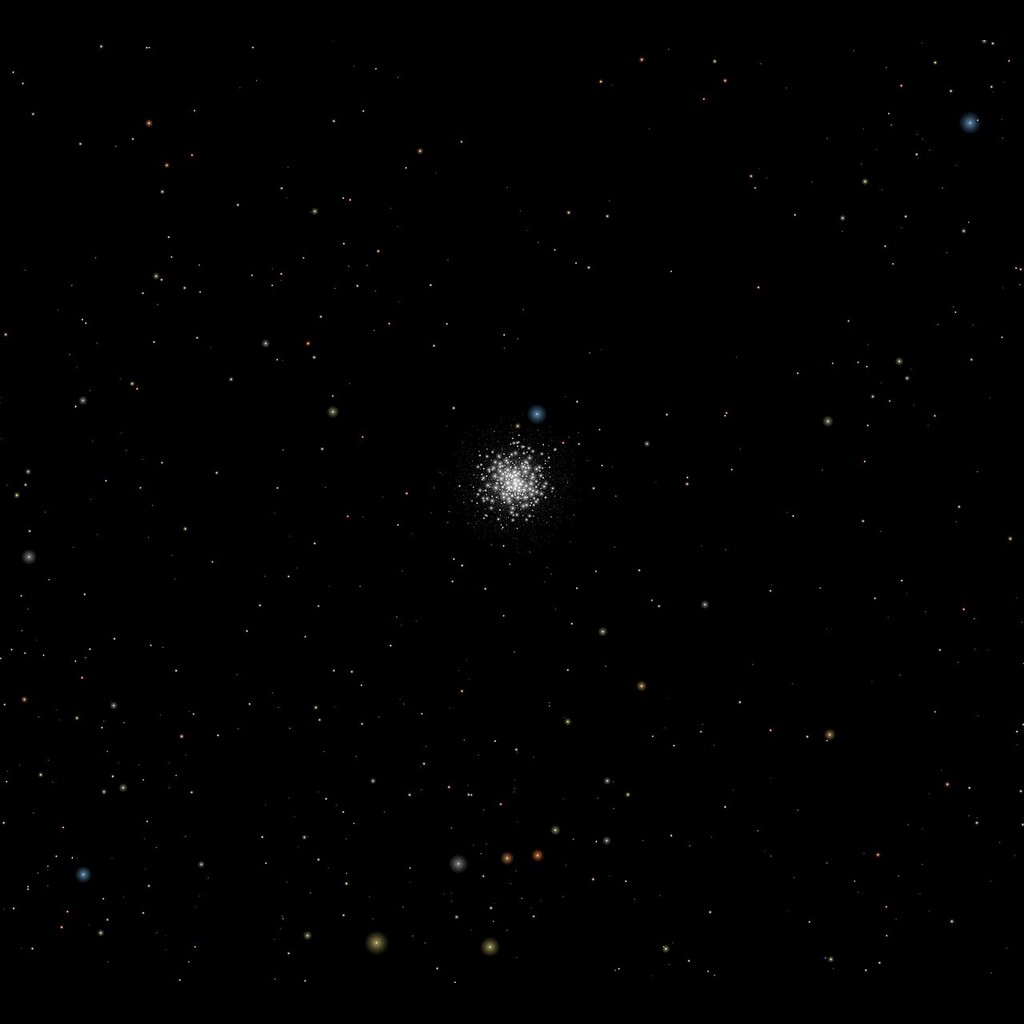
Caldwell 108, or NGC 4372, is a sprawling and ancient globular cluster located approximately 19,000 light-years away in the constellation Musca (The Fly). Despite its impressive size, it often appears more subtle than other clusters due to its location behind the Dark Doodad Nebula, a massive and dense lane of interstellar dust. This dust acts as a cosmic veil, absorbing and reddening the light from the cluster’s stars. Scientifically, NGC 4372 is one of the most "metal-poor" clusters in the Milky Way, meaning its stars contain very few elements heavier than hydrogen and helium. This chemical signature identifies it as a primitive relic from the earliest era of galaxy formation, essentially a "time capsule" from over 12 billion years ago.
Because NGC 4372 is not as tightly packed as many other globular clusters, it has a "loose" and expansive appearance. This lower density allows astronomers to distinguish and study individual stars even near its center, which is much more difficult in highly concentrated clusters like 47 Tucanae. By analyzing these stars, researchers can better understand the early chemical evolution of our galaxy's halo. Its proximity to the dramatic dark clouds of the Musca region makes it a fascinating subject for study, highlighting the complex interplay between the ancient stars of the galactic halo and the cold, dark dust lanes within the Milky Way's disk.
This wide-field view, captured by Roberto Mura, provides the necessary context to appreciate the cluster's relationship with its environment. The image showcases the broad distribution of the cluster's members, revealing how they are scattered against a backdrop of deep-space shadows. By capturing such a wide perspective, Mura highlights the "ghostly" nature of the cluster as it sits nestled near the edge of the sprawling dark nebulae that define this region of the southern sky. It serves as a perfect bridge between the dense star fields we have seen and the mysterious dark voids of the southern hemisphere.