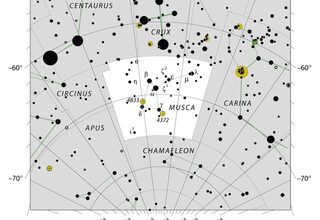
 IAU Chart
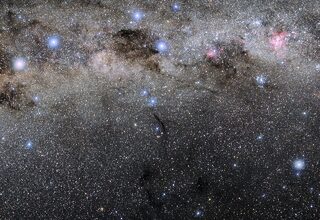 NOIRLab Images
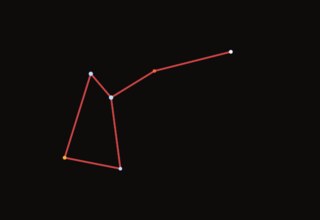 Stars and Sticks
| Abbreviation | Mus |
|---|---|
| Meaning | Fly |
| Pronunciation Guide is based on “Pronouncing Astronomical Names,” published in 1943 by the American Astronomical Society. | MUSS-kuh |
| Genitive The genitive is the Latin possessive form used in star names. For example, Alpha Orionis means “the Alpha of Orion.” | MOOS-kee |
| Best Month | May |
| Visibility | Southern |
| Origin | ExplorationCreated by 16th-century Dutch navigators (Keyser & de Houtman) to fill the blank spaces of the southern sky during their voyages to the East Indies. |
| Author | Keyser & de HoutmanDutch explorers whose southern star observations during the first Dutch expedition to the East Indies provided the data for 12 new constellations. |
| Type | constellation |
| Difficulty | Challenging |
| Description | The Fly was originally named 'Apis' (the Bee) by Dutch navigators Keyser and de Houtman in the 1590s, but was renamed Musca to avoid confusion with Apus (the Bird of Paradise). It lies just south of the Southern Cross in a rich Milky Way field. The constellation contains the Hourglass Nebula (MyCn18) — one of the most visually striking planetary nebulae, its perfectly symmetrical pinched shape resembling an hourglass, famously photographed by the Hubble Space Telescope. The brightest star, Alpha Muscae, is a hot blue-white star about 310 light-years away and significantly more luminous than the Sun. |
Click a thumbnail to view full-size. Plain and Annotated versions available on the image page.
Images: NOIRLab/NSF/AURA/E. Slawik · IAU and Sky & Telescope · Stellarium — Full credits →