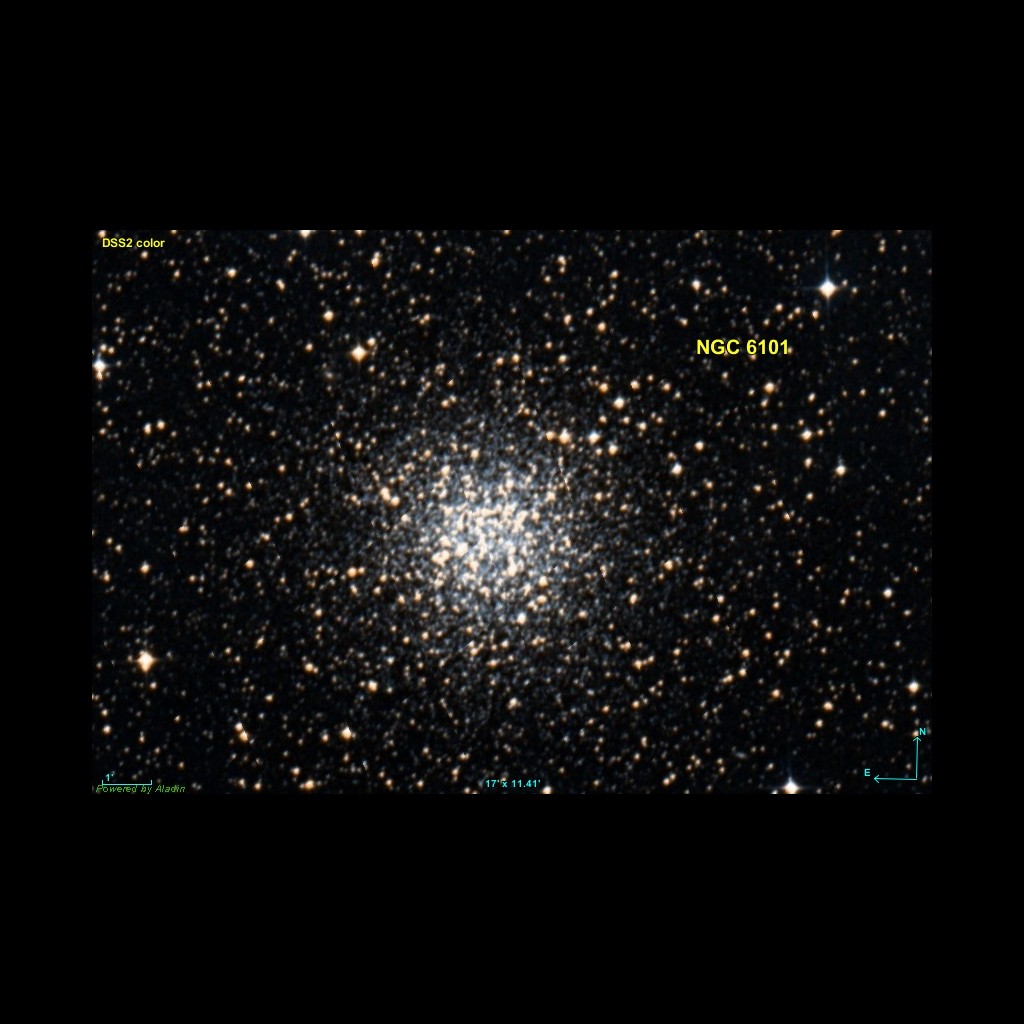
Donald Pelletier / DSS
| Type | Globular Cluster | Constellation | Aps |
|---|---|---|---|
| Magnitude | 9.2 | Size | 10.7′ |
| Distance | 47,600 light-years | Best Month | July |
| Visibility | Southern | Difficulty | Moderate (level 3/4) |
| Min. Aperture | binoculars | RA / Dec | 16h 25m 37.2s · -72° 12' 00" |
| Discovered by | James Dunlop, 1826 | ||
Donald Pelletier / DSS
Caldwell 107, or NGC 6101, is a fascinating globular cluster located about 50,000 light-years away in the southern constellation of Apus (The Bird of Paradise). While it may appear less dense than some of its more famous counterparts like 47 Tucanae, it has recently become a subject of intense scientific scrutiny. Observations and advanced computer simulations have suggested that NGC 6101 contains an unusually high concentration of stellar-mass black holes. Unlike most globular clusters, which were thought to eject their black holes shortly after formation, this cluster appears to have retained hundreds of them, influencing the orbits and distribution of the visible stars we see today.
The cluster is also notable for its "puffed-up" appearance. Because of the gravitational influence of these numerous hidden black holes, the cluster's core is less concentrated than expected, and its stars are more spread out. This makes it a "dynamically young" cluster, even though its stars are billions of years old. By studying the motions of stars within NGC 6101, astronomers can infer the presence of these dark remnants, providing a rare window into the "dark" population of a globular cluster and how it shapes the evolution of the entire system over eons.
This clear, wide-field image was produced by Donald Pelletier using the Aladin Sky Atlas and data from the Digitized Sky Survey (DSS). The DSS, a cornerstone program of the Space Telescope Science Institute (STScI), provides the foundational data that allows for such detailed mappings of the southern sky. Pelletier’s rendering captures the sprawling nature of the cluster, showcasing its relatively loose central concentration and the field of ancient stars that make up this mysterious celestial object. The resulting view highlights the unique structural properties that make NGC 6101 a key piece of the puzzle in understanding the hidden life of globular clusters.